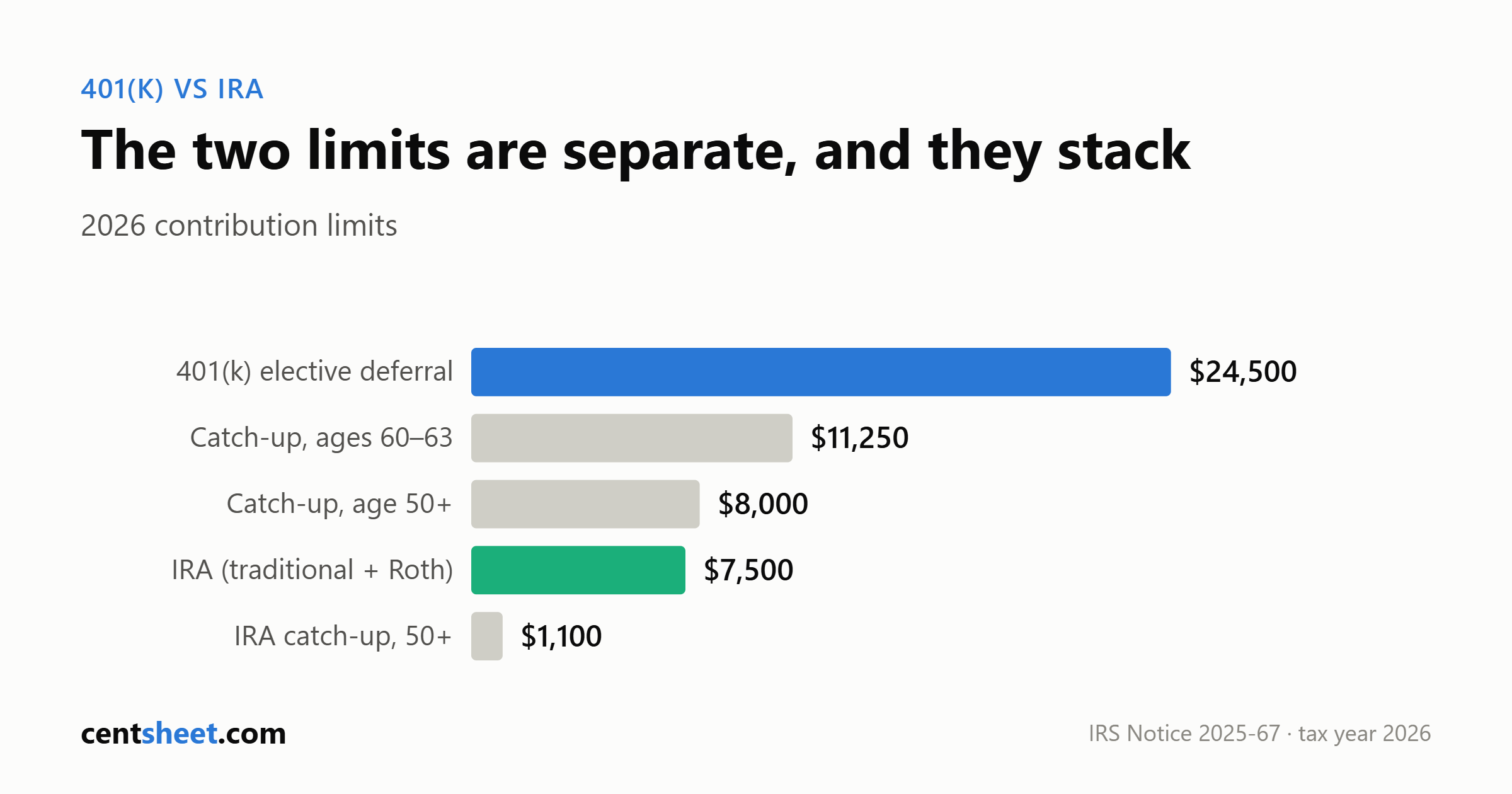
For tax year 2026 the elective deferral limit for a 401(k) is $24,500 and the contribution limit for an IRA is $7,500. Those are two numbers in two different sections of the tax code — IRC 402(g)(1) and IRC 219(b)(5)(A) — and funding one does not spend the other. A saver under 50 with the cash has $32,000 of contribution room in 2026. That addition is ours, not the IRS’s; it assumes earned income at least that high, a plan that lets you defer that much, and eligibility to make an IRA contribution at all.
So “401(k) vs IRA” is the wrong frame. The useful question is which one you fill first, how far, and what your income does to the rules along the way.
The 2026 numbers
All figures below are tax year 2026, from IRS Notice 2025-67 as published in Internal Revenue Bulletin 2025-49, or from the IRS cost-of-living table for dollar limitations (last reviewed June 9, 2026).
| Limit (tax year 2026) | 2026 | 2025 |
|---|---|---|
| 401(k)/403(b)/most governmental 457/TSP elective deferral — IRC 402(g)(1) | $24,500 | $23,500 |
| Catch-up, age 50+ — IRC 414(v)(2)(B)(i) | $8,000 | $7,500 |
| Catch-up, attaining age 60–63 during the year — IRC 414(v)(2)(E)(i) | $11,250 | $11,250 |
| IRA contribution, traditional and Roth combined — IRC 219(b)(5)(A) | $7,500 | $7,000 |
| IRA catch-up, age 50+ — IRC 219(b)(5)(B)(ii) | $1,100 | $1,000 |
| Total annual additions to a defined contribution plan — IRC 415(c)(1)(A) | $72,000 | $70,000 |
| Annual compensation counted for plan purposes — IRC 401(a)(17) | $360,000 | $350,000 |
| Highly compensated employee threshold — IRC 414(q)(1)(B) | $160,000 | $160,000 |
Four things in that table are easy to misread.
The $11,250 for people who turn 60, 61, 62 or 63 during 2026 did not go up — Notice 2025-67 says it “remains $11,250” — and it replaces the $8,000 catch-up rather than stacking on top of it.
The $7,500 IRA limit is combined across every traditional and Roth IRA you own. It is not per account. Opening a second IRA does not buy a second limit.
The IRS states the 2026 IRA total for someone 50 or over as $8,600 ($7,500 plus $1,100). It publishes no equivalent total on the 401(k) side. Adding the deferral limit and the catch-up gives $32,500 for age 50+, or $35,750 for ages 60–63 — our arithmetic, assuming the catch-up is additional to the 402(g) limit, which is what a catch-up limit is.
And the $160,000 HCE threshold is the one nobody warns you about. Cross it and nondiscrimination testing can limit what you are allowed to defer or be matched on, regardless of what the $24,500 says.
What being in a workplace plan actually changes about your IRA
It does not stop you contributing. It changes whether a traditional IRA contribution is deductible. Separately, income decides whether you can fund a Roth IRA at all. Two rules, two sets of 2026 numbers:
| Rule (tax year 2026) | MAGI phase-out range |
|---|---|
| Traditional IRA deduction — single or head of household, covered by a workplace plan | $81,000–$91,000 |
| Traditional IRA deduction — married filing jointly, the contributing spouse is covered | $129,000–$149,000 |
| Traditional IRA deduction — married filing jointly, contributor not covered but spouse is (IRC 219(g)(7)) | $242,000–$252,000 |
| Traditional IRA deduction — married filing separately, covered | $0–$10,000, not indexed |
| Roth IRA contribution — single or head of household | $153,000–$168,000 |
| Roth IRA contribution — married filing jointly | $242,000–$252,000 |
| Roth IRA contribution — married filing separately | $0–$10,000, not indexed |
The joint traditional-deduction range for an uncovered spouse and the joint Roth contribution range are both $242,000–$252,000 in 2026. That is a coincidence of this year’s indexing, not one rule. One MAGI test does not answer both questions.
Both married-filing-separately ranges are $0 to $10,000 and are not adjusted for inflation — Notice 2025-67 says the applicable amount “is not subject to an annual cost-of-living adjustment and remains $0.” That is the design, not an oversight awaiting a fix.
These drift every year: the single Roth range was $150,000–$165,000 in 2025, the joint range $236,000–$246,000. Use the current year’s table, never last year’s.
The match, and the cap on the pay it is computed on
If your plan matches, that is the highest-priority dollar in this article and the one step nobody argues about.
We will not tell you what a typical match looks like. Match rates, formulas and vesting schedules are not IRS figures — they come from industry surveys such as Vanguard’s How America Saves, the PSCA survey and the BLS National Compensation Survey. We did not verify any of them here, so we are not printing a number you might plan around. Your plan’s summary plan description is the only source that is right about your plan. More on the mechanics in employer 401(k) match.
One statutory detail applies to everyone: for 2026, only the first $360,000 of compensation counts under IRC 401(a)(17). Whatever percentage your plan uses, the pay it applies to stops there. As an arbitrary illustration — a flat 4% match, a number chosen to show the mechanics and not a typical figure — someone earning $400,000 would have the match computed on $360,000, giving $14,400 rather than $16,000. That is our arithmetic on an invented formula. The cap is real; the 4% is not data.
The $72,000 ceiling, and what we are not going to tell you about it
The 2026 limit on total annual additions to a defined contribution plan — your deferrals plus employer contributions plus after-tax money — is $72,000 under IRC 415(c)(1)(A), up from $70,000 in 2025.
You will read two claims about it almost everywhere: that catch-up contributions sit on top of the $72,000, and that because the employer match does not count against your $24,500 you can fill the gap up to $72,000 yourself. Both are directionally consistent with how the code is structured — 402(g) and 415(c) are separate provisions with separate figures. We did not verify either interaction from a primary IRS source, and being wrong about a contribution limit is the kind of error that ends in a corrective distribution. So we are not publishing the arithmetic. Use the operative limits your plan administrator gives you.
The $72,000 is also a legal ceiling, not a feature. Whether your plan permits after-tax contributions or in-plan Roth conversions — the machinery behind the mega backdoor Roth — is up to your plan document. Most content selling that strategy does not mention it may not exist where you work.
The catch-up rule that changed for 2026, and the date confusion around it
If you are 50 or over and your prior-year wages from the employer sponsoring your plan exceeded $150,000, your catch-up contributions may have to be made on a Roth basis. Three details get mangled constantly:
The $150,000 is a 2025 wage figure — FICA wages from that plan sponsor, up from $145,000 — used to determine treatment for 2026. Not 2026 income, not household income, not AGI, and measured per employer.
Notice 2025-67 expressly excludes plans described in section 408(k) or 408(p). If you save through a SEP or a SIMPLE, this rule is not about you.
And the dates genuinely conflict across IRS documents, so here is both. IR-2025-91 says the administrative transition period from Notice 2023-62 “generally ends on Dec. 31, 2025,” and the IRS participant catch-up page (last reviewed May 7, 2026) says that beginning in 2026, affected participants must make catch-ups on a Roth basis. The same release says the final regulations’ Roth catch-up provisions “generally apply to contributions in taxable years beginning after Dec. 31, 2026,” and that plans may implement the requirement earlier “using a reasonable, good faith interpretation of statutory provisions.” Read together: the statutory requirement is live for 2026, the detailed regulations bind from 2027, and implementation in 2026 can legitimately differ between plans. Anyone stating flatly that “it starts in 2027” or that “the regulations apply now” has read one document and not the other.
The Saver’s Credit, and a stale IRS page
Below certain incomes, a retirement contribution can also generate a credit. The 2026 AGI bands under IRC 25B:
| Filing status (tax year 2026) | 50% rate up to | 20% rate up to | 10% rate up to |
|---|---|---|---|
| Married filing jointly | $48,500 | $52,500 | $80,500 |
| Head of household | $36,375 | $39,375 | $60,375 |
| All other filers | $24,250 | $26,250 | $40,250 |
The warning matters more than the table. When we checked on August 6, 2026, the IRS’s own Saver’s Credit landing page was still showing a tax-year-2024 table — a 50% band of $46,000 for joint filers, full phase-out at $76,500. Two-year-old numbers on a live IRS page. Use Notice 2025-67 in IRB 2025-49.
The sequence, and who benefits from it being simple
The standard ordering is: capture the full employer match, clear high-interest debt, then fill the remaining tax-advantaged space. We think it is sound. We are not going to dress it up as arithmetic, because the honest version has a hole in it.
The hole is the debt step. Naming the interest rate above which paying debt beats investing requires an expected investment return. We have no sourced return figure and will not invent one, so we publish no cutoff rate. The debt side of that comparison is printed on your statement; the investing side is a guess. If the guaranteed number is large, act on it. Avalanche vs snowball covers the payoff mechanics.
The same applies to Roth versus traditional. The trade is structural — tax now or tax later — and choosing correctly requires knowing your future tax rate. Nobody knows that. A calculator that hands you a confident break-even year is showing you the output of assumptions it made on your behalf.
Notice who gains from the simplified versions. “Max your 401(k) first” is convenient for a recordkeeper paid on assets under administration. “Roll your old 401(k) into an IRA” moves the balance to a retail brokerage that then earns on it. Neither is automatically wrong. Both are advice with a beneficiary other than you.
What to actually do
1. Find out whether your plan matches and what the formula is, from the summary plan description rather than from an article. Contribute at least enough to capture all of it. 2. Fund the cash buffer before escalating retirement contributions. How much emergency fund you need is the prior question. 3. Attack debt whose rate is high and certain. The certainty is the argument, not a threshold someone published. 4. Check your 2026 MAGI against the phase-out table before contributing to an IRA. The traditional deduction test and the Roth eligibility test are separate rules that happen to share a range this year. 5. If you are 50 or over and earned more than $150,000 in 2025 from your plan’s sponsor, ask HR how your plan is handling the Roth catch-up requirement for 2026. Answers can legitimately differ between employers this year. 6. If you are pushing deferrals toward $24,500, confirm your plan’s operative limits with the administrator instead of assuming the statutory maximum applies to you — the $160,000 HCE threshold and plan testing can bind first. 7. Decide what the money buys once it is inside. The account is a wrapper, not an investment — see index funds for beginners.
The short version: for 2026 you have $24,500 of 401(k) room and $7,500 of IRA room, they are separate, and almost nobody is constrained by the ceiling. Most people are choosing between contributing something and contributing nothing, which makes the “vs” the least important decision on the list.
CentSheet publishes educational content, not personalized financial advice, and nothing here is legal or tax advice.
Get the CentSheet Money Brief
Email me CentSheet weekly: practical money decisions, new calculators, and useful worksheets. Unsubscribe anytime.