Category: Debt

  • Credit Utilization: The Score Factor You Can Fix in 30 Days

    Credit Utilization: The Score Factor You Can Fix in 30 Days

    Most credit-score factors reward patience: age of accounts, payment history, time. Utilization is the exception — it’s a large slice of your score, it has essentially no memory, and it updates as fast as your card reports. Fix it this month and the score reflects it next month.

    That combination makes it the highest-leverage move available to most people with credit cards. It’s also widely misunderstood in two specific ways.

    What utilization actually is

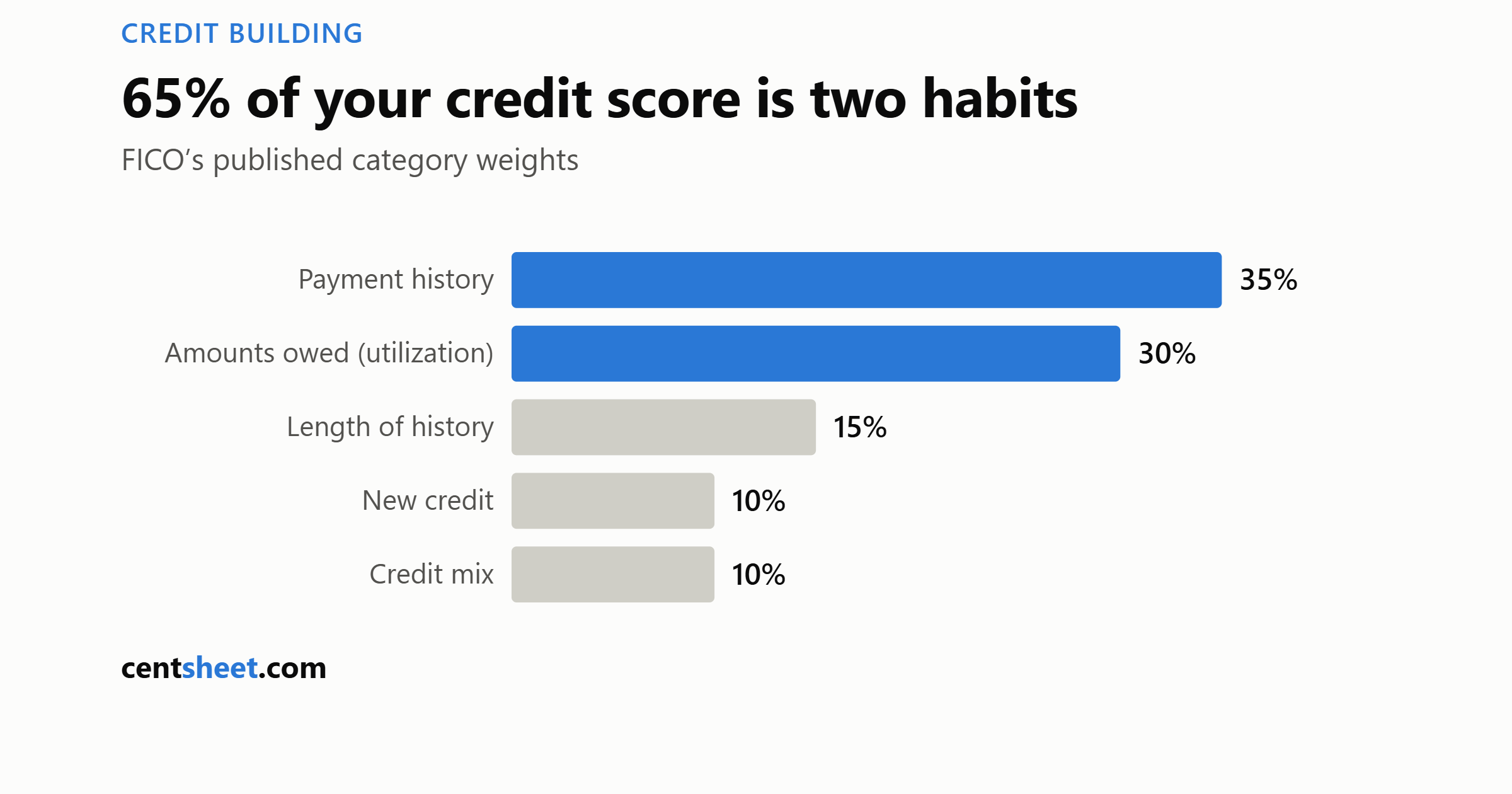
    Utilization is your reported card balances divided by your credit limits — the share of available revolving credit you appear to be using. Scoring models treat high utilization as a distress signal, and the commonly cited guidance — the same figure FICO’s own consumer materials use — is to stay under roughly 30%, with lower being better.

    Say you have three cards totaling $15,000 in limits and $4,600 in reported balances:

    Limit Reported balance Utilization
    Card A $3,000 $2,800 93.3%
    Card B $7,000 $1,200 17.1%
    Card C $5,000 $600 12.0%
    Overall $15,000 $4,600 30.7%

    Misunderstanding #1: it’s measured per card too

    The overall 30.7% above looks borderline-fine. Card A at 93.3% is the problem — scoring models look at individual cards as well as the total — FICO’s public documentation describes considering “how much of each credit line is being used” — so one maxed card hurts even when the overall number is acceptable.

    Practical consequence: where your balance sits matters. $4,600 spread evenly across those three cards produces the same 30.7% overall with no card above 35% — a materially better picture from identical debt.

    Misunderstanding #2: it’s not about the due date

    This is the one that costs people. Utilization is calculated from the balance your issuer reports to the bureaus, which is typically the balance on your statement closing date — not what’s left after you pay the bill by the due date.

    You can pay in full every month, never pay a cent of interest, and still report high utilization — because the statement closes before your payment.

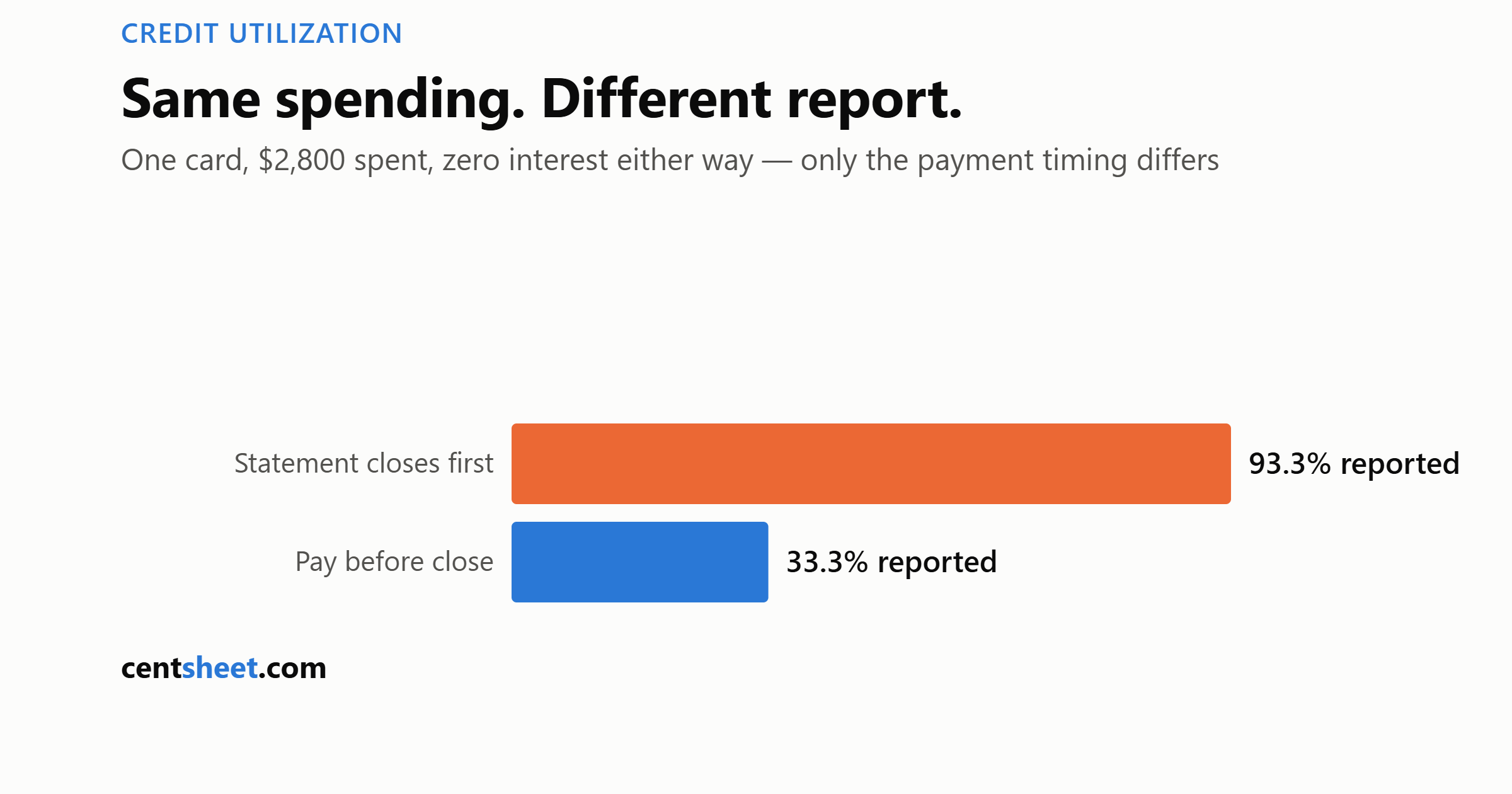
    The fix is timing, and it’s free: pay down the card before the statement closes, then pay whatever remains by the due date as usual. On Card A above, paying $1,800 a few days before the close date drops the reported balance to $1,000 — utilization reported at 33.3% instead of 93.3%. Same spending, same zero interest, very different report.

    The 30-day playbook

    1. Find each card’s statement closing date (on the statement or in the app — it is not the due date). 2. Target the worst card first. One card above 90% is doing more damage than three cards at 25%. 3. Pay before the close, not just before the due date. 4. Don’t close old cards to “clean up.” Closing a card deletes its limit from your denominator and pushes utilization up on everything else — a classic own-goal. 5. A limit increase cuts utilization arithmetically — same balance over a bigger denominator — but only helps if the extra headroom doesn’t become extra spending. Know yourself before requesting one.

    What this is not

    Utilization tuning is presentation, not progress — it changes how existing debt reports, not what you owe. If the balance itself is the problem, the real fix is the payoff math, and a balance carried at 24% APR costs vastly more than any score benefit is worth. Optimize the reporting while paying it down, not instead of paying it down.

    One more honesty note: scoring models are proprietary and change over versions. The mechanics above reflect the publicly documented behavior of the major models; nobody outside those companies knows exact weightings, and anyone quoting you precise point impacts is guessing.


    CentSheet publishes educational content, not personalized financial advice.

  • Debt Avalanche vs. Snowball: The Actual Math (With Calculator)

    Debt Avalanche vs. Snowball: The Actual Math (With Calculator)

    Every personal finance site tells you there are two ways to pay off debt. Almost none of them show you what the difference actually costs in dollars. Let’s fix that.

    The avalanche method says: pay minimums on everything, throw every spare dollar at the highest-interest debt first. The snowball method says: same thing, but target the smallest balance first, regardless of rate.

    Avalanche is mathematically optimal. Snowball is psychologically easier. You have heard both claims. What you probably haven’t seen is the size of the gap — so we measured it.

    The test case

    Three debts that look like a lot of real households:

    Debt Balance APR Minimum
    Credit card $8,000 24% $240
    Store card $3,500 19% $105
    Car loan $11,000 7% $260

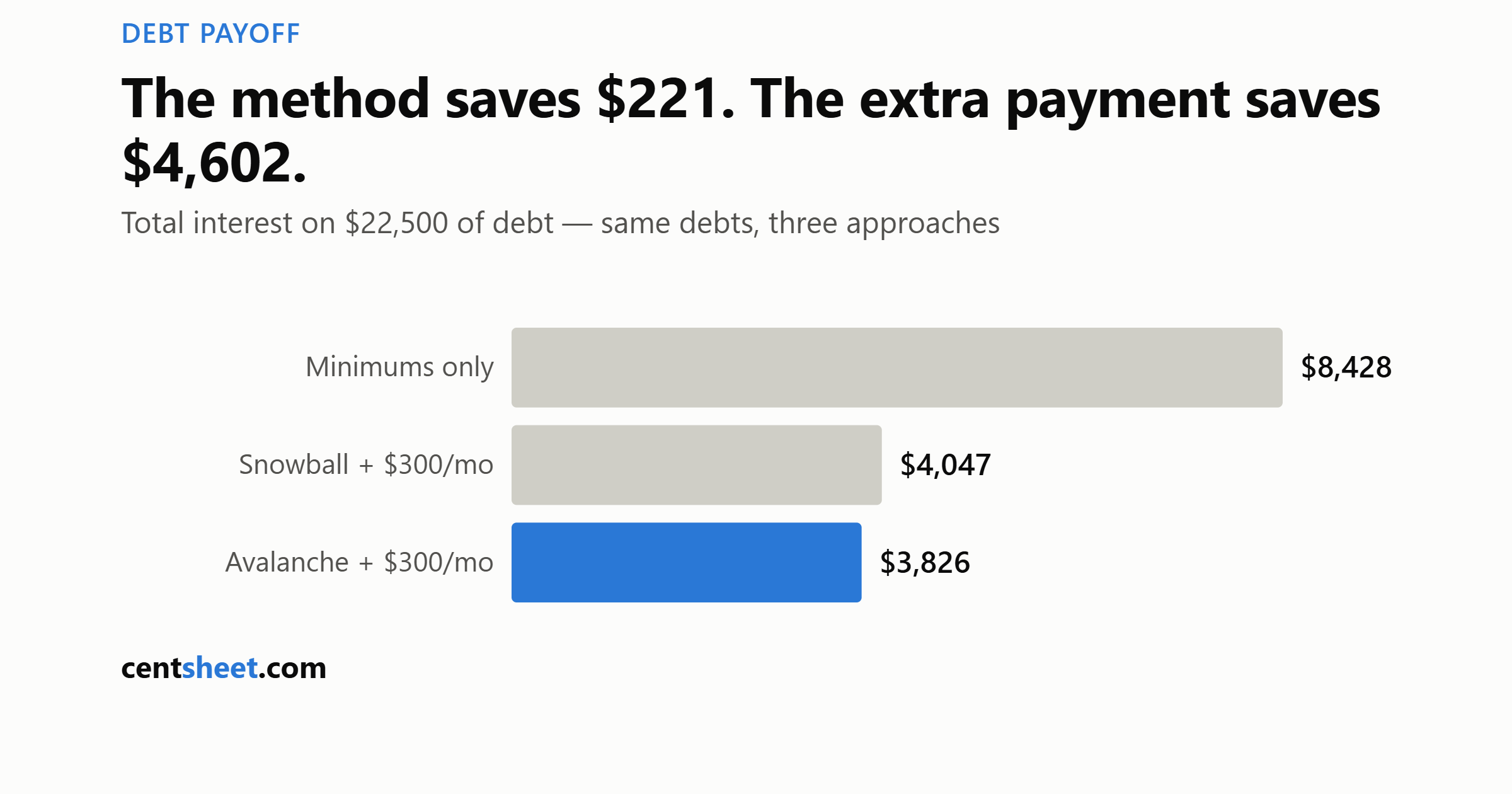
    Total: $22,500 of debt, $605/month in minimums. Suppose you can find $300/month extra. Here’s what each strategy produces, from our payoff calculator:

    Strategy Debt-free in Total interest
    Avalanche (highest APR first) 2 years 6 months $3,826
    Snowball (smallest balance first) 2 years 6 months $4,047
    Minimums only, no extra 4 years 4 months $8,428

    Two results worth staring at.

    First: the avalanche “win” is $221. Not nothing — but spread over 30 months, it’s about $7 a month. If focusing on the smallest balance first is what keeps you actually doing this for two and a half years, $7/month is a cheap price for follow-through.

    Second: the method matters far less than the extra payment. The gap between the two strategies is $221. The gap between either strategy and coasting on minimums is more than $4,400 and nearly two extra years in debt. The decision that changes your life isn’t avalanche-vs-snowball. It’s finding the $300.

    When the gap gets big

    The $221 gap is small here because the two orderings nearly agree — the highest-APR debt (24% card) is also mid-sized. The avalanche advantage grows when your debts are “inverted”: a small low-rate debt and a large high-rate one.

    Imagine a $1,500 personal loan at 6% and a $12,000 card at 27%. Snowball attacks the $1,500 first while the $12,000 compounds at 27% — and every month it waits costs you roughly $270 in interest on that card alone. In inverted situations like that, avalanche can save four figures. Run your own numbers in the calculator below; the answer depends entirely on your specific debts.

    Debt payoff calculator: avalanche vs. snowball

    Debt name Balance ($) APR (%) Min. payment ($)


    Assumes fixed APRs, fixed minimum payments, and a constant total monthly budget
    (all minimums + your extra). As each debt clears, its minimum rolls into the next target
    automatically. Educational tool — not financial advice.

    What the calculator assumes

    Honesty about the model, because payoff calculators rarely explain themselves:

    • Your total monthly budget stays constant: all minimums plus your extra. When a debt clears, its minimum payment rolls into the next target automatically. That rollover is the “snowball effect,” and it applies to both methods.
    • APRs and minimums are treated as fixed. Real card minimums shrink as balances fall — paying the original minimum throughout, as modeled here, is both simpler and slightly faster.
    • No new debt gets added along the way. The math only works if the balances only go down.

    So which one should you pick?

    The genuinely useful answer, not the diplomatic one:

    Pick avalanche if the interest-rate spread across your debts is wide (say, anything over ~10 percentage points between your highest and lowest APR), or if the dollar gap the calculator shows for your situation is meaningful to you.

    Pick snowball if you’ve tried to pay down debt before and stalled. The evidence from behavioral research is that closing an account — actually zeroing something out — is what keeps people in the game. A plan you follow beats a plan you abandon, by a margin far larger than $221.

    Either way: the extra payment is the engine. The ordering is a tuning decision.

    One warning the calculators bury

    If any debt’s minimum payment barely covers its monthly interest, minimums alone will never clear it — the balance treads water while you pay indefinitely. A $10,000 card at 25% APR accrues about $208 of interest in month one; a $200 minimum doesn’t even hold it steady. If that’s your situation, the payoff method debate is premature: the first job is getting the rate down (balance transfer, negotiation, consolidation) or the payment up. Our calculator flags this case explicitly rather than showing you a fantasy payoff date.


    CentSheet publishes educational content, not personalized financial advice. Numbers above are illustrative model outputs; your card agreement’s actual minimum-payment formula and rate changes will alter real-world results.