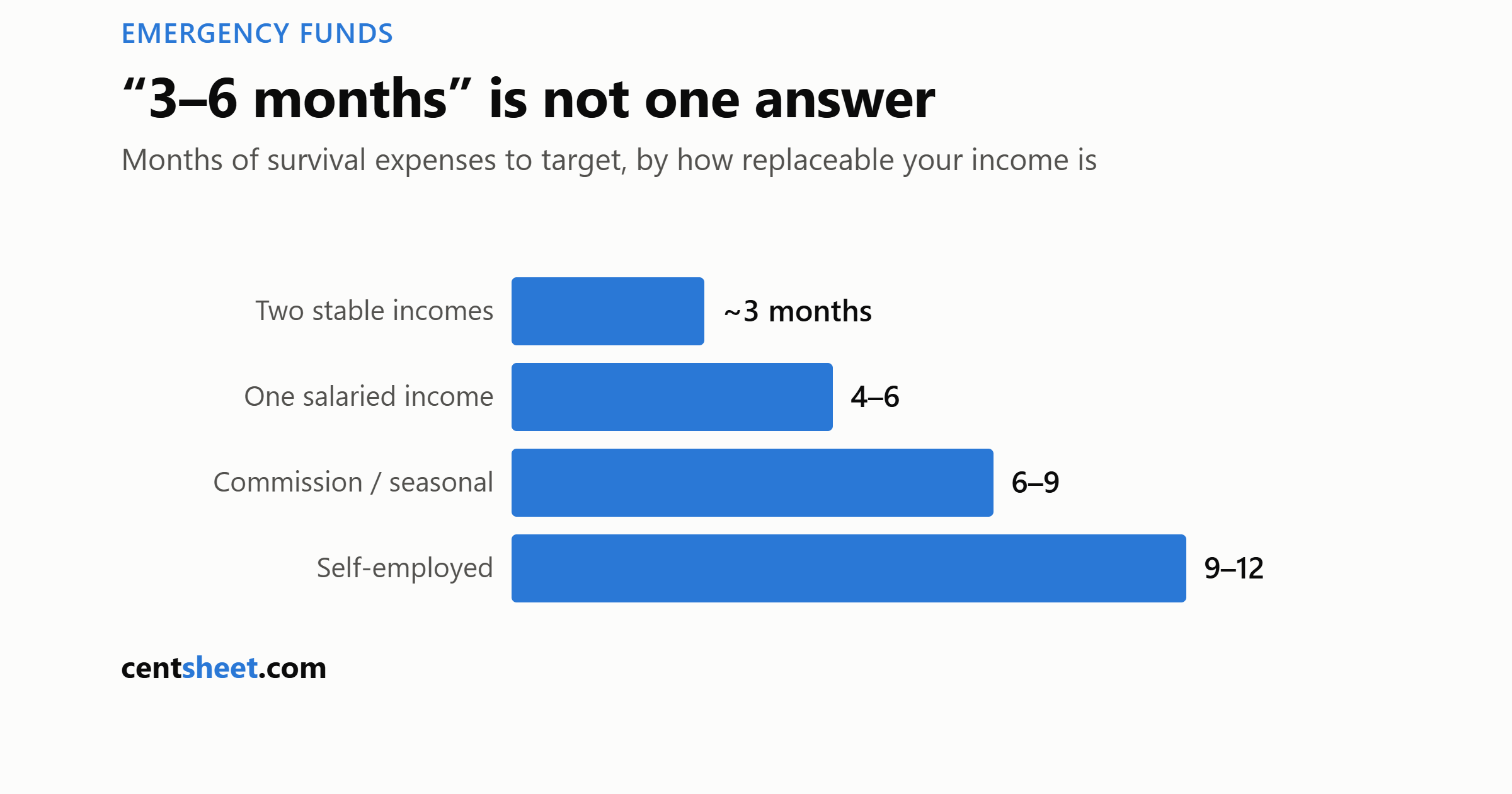
Ask ten finance writers how big an emergency fund should be and nine will say “three to six months of expenses.” It’s the most repeated rule in personal finance, and it skips the only question that matters: three to six months of expenses against what risk?
An emergency fund insures your income, mostly. The right size depends on how likely your income is to stop and how long it would take to replace — not on a universal number.
Start with the right base: expenses, not income
The fund covers what you must spend, not what you currently earn. Add up a bare-bones month: housing, utilities, food, insurance, minimum debt payments, transport, and anything contractual you can’t pause. Call that your survival number.
If you take home $5,500/month but could keep the lights on at $3,400, your emergency fund math runs on $3,400. Using income instead of expenses inflates the target by 30–60% for most people, and an inflated target is a target you give up on.
Then size by income stability, not by rule of thumb
| Your situation | Target | Why |
|---|---|---|
| Two stable incomes in the household | ~3 months of survival expenses | Two simultaneous job losses is the tail risk, not the base case |
| One stable salaried income | 4–6 months | One event removes 100% of income |
| Commission, tips, or seasonal income | 6–9 months | The fund smooths normal variance and covers true emergencies |
| Self-employed / contract / freelance | 9–12 months | Income can fall gradually, which burns runway before you react |
| Single specialized income, thin job market | 9+ months | Time-to-replace is the driver: a niche role can take two or three quarters to rehire |
The pattern: the fund should cover realistic time-to-replace your income, plus margin. A registered nurse in a big metro can often re-employ in weeks; a specialized manager in a small industry cannot.
Build it in stages — the full number comes later
A $30,000 target on day one is demoralizing arithmetic. Stage it:
Stage 1 — $1,000 starter fund, fast. This is the “stop using the credit card for surprises” fund. Most common emergencies — car repair, urgent travel, a deductible — land under this line.
Stage 2 — one month of survival expenses. At this point a late paycheck or a bad month stops being a crisis.
Stage 3 — your full target from the table. Automate a fixed transfer on payday and stop thinking about it. $400/month reaches a $10,200 three-month fund in about 26 months — slow is fine; the staged fund is protecting you the whole way up.
Where to keep it
Rules: liquid within a day or two, boring, and never invested in anything that can be down 30% the week you need it.
- High-yield savings account — the default answer. As of August 2026, top US HYSAs pay around 4% APY while big-bank checking still pays effectively nothing. On a $10,000 fund, 4% is roughly $400/year for zero extra risk — free money for filling in one form.
- Money market funds work similarly well inside a brokerage you already have.
- Not the stock market. The whole point of this money is that its value on a bad day is known.
- Not a CD ladder for the core fund — early-withdrawal penalties fight the fund’s one job, though CDs are fine for months 6–12 of an extended runway.
The objection worth taking seriously: “but my credit card debt is at 24%”
Correct instinct — parking $15,000 at 4% while carrying $8,000 at 24% costs you real money. The resolution most planners land on: build Stage 1 only ($1,000), attack the high-interest debt hard, then come back and build the full fund. The starter grand exists so that the next surprise doesn’t get financed at 24% and undo a year of payoff progress.
When you actually use it
Two rules make the fund durable. First, define an emergency before you have one: involuntary income loss, medical, essential home/car failure, family crisis. A sale is not an emergency. Second, when you do spend from it — that’s success, not failure. Refill it with the same automated transfer and move on. The fund’s job was to turn a catastrophe into an inconvenience, and it did.
CentSheet publishes educational content, not personalized financial advice. Rates cited are illustrative and dated; check current figures before acting.
Get the CentSheet Money Brief
Email me CentSheet weekly: practical money decisions, new calculators, and useful worksheets. Unsubscribe anytime.