Most credit-score factors reward patience: age of accounts, payment history, time. Utilization is the exception — it’s a large slice of your score, it has essentially no memory, and it updates as fast as your card reports. Fix it this month and the score reflects it next month.
That combination makes it the highest-leverage move available to most people with credit cards. It’s also widely misunderstood in two specific ways.
What utilization actually is
Utilization is your reported card balances divided by your credit limits — the share of available revolving credit you appear to be using. Scoring models treat high utilization as a distress signal. The widely repeated advice is to stay under 30% — and that figure is VantageScore’s published guidance, not a universal rule. FICO’s own position is different, and worth knowing: it says the data does not support the idea that a score dips once utilization crosses 30%, and that lower is simply better, with single-digit utilization associated with the best scores. Treat 30% as a ceiling worth clearing, not a line that makes you safe.
Say you have three cards totaling $15,000 in limits and $4,600 in reported balances:
| Limit | Reported balance | Utilization | |
|---|---|---|---|
| Card A | $3,000 | $2,800 | 93.3% |
| Card B | $7,000 | $1,200 | 17.1% |
| Card C | $5,000 | $600 | 12.0% |
| Overall | $15,000 | $4,600 | 30.7% |
Misunderstanding #1: it’s measured per card too
The overall 30.7% above looks borderline-fine. Card A at 93.3% is the problem — scoring models look at individual cards as well as the total — FICO’s public documentation describes considering “how much of each credit line is being used” — so one maxed card hurts even when the overall number is acceptable.
Practical consequence: where your balance sits matters. $4,600 spread evenly across those three cards produces the same 30.7% overall with no card above 35% — a materially better picture from identical debt.
Misunderstanding #2: it’s not about the due date
This is the one that costs people. Utilization is calculated from the balance your issuer reports to the bureaus, which is typically the balance on your statement closing date — not what’s left after you pay the bill by the due date.
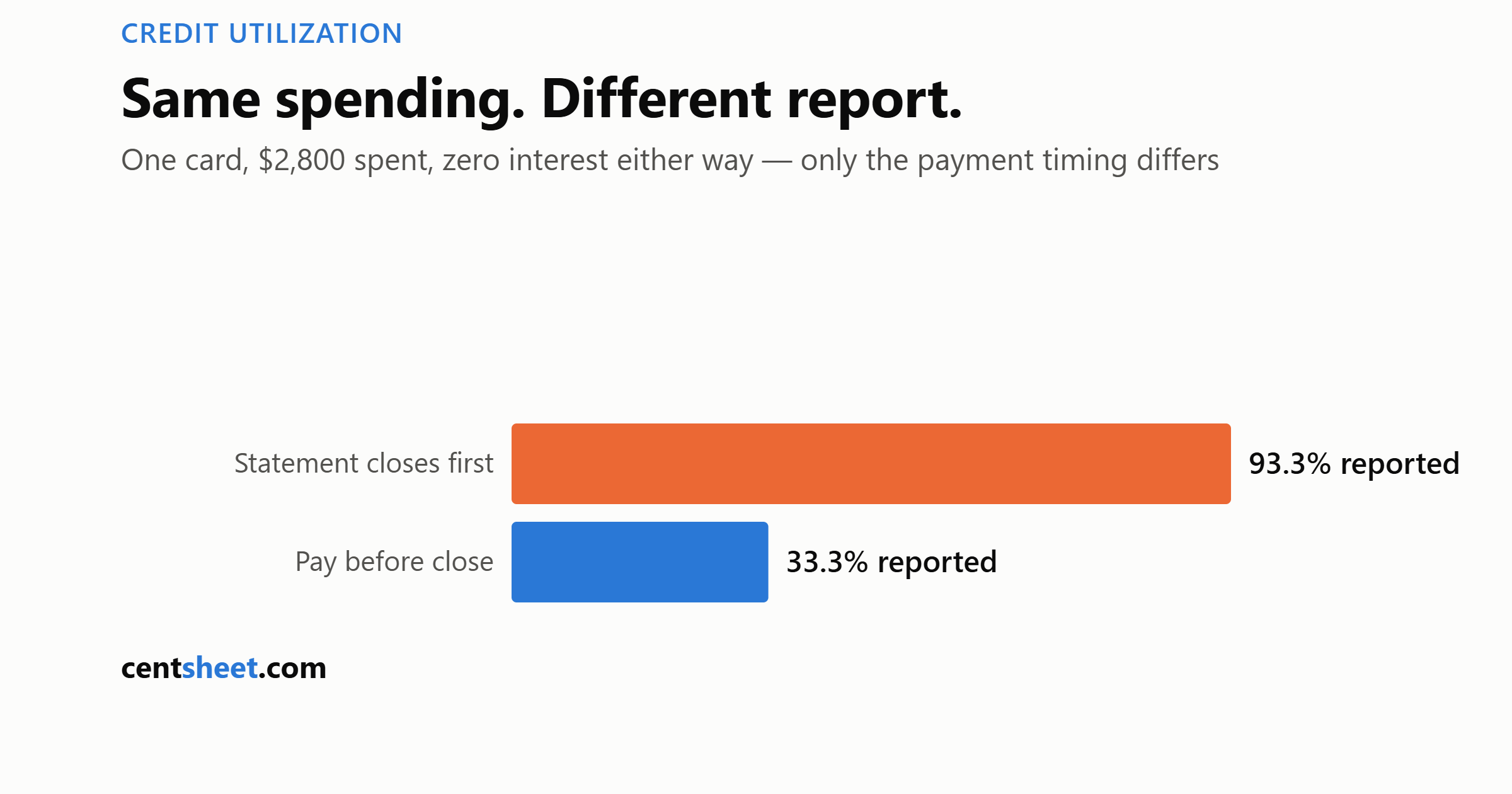
You can pay in full every month, never pay a cent of interest, and still report high utilization — because the statement closes before your payment.
The fix is timing, and it’s free: pay down the card before the statement closes, then pay whatever remains by the due date as usual. On Card A above, paying $1,800 a few days before the close date drops the reported balance to $1,000 — utilization reported at 33.3% instead of 93.3%. Same spending, same zero interest, very different report.
The 30-day playbook
1. Find each card’s statement closing date (on the statement or in the app — it is not the due date). 2. Target the worst card first. One card above 90% is doing more damage than three cards at 25%. 3. Pay before the close, not just before the due date. 4. Don’t close old cards to “clean up.” Closing a card deletes its limit from your denominator and pushes utilization up on everything else — a classic own-goal. 5. A limit increase cuts utilization arithmetically — same balance over a bigger denominator — but only helps if the extra headroom doesn’t become extra spending. Know yourself before requesting one.
What this is not
Utilization tuning is presentation, not progress — it changes how existing debt reports, not what you owe. If the balance itself is the problem, the real fix is the payoff math, and a balance carried at 24% APR costs vastly more than any score benefit is worth. Optimize the reporting while paying it down, not instead of paying it down.
One more honesty note: scoring models are proprietary and change over versions. The mechanics above reflect the publicly documented behavior of the major models; nobody outside those companies knows exact weightings, and anyone quoting you precise point impacts is guessing.
CentSheet publishes educational content, not personalized financial advice.
Get the CentSheet Money Brief
Email me CentSheet weekly: practical money decisions, new calculators, and useful worksheets. Unsubscribe anytime.