Every “best savings rates” comparison ranks by headline APY. Almost none of them mention the variable that can reorder the entire list: taxes — specifically, that interest from US Treasury bills is exempt from state and local income tax, while bank interest isn’t.
If you live in a state with an income tax, the lower headline rate sometimes wins. Here’s the actual arithmetic.
The three vehicles in one paragraph each
High-yield savings account (HYSA): a bank account paying a competitive floating rate. Fully liquid, FDIC-insured, rate can change any day. The default home for an emergency fund.
Certificate of deposit (CD): you lock money at a bank for a fixed term at a fixed rate. FDIC-insured; leaving early costs a penalty, typically several months of interest.
Treasury bills: short-term US government debt (4 to 52 weeks), bought at a discount through a brokerage or TreasuryDirect. Backed by the federal government, and — the part that matters here — interest is exempt from state and local income tax.
The math nobody runs
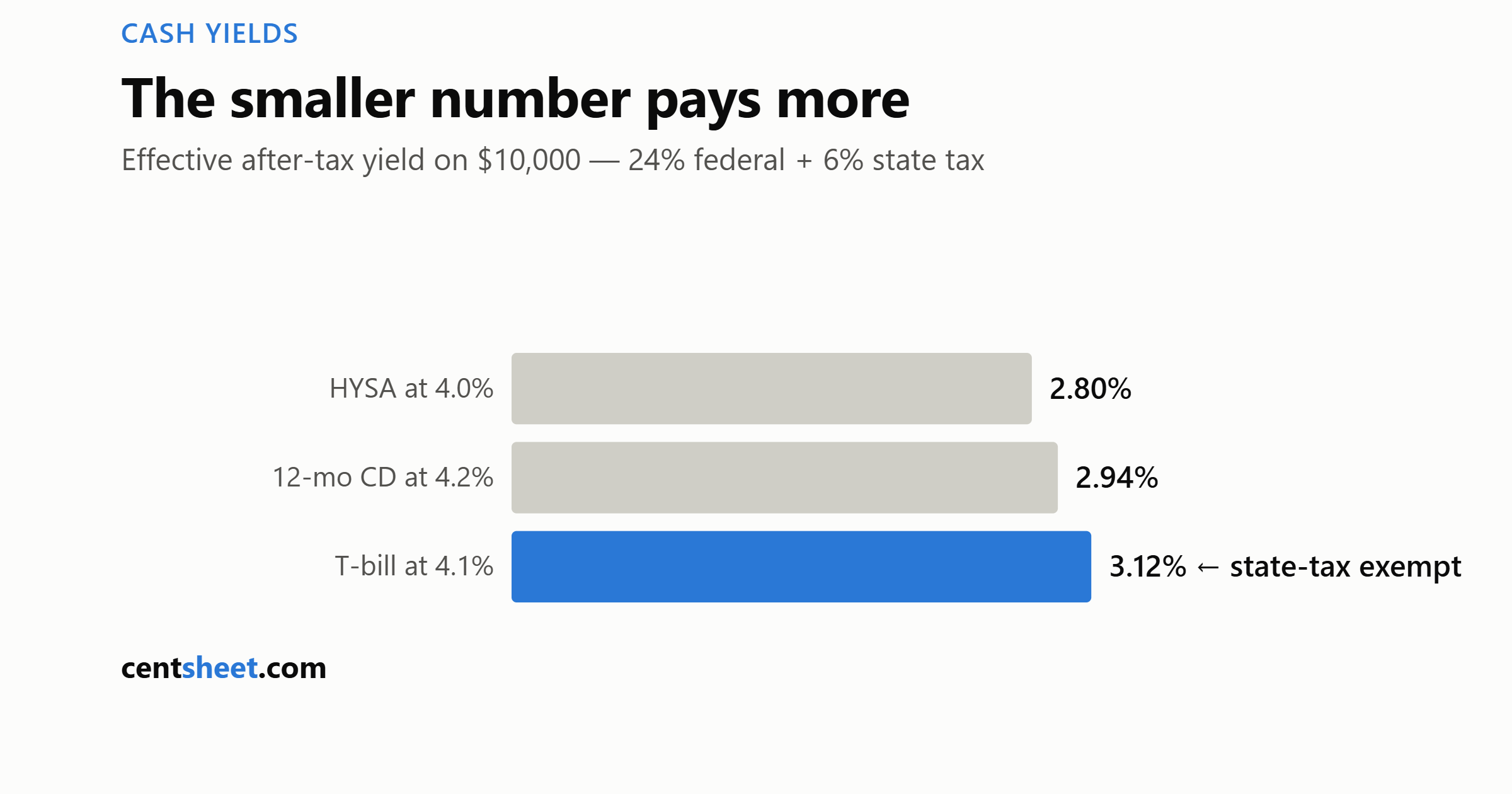
$10,000 for a year. Illustrative rates deliberately set close together — HYSA 4.0%, 12-month CD 4.2%, T-bills 4.1% — and close to real market levels as of August 2026, when the 1-year Treasury sat near 4.0% and top HYSAs and CDs paid about the same. Saver pays 24% federal and lives in a 6% income-tax state.
| Headline | Gross interest | Taxed at | After-tax | Effective rate | |
|---|---|---|---|---|---|
| HYSA | 4.0% | $400 | 30% (fed+state) | $280 | 2.80% |
| CD | 4.2% | $420 | 30% (fed+state) | $294 | 2.94% |
| T-bill | 4.1% | $410 | 24% (fed only) | $311.60 | 3.12% |
The T-bill wins with the middle headline rate. The state exemption is worth roughly the state tax rate times the yield — invisible on every comparison chart, real on every tax return.
Three qualifiers, honestly stated: in a no-income-tax state the exemption is worth nothing and the CD wins this table. In a high-tax state the T-bill’s edge grows well beyond this example. And at small balances the absolute dollars are modest — on $10,000 the T-bill beats the CD by about $18/year here; on $100,000 it’s $180.
The early-exit asymmetry
The tax angle is the underrated difference; the exit terms are the misunderstood one.
Breaking a CD costs you interest. A common structure for a 1-year CD is a penalty of roughly three months of interest, though terms vary meaningfully by bank — read yours before you buy. On our 4.2% CD, exiting at month five means roughly $175 earned minus a $105 penalty: net $70, an effective annualized 1.68% — worse than any savings account you’d have used instead.
T-bills have no penalty — but they have a market. Sell before maturity and you get the market price, which can be slightly more or less than you paid if rates moved. For 4–26 week bills the swing is small, but it is not zero, and nobody refunds you a “penalty” because there wasn’t one — you simply got the price.
The HYSA’s exit cost is zero. That’s its entire argument, and for money that might be needed on a Tuesday, it’s decisive.
When each one actually fits
| Money | Vehicle | Why |
|---|---|---|
| Emergency fund | HYSA | Exit cost zero; the fund’s job is availability, not yield |
| Known expense, known date (tuition in 9 months) | CD or T-bill matched to the date | Lock the rate; no exit needed if the date is real |
| Known expense, income-tax state | T-bill ladder | The exemption stacks with the rate lock |
| “Parking” cash while deciding | HYSA or 4-week T-bills | Flexibility dominates |
| Rate expected to fall | CD or longer T-bill | Fixed beats floating on the way down; HYSA rates follow the market down quickly |
A note on ladders, since the word gets used as magic: buying T-bills or CDs in staggered maturities (every 4–13 weeks) is just a way to get most of the fixed-rate benefit while never being more than a few weeks from cash. It’s a fine technique and a boring one, which is a compliment.
Bottom line
The ranking that matters is after-tax, after-exit-terms, for your state and your date certainty — not the headline table. The one-minute version: emergency money goes in the HYSA regardless; dated money goes fixed; and if your state taxes income, run the T-bill exemption math before defaulting to the shiniest CD rate, because a smaller number sometimes pays more.
CentSheet publishes educational content, not personalized financial advice. Rates shown are illustrative, not current quotes; tax treatment described is general and not tax advice for your situation.
Get the CentSheet Money Brief
Email me CentSheet weekly: practical money decisions, new calculators, and useful worksheets. Unsubscribe anytime.