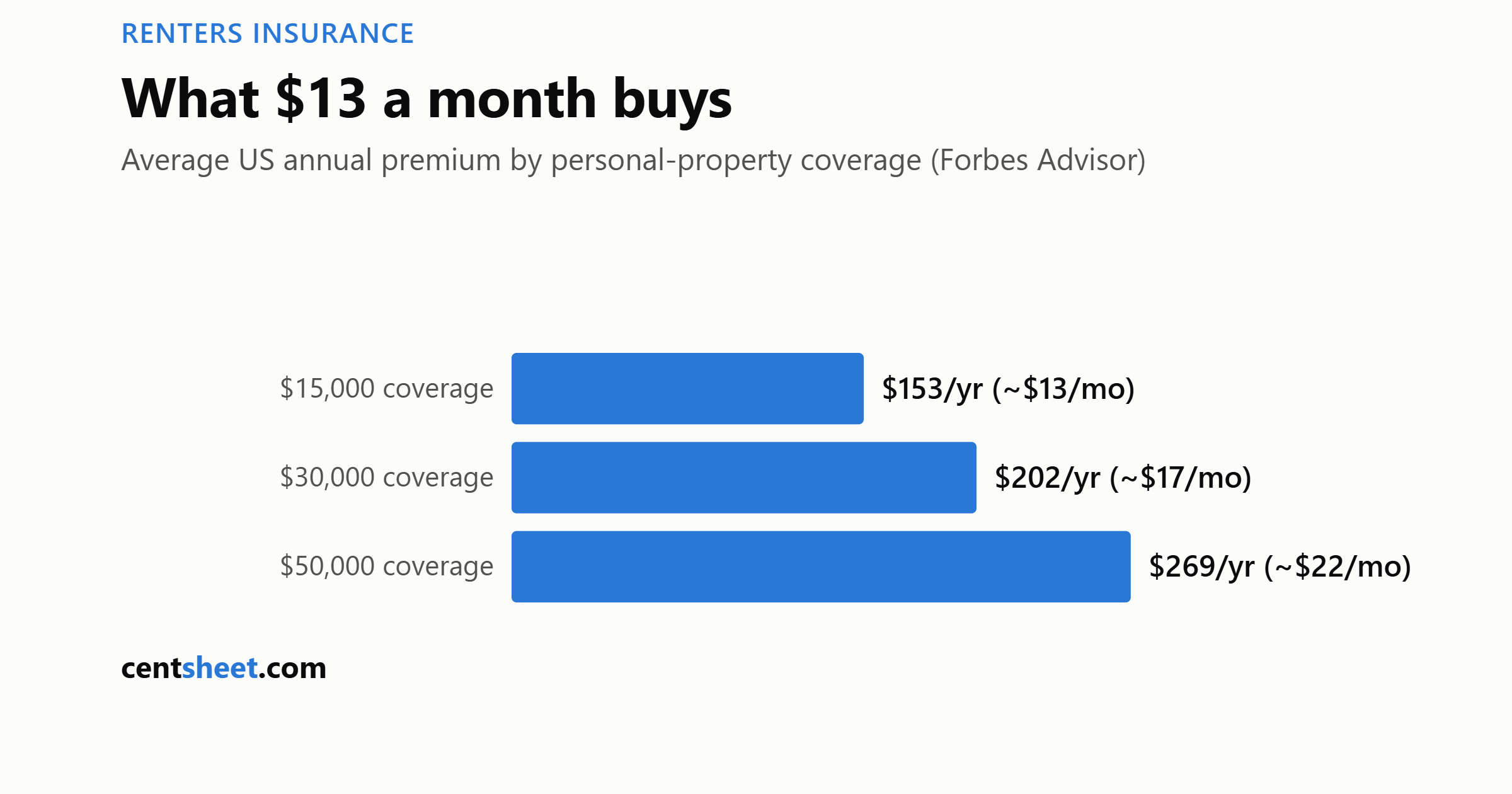
Your landlord’s insurance covers the building. It covers none of what’s inside your unit — not your laptop, not your furniture, not the hotel you’d need after a kitchen fire, and not the lawsuit if a guest slips in your bathroom. That’s the gap renters insurance fills, and it’s among the cheapest meaningful policies in existence. The US average runs about $153 a year — $13 a month — for $15,000 of personal-property coverage (Forbes Advisor). Doubling coverage barely moves it: roughly $17/month for $30,000 and $22/month for $50,000. Location matters more than coverage — state averages range from about $89 a year in Wyoming to $349 in Rhode Island.
Roughly half of US renters carry it. The half that doesn’t is mostly not making a calculation — they’re assuming the landlord’s policy does something it explicitly doesn’t.
The three coverages you’re buying
1. Personal property. Your belongings, against fire, smoke, theft, vandalism, water damage from burst pipes (not floods — see below), and similar named perils. It typically applies anywhere — a laptop stolen from your car or a bag lifted while traveling is usually covered, subject to your deductible.
Do the two-minute inventory: phone-photograph every room, closets open. Most people guess their stuff is worth a few thousand dollars and add up to $20,000+ once furniture, clothes, kitchen, and electronics are honestly counted. The photos live in cloud storage and become your claim evidence.
2. Liability. The quietly important one: if someone is injured in your place or you accidentally damage others’ property (your overflowing tub, downstairs neighbor’s ceiling), this pays the damages and — often more valuably — the legal defense. Standard policies start around $100,000 of coverage.
3. Loss of use. If a covered event makes the unit uninhabitable, this pays the hotel and the above-normal living costs while you’re displaced. It’s the difference between a disaster and a disaster plus a housing crisis.
The two settings that matter when you buy
Replacement cost, not actual cash value. ACV pays what your five-year-old TV was worth (nearly nothing); replacement cost pays what a new equivalent costs. The premium difference is small; always take replacement cost.
Know the exclusions. Floods and earthquakes are standard exclusions everywhere (separate policies exist); high-value categories — jewelry, instruments, cameras, collectibles — carry sub-limits (often $1,000–2,500 for theft) and need a cheap “scheduled” rider if you own real value there. If you run a business from home, business equipment usually needs its own endorsement.
Making it cheaper than cheap
- Bundle with auto insurance — the multi-policy discount often covers a third or more of the renters premium, and re-quoting both at renewal is the negotiation.
- Raise the deductible to a level your emergency fund can absorb — insurance is for disasters, not $300 annoyances.
- Alarm/smoke-detector and autopay discounts are commonly a question away.
The honest verdict
Insurance content on the internet oversells everything, so, plainly: renters insurance is worth it for almost everyone because the premium is trivial against two specific tail risks — total loss of possessions, and liability. If you own nearly nothing and judge your liability exposure minimal, the math gets closer. But at $13 a month, “I’ll risk it” is usually not a decision anyone made — it’s a decision that happened by default. Make it on purpose, either way.
CentSheet publishes educational content, not personalized financial advice. Coverage terms vary by state and insurer; the policy document governs.
Get the CentSheet Money Brief
Email me CentSheet weekly: practical money decisions, new calculators, and useful worksheets. Unsubscribe anytime.