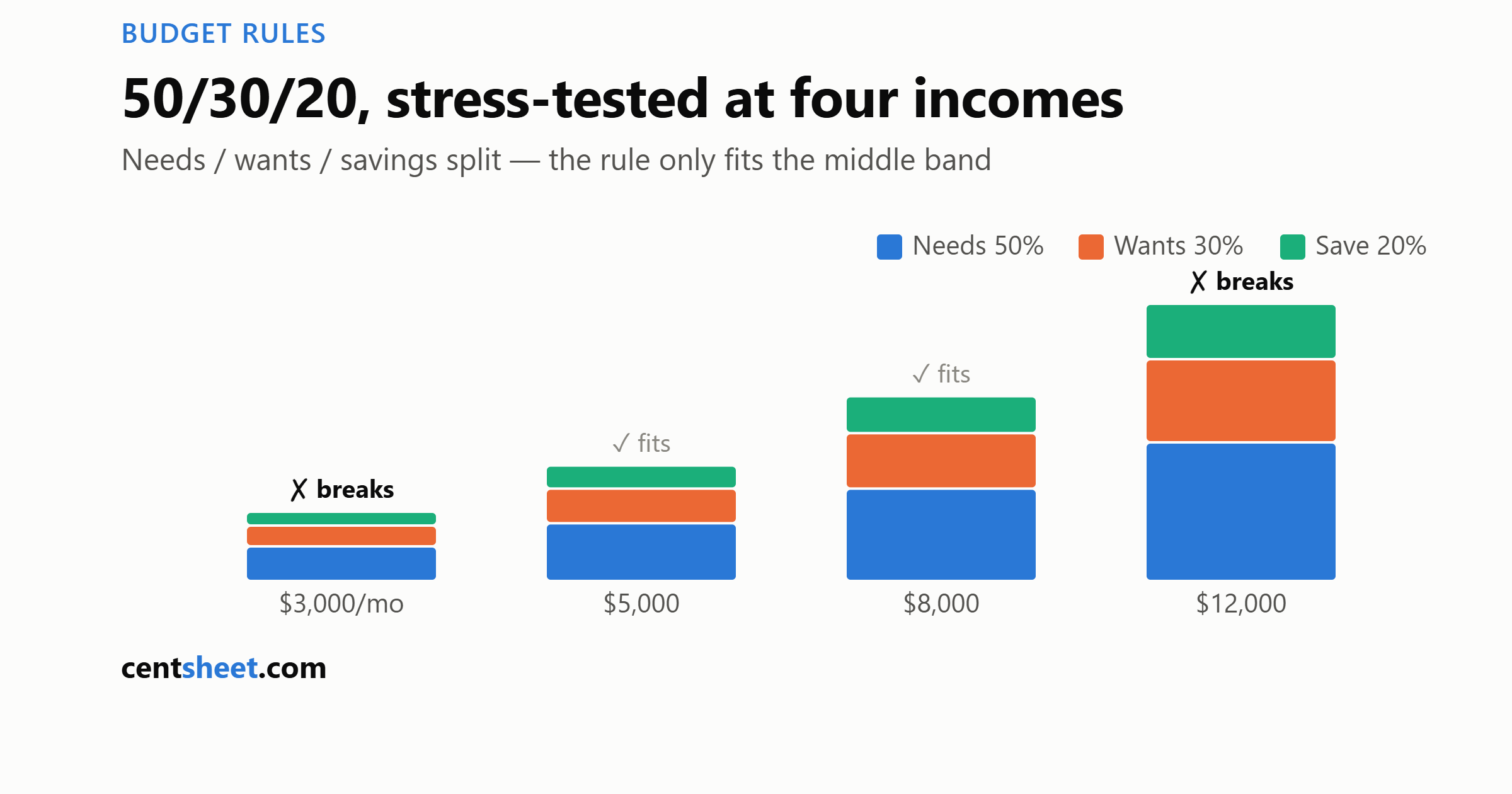
The 50/30/20 rule — 50% of take-home pay to needs, 30% to wants, 20% to savings — is the most-repeated budgeting advice in America, popularized by Senator Elizabeth Warren back when she was a bankruptcy law professor. It’s popular because it’s simple.
It’s also treated as universal, and it isn’t. Run it at four different incomes and watch what happens.
The rule at four take-home levels
| Monthly take-home | Needs (50%) | Wants (30%) | Savings (20%) |
|---|---|---|---|
| $3,000 | $1,500 | $900 | $600 |
| $5,000 | $2,500 | $1,500 | $1,000 |
| $8,000 | $4,000 | $2,400 | $1,600 |
| $12,000 | $6,000 | $3,600 | $2,400 |
Two of these rows work. Two are quietly broken.
Where it breaks: $3,000/month
At $3,000 take-home, the rule allots $1,500 for all needs — rent, utilities, groceries, insurance, transport, minimum debt payments. In much of the US, rent alone consumes most or all of it: the national median rent runs about $1,400, and the median asking rent on available listings tops $1,650 (Apartment List and Realtor.com data, mid-2026).
Someone in this position running the numbers doesn’t have a discipline problem; they have arithmetic that doesn’t close. Telling them to “just follow 50/30/20” produces either shame or a quiet decision that budgeting is nonsense. Neither helps.
What actually works at this level: flip the rule from prescription to diagnosis. If needs consume 65–75% of take-home, the leverage is structural — housing cost (roommate, relocation, renegotiation), transport cost, or income (the harder, more honest half of every budget conversation). Percentage-shuffling within the remaining 25% moves tens of dollars; the structural moves shift hundreds.
Where it also breaks: $12,000/month
The opposite failure is politer but real. At $12,000 take-home, the rule blesses $3,600/month of wants and asks for only $2,400 of savings — a 20% rate at an income where 35–45% is comfortably achievable without austerity.
High earners who anchor on 50/30/20 are letting a rule designed as a floor for savings act as a ceiling. Lifestyle inflation loves a percentage that scales with income. At this level the better frame is a fixed savings-first target (“we save $4,500, then spend the rest guilt-free”), not a spending allowance that grows with every raise.
Where it genuinely fits
The $4,500–$9,000 take-home band is where the ratios describe a livable reality for most US households: needs fit inside half, 20% builds wealth at a meaningful pace, and 30% of wants is enough room that the budget doesn’t feel like punishment — which is what makes people actually keep budgets.
If that’s you, the rule is a good starting scaffold. Check your real split below.
50/30/20 budget check
Enter monthly take-home pay (after taxes) and what you actually spend. Needs = housing, utilities, groceries, insurance, minimum debt payments, transport. Wants = everything optional. Savings = savings, investments, and extra debt payments.
The 50/30/20 rule is a diagnostic, not a law — see the article above for where it breaks down. Educational tool — not financial advice.
The three honest uses of 50/30/20
1. As a diagnostic. Your actual percentages tell you which of three different problems you have: a cost-structure problem (needs way over 50%), a leak problem (wants over 30% and savings under 20%), or no problem at all. The fixes are completely different, which is why the single rule can’t be the fix. 2. As a first budget. For someone who has never categorized a dollar, three buckets beat forty categories. Precision can come later; the habit comes first. (Once the habit exists, zero-based budgeting is the upgrade path.) 3. As a floor for savings. 20% is a fine minimum at middling incomes. It is not a target to stop at when income rises.
What the categories actually mean (the part everyone argues about)
The classification that trips everyone: minimum debt payments are needs — miss them and consequences follow. Extra debt payments are savings, not needs — they build net worth, same as investing (the payoff-order math is its own article). Gym memberships, streaming, and dining out are wants no matter how strongly it feels otherwise at 6 a.m. — the test is “what happens if I stop for a month,” not “how virtuous is it.”
Bottom line
50/30/20 is a good thermometer and a mediocre thermostat. Measure yourself against it — the calculator above takes a minute — then act on the specific imbalance it reveals, not on the slogan.
CentSheet publishes educational content, not personalized financial advice.
Get the CentSheet Money Brief
Email me CentSheet weekly: practical money decisions, new calculators, and useful worksheets. Unsubscribe anytime.