Net worth is the current value of what you own minus what you owe.
That one-line formula is easy. Building an honest list is harder. A house is not worth its purchase price forever. A car is not worth the sum of its loan payments. A credit limit is not an asset. Salary is cash flow, not wealth. And a shared asset should not appear at 100% on two separate personal balance sheets.
The result is useful as a trend, not a grade. A recent graduate with student debt can have a negative number and a strong monthly surplus. A homeowner can report a large positive number and still lack enough cash for next week's repair. Net worth measures a stock on one date; a budget measures the flow of money over time.
Net worth = total assets – total liabilities
| Put on the balance sheet | Keep in the budget instead |
|---|---|
| Cash and deposit accounts | Paychecks not yet earned |
| Investment and retirement balances | Monthly contributions |
| Defensible home and car values | Mortgage and car payments |
| Business ownership with supportable value | Expected future business revenue |
| Current payoff amounts for every debt | Ordinary monthly spending |
Pick a date, use values available on that date, and preserve your method. Consistency makes the trend meaningful.
Net worth is a balance sheet, not a spending plan
The Federal Reserve's 2022 Survey of Consumer Finances—the latest released SCF as of August 14, 2026—makes the distinction clearly: income is a flow measure, while net worth is a stock measure at the interview date. The survey defines net worth as assets minus liabilities and separately inventories financial assets, nonfinancial assets, and debts.
That distinction prevents several common errors.
- A $90,000 salary is not a $90,000 asset. Most of it has not been earned, taxed, or saved.
- A $2,000 monthly mortgage payment is not a $2,000 liability. The mortgage payoff balance is the liability; the payment belongs in cash flow.
- A $20,000 credit limit is not an asset. It is permission to borrow.
- A $50,000 car loan does not make the car a $50,000 asset. Value the vehicle and debt independently.
Use the monthly budget calculator to test cash flow. Use this worksheet to measure the accumulated result.
List assets at a value you could defend
Start with accounts that already have a statement value:
- Checking and savings accounts
- Certificates of deposit
- Taxable brokerage accounts
- 401(k), 403(b), TSP, IRA, and similar retirement accounts
- Health savings account balances
- Savings bonds and other investments
- Cash value in a permanent life-insurance policy, if it is genuinely accessible under the contract
Use the balance as of the same date. Do not subtract an early-withdrawal penalty from one CD while leaving every other account gross unless you are intentionally building a separate “cash available now” view.
Retirement accounts belong on the sheet because they are assets you own, even when withdrawals would create tax or penalty consequences. Record the statement value first. If a second, tax-adjusted estimate would help, show it in a separate column and document the assumed rate. There is no universal tax haircut: account type, age, basis, income, and state rules change it.
Expected Social Security benefits, future salary, and a possible inheritance are not current assets in this practical worksheet. A defined-benefit pension can have significant economic value, but converting its future payment promise into today's lump-sum value requires assumptions about longevity, discount rates, survivor terms, and inflation adjustments. Track the promised benefit separately unless the plan provides a current lump-sum value.
For investment basics behind the account values, see what owning an index fund means. Do not replace market value with the amount originally contributed.
Home value and mortgage balance are separate lines
For a home, enter a supportable current market-value estimate under assets and a current mortgage payoff under liabilities.
Suppose a home could reasonably sell for $310,000 and the mortgage payoff is $246,000. The apparent home equity is $64,000:
$310,000 – $246,000 = $64,000
That is a CentSheet calculation, not a guaranteed sale result. It excludes agent commissions, transfer taxes, repairs, concessions, moving expenses, and other transaction costs. If the worksheet is meant to answer “what might remain after a sale,” add an explicitly labeled selling-cost estimate. If it is meant to track standard net worth, keep gross market value and debt visible as separate lines.
Do not use the county tax assessment automatically. An assessed value can be designed for taxation rather than current resale. A recent independent appraisal is stronger but still dated. Recent comparable sales and several valuation sources can create a reasonable range. Use the conservative end when evidence conflicts, and date the estimate.
Use the loan servicer's payoff or principal balance, not the sum of all future scheduled payments. Future interest has not all accrued yet.
Treat a car the same way—and expect faster decay
A vehicle is an asset even if it loses value. List a realistic current sale value, then list the auto-loan payoff separately.
If a car could sell for $18,000 and the payoff is $11,600, its current equity is $6,400. The original sticker price, trade-in allowance, and total of future loan payments do not answer that question.
Choose a valuation basis and keep it consistent:
- Private-party value if you would realistically sell it yourself
- Trade-in value if replacement through a dealer is the likely transaction
- A documented written offer when available
Do not count leased vehicles as owned assets merely because they sit in the driveway. A lease can still create contractual obligations, excess-mileage exposure, or an end-of-lease charge. Those belong in a separate obligation note unless a current buyout and supportable vehicle value make an equity calculation useful.
Ordinary furniture, clothing, electronics, and kitchenware are usually omitted from a practical net-worth tracker. Their resale value is difficult to support and rarely changes a decision. Include a material collectible, jewelry holding, or other salable property only at a conservative resale value—not replacement cost or sentimental value.
Use payoff balances for every liability
Liabilities include money currently owed, whether or not a payment is due this week:
- Mortgage and home-equity balances
- Auto loans
- Student loans
- Credit-card balances
- Personal loans
- Medical debt
- Taxes already owed
- Margin loans and other investment-related borrowing
- Legally enforceable family or business debts
For federal student loans, the official Federal Student Aid dashboard can help locate loan and servicer information. A servicer's current payoff figure remains the better amount when accrued interest or a pending payment makes the displayed principal incomplete.
For credit cards, use posted balances as of the snapshot date and avoid counting the same purchase twice as both pending and posted. If balances are substantial, the debt payoff calculator answers the next question: what payment and payoff date follow from the starting debt?
A disputed debt does not vanish from the worksheet. Put it in a separate “disputed” line with a note, then show both totals if the outcome would materially change the result. Hiding it produces a precise-looking number built on a known uncertainty.
A worked personal balance sheet
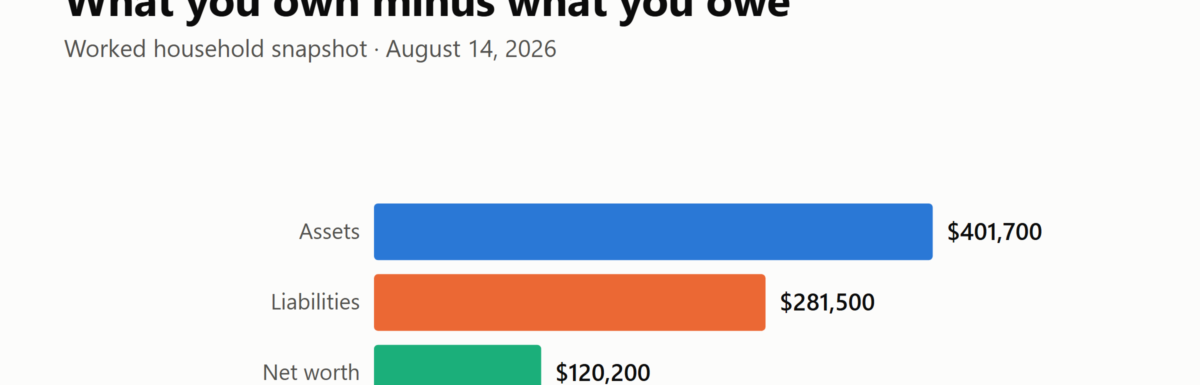
Here is a hypothetical household snapshot dated August 14, 2026.
| Assets | Value |
|---|---|
| Checking | $4,200 |
| Savings | $12,000 |
| 401(k) | $48,500 |
| Roth IRA | $9,000 |
| Car | $18,000 |
| Home | $310,000 |
| Total assets | $401,700 |
| Liabilities | Payoff balance |
|---|---|
| Credit card | $1,100 |
| Student loans | $22,800 |
| Auto loan | $11,600 |
| Mortgage | $246,000 |
| Total liabilities | $281,500 |
The net worth is $120,200:
$401,700 – $281,500 = $120,200
Every figure is a CentSheet illustrative assumption, and the arithmetic was computed from the displayed values. The result excludes estimated selling costs and tax on future retirement withdrawals. It also does not say the household has $120,200 available to spend. Only $16,200 sits in checking and savings; most of the positive value is locked in a home, retirement accounts, and car.
That liquidity distinction is why an emergency-fund target remains relevant even for someone with positive net worth. Home equity cannot normally pay a same-day deductible without a sale or new borrowing.
Joint ownership needs one consistent point of view
First decide whether the sheet measures an individual or a household.
For a combined household sheet, include jointly owned assets once and all household liabilities once. Do not list the same checking account under both partners and then add the columns.
For an individual sheet, include the share that the person actually owns and the debts for which that person is legally responsible. A simple 50% division may be a useful private estimate for a genuinely equal asset, but titles, contracts, state marital-property rules, divorce orders, guarantees, and rights of survivorship can produce a different legal result.
Do not use a net-worth worksheet to settle a legal ownership dispute. Mark uncertain items, preserve supporting documents, and get qualified legal advice where ownership affects an estate, separation, creditor claim, or tax filing.
How often to calculate it
Monthly tracking creates motion without much information for most households. Market prices move, a mortgage amortizes slowly, and home estimates are noisy.
Quarterly or twice-yearly tracking is usually enough. Also update after a major event: buying or selling a home, paying off a debt, receiving an inheritance, combining finances, separating, or changing retirement accounts.
Use the same valuation method each time. A conservative car trade-in value in January should not become an optimistic dealer listing in April merely to improve the graph. Keep notes beside estimates and retain the prior sheet.
Negative net worth is not an instruction to liquidate retirement savings or sell a necessary car. Break the number into causes. High-rate revolving debt, a recent professional degree, and a new mortgage create very different next steps. Protect a small cash buffer, then direct additional money according to rate, risk, employer benefits, and time horizon.
What to actually do
- Pick a snapshot date and decide whether the sheet is individual or household-level.
- Download current account statements and loan payoff balances.
- List financial assets at statement value; value property conservatively and document the source.
- List every liability separately, including disputed amounts in a clearly marked section.
- Add assets, add liabilities, and subtract liabilities from assets.
- Keep a separate liquidity subtotal so home equity does not masquerade as emergency cash.
- Save the assumptions, repeat the same method quarterly or twice a year, and focus on the trend.
- If the number is negative, identify the costly or risky liabilities rather than treating the total as a verdict.
CentSheet publishes educational content, not personalized financial, tax, valuation, or legal advice. Property values, payoff balances, ownership rights, taxes, and transaction costs vary. Verify current figures with account providers and qualified professionals. The worked example is a mathematical illustration based on stated assumptions.
Get the CentSheet Money Brief
Email me CentSheet weekly: practical money decisions, new calculators, and useful worksheets. Unsubscribe anytime.