Either owner of a joint checking account can generally take all the money out and close it. Neither can generally remove the other owner without that person’s consent. Both come from the Consumer Financial Protection Bureau, on pages last reviewed December 18, 2024, and the gap between them is what to understand first. No app touches this layer: titling decides who owns the money, who owes the debt, and who keeps it when someone dies.
A joint account gives the bank permission, not the two of you an answer
Toward the bank, the CFPB is blunt: “In most circumstances, either person on a joint checking account can withdraw money from and close the account.” For insurance purposes, the FDIC “assumes each co-owner is an equal owner unless the IDI records clearly indicate otherwise” (12 C.F.R. § 330.9).
Between the two of you, the default in some states is not equal at all. California Probate Code § 5301(a) provides that an account “belongs, during the lifetime of all parties, to the parties in proportion to the net contributions by each, unless there is clear and convincing evidence of a different intent,” and subsection (b) gives a co-owner an ownership interest in the other’s “excess withdrawal” — the amount exceeding that party’s net contribution on deposit immediately beforehand. The partner who empties the account can be entirely within the bank’s rules and still owe money back.
That is the Uniform Multiple-Person Accounts Act default, codified in California; other states differ. For married Californians, § 5305 adds a rebuttable presumption that their net contribution is and remains community property. The line that each joint owner “owns 100% of the balance” describes the bank’s authority to pay any party on demand, not ownership between two people.
Deposit insurance is counted per co-owner
FDIC coverage in the joint account ownership category is $250,000 per co-owner, per insured bank — not per account. Each co-owner’s shares of every joint account at the same bank are added together and insured to that limit. Three conditions apply: co-owners must be living natural persons; all must have equal rights to withdraw, since unequal rights mean the account “will not be insured as a joint account” under § 330.9; and all must have personally signed a signature card (not required for CDs).
CentSheet’s calculation: two co-owners with one joint account at one insured bank, all three conditions met and no other joint accounts there, are covered to $500,000 in that category — 2 × $250,000. That is arithmetic on the FDIC’s per-co-owner rule as fetched in August 2026. Credit unions are a gap: ncua.gov did not resolve during research, so we have no verified share-insurance figure for one — check 12 C.F.R. § 745.8.
Survivorship, and what a will does not control
With right of survivorship, the CFPB states the money passes to the surviving owner on death. An account may instead be titled as tenants in common, in which case that person’s share “passes to their heirs, either as described in their will or per their state’s laws.” The account agreement decides which you have (CFPB, updated May 15, 2024). California goes further: Probate Code § 5302 provides that survivorship rights on a multiple-party account cannot be changed by will (we are summarizing; the verbatim text was not obtained). If your estate plan and the bank paperwork disagree, the paperwork often wins.
Community property versus common law
IRS Publication 555 (Rev. December 2024) lists exactly nine community property states: Arizona, California, Idaho, Louisiana, Nevada, New Mexico, Texas, Washington and Wisconsin. Everything else is common law; generally your state of domicile governs whether you have community property and community income federally.
Alaska does not belong on it: Alaska Statute § 34.77.030 makes spouses’ property community property “only to the extent provided in a community property agreement or a community property trust” — opt-in, not default. We could not verify the Tennessee, Florida, Kentucky and South Dakota community-property-trust statutes; territories were not researched. The IRS also states that people in a registered domestic partnership or civil union are not married federally — but RDPs in Nevada, Washington and California must apply their state’s community property law.
Can a creditor of one partner reach a joint account? Nobody we could verify publishes a general answer. Garnishment is state law, the CFPB says so repeatedly, and no state-by-state primary source held up. The one verified federal overlay is narrow: two months’ worth of directly deposited federal benefits (Social Security, SSI, VA) are protected under the Treasury rule at 31 C.F.R. Part 212. Deposit the same benefits by check and the bank need not protect them.
Credit: two files, no shared score
Opening a joint account does not merge your credit reports, and there is no joint credit score. It creates joint liability. On a joint credit card, per the CFPB in January 2024, “each account holder is responsible for the full amount of the balance” — the issuer can pursue either of you. Divorce does not undo that: a decree “may allocate debts to a specific spouse, but it doesn’t change the fact that a creditor can still collect from anyone whose name appears as a borrower on the loan or debt” (CFPB, September 2024).
Regulation B § 1002.10 requires creditors to designate new accounts to reflect both spouses where one may use the account or is contractually liable, and to update existing designations within 90 days of a written request. But the official commentary says a creditor “need not distinguish between accounts on which the spouse is an authorized user and accounts on which the spouse is a contractually liable party.” An authorized user is a different status from a joint owner, per the CFPB — the liability gap is total, while the report may not show which one you are. We found no primary source on how FICO or VantageScore treat authorized-user tradelines, so we make no claim that being added to a partner’s card builds credit. A shared balance does land on both files, which matters for credit utilization.
The three structures
| All joint | All separate | Joint for shared bills | |
|---|---|---|---|
| One partner can drain it | Generally, and close it | Own accounts only | Generally, the joint part |
| Removing the other owner | Generally needs consent | N/A | Generally needs consent |
| FDIC joint category | $250,000 per co-owner | Does not apply | Joint account only |
| On death | Per the account agreement | Per will or state law | Split treatment |
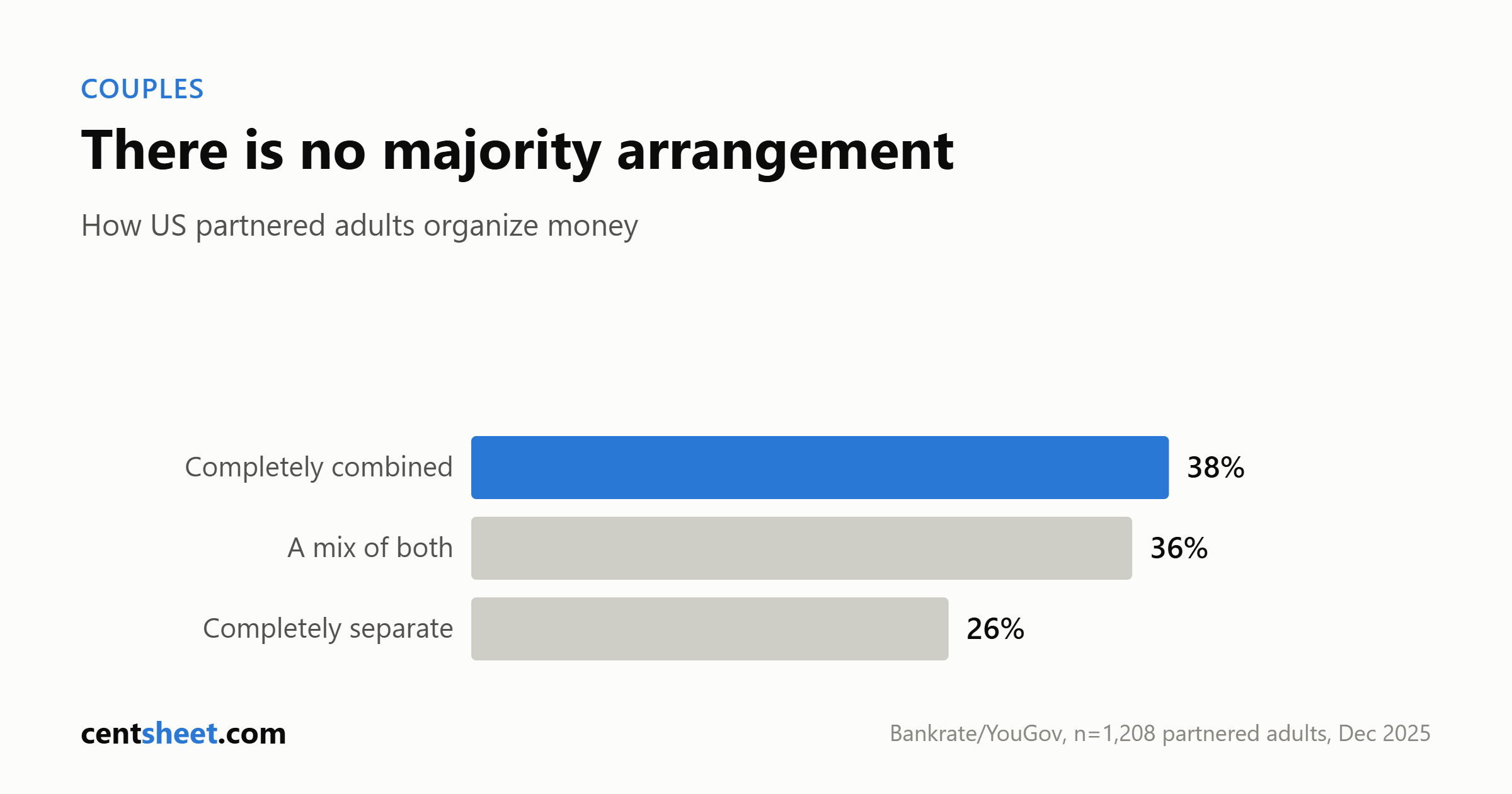
How common each is depends on who ran the survey. Both recent surveys are non-probability online panels commissioned by firms selling financial products or referrals; no federal statistical agency publishes this number.
| Arrangement | Bankrate/YouGov (n=1,208 partnered, Dec. 2–8, 2025) | Fidelity/Versta (n=3,193 partnered 3+ yrs, Oct.–Nov. 2025) |
|---|---|---|
| Completely combined | 38% combine completely | 42% into joint accounts |
| Completely separate | 26% | about 1 in 5 (~20%) |
| A mix | 36% | Not reported in the release |
Fidelity screened for couples together three or more years, which skews older and more merged; Bankrate included anyone married, partnered or cohabiting. Do not average them. The other side of Bankrate’s data: 62% keep at least some accounts in their name only.
| Generation | Bankrate: completely separate | Bankrate: completely combine | Fidelity: prefer completely separate |
|---|---|---|---|
| Gen Z (18–29) | 51% | 22% | 34% |
| Millennials (30–45) | 34% | 32% | 26% |
| Gen X (46–61) | 23% | 40% | Not reported |
| Boomers (62–80) | 15% | 45% | Not reported |
Seventeen points apart on Gen Z. Bankrate does not publish per-generation sample sizes and Fidelity’s screen excludes many of the newest couples; quoting one figure alone is picking a side.
“One of us handles the money” is an exposure
This is less about trust than about what the rules do when access runs one way.
Regulation E excludes from “unauthorized electronic fund transfer” any transfer “initiated by a person who was furnished the access device to the consumer’s account by the consumer, unless the consumer has notified the financial institution that transfers by that person are no longer authorized” (12 C.F.R. § 1005.2(m)). Handing over a card or a login generally forfeits the claim.
The CFPB’s December 17, 2024 issue spotlight on mortgages after divorce or death reported servicers refusing to remove an abuser’s name from a loan, sending account information to the abuser while refusing to speak with the survivor, and delaying assumption requests for months. On coerced debt, the Bureau issued an Advance Notice of Proposed Rulemaking on December 9, 2024 (89 FR 100922); comments closed April 7, 2025. There is no proposed or final rule. Trade commentary in September 2025 reported the agenda targeting May 2026; the 2026 Unified Agenda entry (RIN 3170-AB36) instead places it in Long-Term Actions, next action “To Be Determined.”
What the research actually shows
One causal study exists. Olson, Rick, Small and Finkel randomized 230 engaged or newlywed couples over two years into joint, separate or no-intervention conditions (Journal of Consumer Research, December 2023). Couples assigned to separate accounts and to the control condition “exhibited the normative decline in relationship quality across the first 2 years of marriage”; those assigned to merge “sustained strong relationship quality throughout.”
Read the limits first. Per the researchers’ own institution, roughly 20% of couples did not finish, participants were 75% white with a mean age of 28, and all were in first marriages. It says nothing about remarriages, long-married or cohabiting couples, large income disparities, or a history of financial abuse — and it is not a forecast for any particular couple.
Two older papers are routinely reversed. Papp, Cummings and Goeke-Morey (Family Relations, February 2009), diarying 748 conflicts among 100 husbands and 100 wives, found money was not the most frequent conflict topic — money conflicts were rarer than others but “more pervasive, problematic, and recurrent, and remained unresolved.” Dew, Britt and Huston (Family Relations, October 2012), using 4,574 couples in the National Survey of Families and Households, found financial disagreements the strongest of the disagreement types tested at predicting divorce, while financial well-being itself was not associated with divorce once disagreements were in the model. That is not “money is the number one cause of divorce.” The papers are 17 and 14 years old.
On budgeting apps for couples
We could not verify independent efficacy data on shared budgeting apps; the category’s marketing is not evidence. An app gives both partners visibility into the same numbers — which is exactly what one-sided access removes. It cannot change who owns the balance, who is liable, or what happens on death. Zero-based budgeting works on paper, and our budget calculator needs no linked account.
What to actually do
1. Read the account agreement for every joint account. The CFPB defers to it on survivorship, withdrawal rights and removal. 2. Confirm the titling — survivorship and tenants in common produce different outcomes on death. 3. Check the FDIC conditions if balances are large; unequal withdrawal rights break the joint category. Verify credit-union coverage under 12 C.F.R. § 745.8. 4. Know your regime: nine community property states per IRS Publication 555 (Rev. December 2024), everything else common law. 5. Treat a joint card as full liability for the whole balance, and a divorce decree as binding on your ex, not on the creditor. 6. Give both partners independent account access and read the statements. Regulation E generally will not help whoever handed over the login.
CentSheet publishes educational content, not personalized financial advice, and nothing here is legal or tax advice. Account titling and creditor rights are governed by state law and your account agreement.
Get the CentSheet Money Brief
Email me CentSheet weekly: practical money decisions, new calculators, and useful worksheets. Unsubscribe anytime.