Something changed this year that most guides to this subject have not caught up with: the CFPB will now turn your credit reporting complaint away unless you have already disputed with the credit bureau and either waited more than 45 days or had the dispute closed.
That reordering matters, because the complaint used to be the shortcut people reached for first. It is now the last step, not the first. Here is the whole process in the correct order.
Step 1: Get the reports and find the actual error
You are entitled by statute to one free report from each bureau every 12 months through AnnualCreditReport.com, delivered within 15 days of request.
In practice you can get one every week from each bureau — but be clear about what that is. Weekly access is a voluntary program the three bureaus made permanent in September 2023, not a legal right. Sources describing it as a legal entitlement are wrong on the law, even though the practical availability is identical today. A bureau could end it; the annual right survives regardless.
You also get a free report when you receive an adverse action notice (within 60 days), when you place a fraud alert or are an identity theft victim, when you certify you are unemployed and intend to apply for work within 60 days, or when you receive public welfare assistance. Where none of those apply and you want an extra copy, the maximum a bureau may charge in 2026 is $16.00.
The CFPB groups the errors worth hunting for into three families:
- Identity errors — wrong name, address or phone; accounts belonging to someone with a similar name (a “mixed file”); accounts opened by an identity thief.
- Incorrect account status — closed accounts shown open; you listed as owner when you are only an authorized user; accounts wrongly marked late; wrong payment, opening or delinquency dates; the same debt listed twice under different collector names.
- Data management errors — wrong current balance, wrong credit limit.
A wrong credit limit is worth special attention. It silently inflates your utilization, which is one of the heaviest-weighted factors in every model.
How common is any of this? The only congressionally mandated national study found 1 in 5 consumers had an error on at least one report and 5% had errors serious enough to cost them worse terms on credit or insurance. That study’s data was collected between 2004 and 2012, with a follow-up in January 2015 — it is roughly fourteen years old and no comparable federal study has been published since. Cite it as history, not as a current measurement.
Step 2: Dispute with the bureau — and the furnisher
The CFPB advises disputing with both the credit reporting agency and the furnisher (the bank, lender or collector that supplied the item). That is not belt-and-braces; the two routes have genuinely different coverage.
Bureau channels:
| Bureau | Online | |
|---|---|---|
| Experian | Experian Dispute Center | Experian, Dispute by Mail, P.O. Box 4500, Allen, TX 75013 |
| TransUnion | dispute.transunion.com | TransUnion Consumer Solutions, P.O. Box 2000, Chester, PA 19016-2000 |
| Equifax | equifax.com/investigate | Equifax Information Services LLC, P.O. Box 740256, Atlanta, GA 30374-0256 |
Include a copy of the report with the disputed items circled, the account numbers, a clear explanation of what is wrong, and copies of your supporting documents — never originals. Experian states plainly that mailed documents are not returned.
Certified mail is a good idea because it creates proof of delivery. It is not legally required, and neither is writing — the FCRA does not mandate a written dispute.
The furnisher route has holes you need to know about. Under Regulation V, a furnisher must investigate a direct dispute about your liability for an account, its terms, your payment history, or other information bearing on your creditworthiness. But it is exempt from investigating direct disputes about:
- your identifying information — name, Social Security number, address, phone
- your past or present employer
- inquiries, or tradelines from other furnishers
- information taken from public records
- information related to fraud or active-duty alerts
- anything submitted by a credit repair organization
Read that list against the error categories above. Mixed files, wrong addresses, stray inquiries and public-record problems are exactly the cases where a direct dispute to the furnisher does nothing — the bureau is your only effective route. Most consumer guides omit this entirely.
That last exemption also deserves a moment. If you pay a credit repair company to dispute on your behalf, furnishers are under no obligation to investigate what they send. Doing it yourself is not merely cheaper; it is the version the law actually protects.
Step 3: Know the clock
The FCRA deadlines are specific, and knowing them is most of your leverage.
| Deadline | What must happen |
|---|---|
| 5 business days | Bureau must notify the furnisher and forward all relevant information you provided |
| 30 days | Bureau must complete a reasonable reinvestigation and record the current status — or delete the item |
| +15 days (45 total) | Extension available only if you supply additional relevant information during the initial 30 days |
| 5 business days after completion | Bureau must send you written results, a copy of the revised report, and notice of your right to add a statement |
| 5 business days | If the bureau deems your dispute frivolous, it must tell you why and what it would need from you |
| 3 business days | If the bureau simply deletes the item this fast, it can skip the furnisher-notice steps — but must call you and confirm in writing within 5 business days |
Two things about that 45-day number, because popular coverage routinely garbles them. The 15-day extension applies when you add information mid-investigation. Separately, the CFPB says a dispute filed after you obtain your free annual report carries a 45-day window from the outset. Those are different triggers. Neither is “the” rule.
The single most useful provision is this one: if the disputed information is inaccurate, incomplete, or cannot be verified, the bureau must promptly delete or modify it. Cannot be verified stands on its own. You do not have to prove the item is wrong — the furnisher has to be able to prove it is right.
If an item is deleted and later reinserted, that requires the furnisher to certify it is complete and accurate, and the bureau must notify you in writing within 5 business days.
Step 4: If it comes back “verified”
This happens often, and it is not the end.
Ask the bureau for a description of the procedure used — a right the results notice must tell you about. A furnisher that responded identically to every dispute, or did not respond at all, is a documented failure pattern, not a hypothetical one. CFPB supervisory findings describe bureaus accepting responses from furnishers that failed to answer all or nearly all disputes or sent the same answer to every one; auto lenders continuing to report information they knew was false; and furnishers sending result notices that never told the consumer the outcome. The CFPB’s enforcement suit against Experian alleging sham dispute investigations, filed in January 2025, survived a motion to dismiss in October 2025 and remains active.
Your options at this point:
1. File a statement of dispute. You may add a brief statement to your file; the bureau may cap it at 100 words if it helps you write a clear summary. Once filed, any later report containing that item must note it is disputed and include the statement or a summary. 2. Notify everyone who already saw it. On request, the bureau must send notice of the deletion or your dispute statement to anyone who received the report in the prior six months — or the prior two years for reports furnished for employment purposes. If a bad item cost you a job or an apartment, use this. 3. File a CFPB complaint — now subject to the gate described below. 4. Contact your state attorney general. Some states provide protections beyond federal law. 5. Consult an attorney. FCRA suits must be brought within the earlier of 2 years after you discover the violation or 5 years after it occurred. For willful noncompliance, the statute allows actual damages or statutory damages of $100 to $1,000, plus punitive damages at the court’s discretion, plus costs and reasonable attorney’s fees. That fee-shifting provision is why consumer attorneys take these cases.
The 2026 CFPB gate
Now the change. The CFPB’s credit reporting complaint page tells consumers, in capitals, that they must first dispute with the credit reporting agency, and asks a screening question: have you submitted your dispute more than 45 days ago, or is it no longer pending? If not, it instructs you not to submit the complaint.
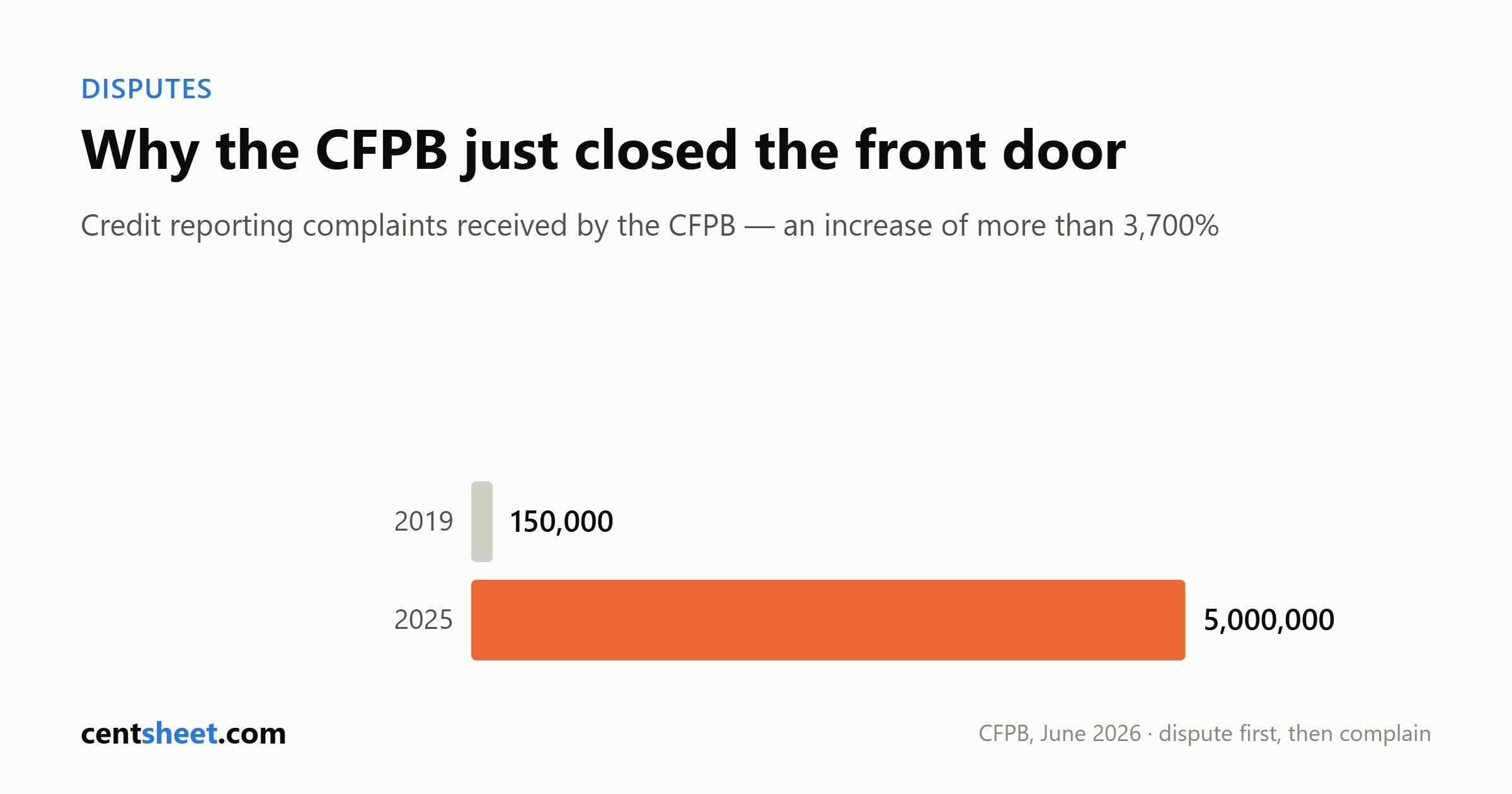
This came out of a June 24, 2026 overhaul of the complaint system, driven by volume that is genuinely extraordinary: credit reporting complaints rose from more than 150,000 in 2019 to more than 5 million in 2025 — an increase the Bureau puts at over 3,700%. The CFPB attributes the surge to credit repair organizations, social media influencers, AI-driven complaint tools, and businesses disputing accurate information. In 2025 credit and consumer reporting made up roughly 88% of all complaints the Bureau received.
The mechanism worked, which is part of why it was flooded: the three nationwide bureaus closed more than 1.3 million CFPB complaints with non-monetary relief — updates and deletions — in 2024, rising to 2.1 million in 2025.
One honest caveat on how the gate is described. The CFPB’s page states you are “required by law” to dispute directly first. The National Consumer Law Center argued in March 2026 that the portal’s notices mis-state the law and will deter consumers. Nothing in the FCRA’s dispute section conditions a complaint on a prior bureau dispute. The practical reality is unchanged — the portal will turn you away without one — but treat it as an operational requirement of the CFPB’s own process, not as a statutory precondition to your rights.
If you do file: online submission usually takes under ten minutes, or call (855) 411-2372 weekdays 9 a.m.–6 p.m. ET. Most companies respond within 15 days; where a case stays open you should get a status update at 15 days and a final response within 60.
Set expectations accordingly. The Bureau’s capacity has been reduced substantially since early 2025, and the June 2026 overhaul added new administrative closure options for complaints where the dispute process was not completed. The portal is open and operating. Whether an individual complaint gets substantive attention is a different question, and we would not promise you it will.
A note on medical debt
The CFPB rule that would have barred medical debt from credit reports was vacated on July 11, 2025 by a federal court that found the Bureau exceeded its FCRA authority. Medical debt can still appear on credit reports under federal law.
The three bureaus’ own earlier voluntary policies — not reporting paid medical collections, not reporting medical collections under $500, and delaying new medical collections for 365 days — are described in 2026 coverage as still in effect, but we could not verify that against the bureaus’ current statements. If medical debt is your issue, check each bureau’s current policy directly rather than relying on any summary, including this one.
What we are not going to tell you
How many points removing an error will gain you. Nobody can. The models are proprietary, and the effect depends on the error type, the rest of your file, and which model version is being run. Any site quoting you a number for this is guessing.
A dispute success rate. You will see the CFPB’s 2025 complaint outcomes — about 51% closed with explanation, 40% with non-monetary relief — recycled as though they describe FCRA disputes. They do not. Those are complaint outcomes, a different process measured a different way.
What we can tell you is that the FTC’s study found about half of consumers who disputed a potential material error saw a change in their credit score. That is a 2013 finding on data collected years earlier, and it is the most authoritative number that exists.
The short version
1. Pull all three reports — they differ, and an error on one may not be on the others. 2. Dispute with the bureau for identity, inquiry and public-record problems; with both bureau and furnisher for account-level problems. 3. Send copies, keep originals, and keep proof of delivery. 4. Hold them to 30 days (45 only under the specific triggers above). 5. If it comes back verified, request the investigation procedure and file a statement of dispute. 6. Only then take it to the CFPB — after 45 days or a closed dispute. 7. If it was willful and it cost you, the FCRA has a fee-shifting provision and a two-year clock.
Fixing a genuine error is legitimate and worth the effort. Nothing here removes accurate negative information, and no company can do that either — which is the entire business model of the credit repair industry the CFPB is now openly blaming for breaking its complaint system.
CentSheet publishes educational content, not personalized financial advice, and nothing here is legal advice. Statutory citations are to the FCRA as of August 2026.
Get the CentSheet Money Brief
Email me CentSheet weekly: practical money decisions, new calculators, and useful worksheets. Unsubscribe anytime.