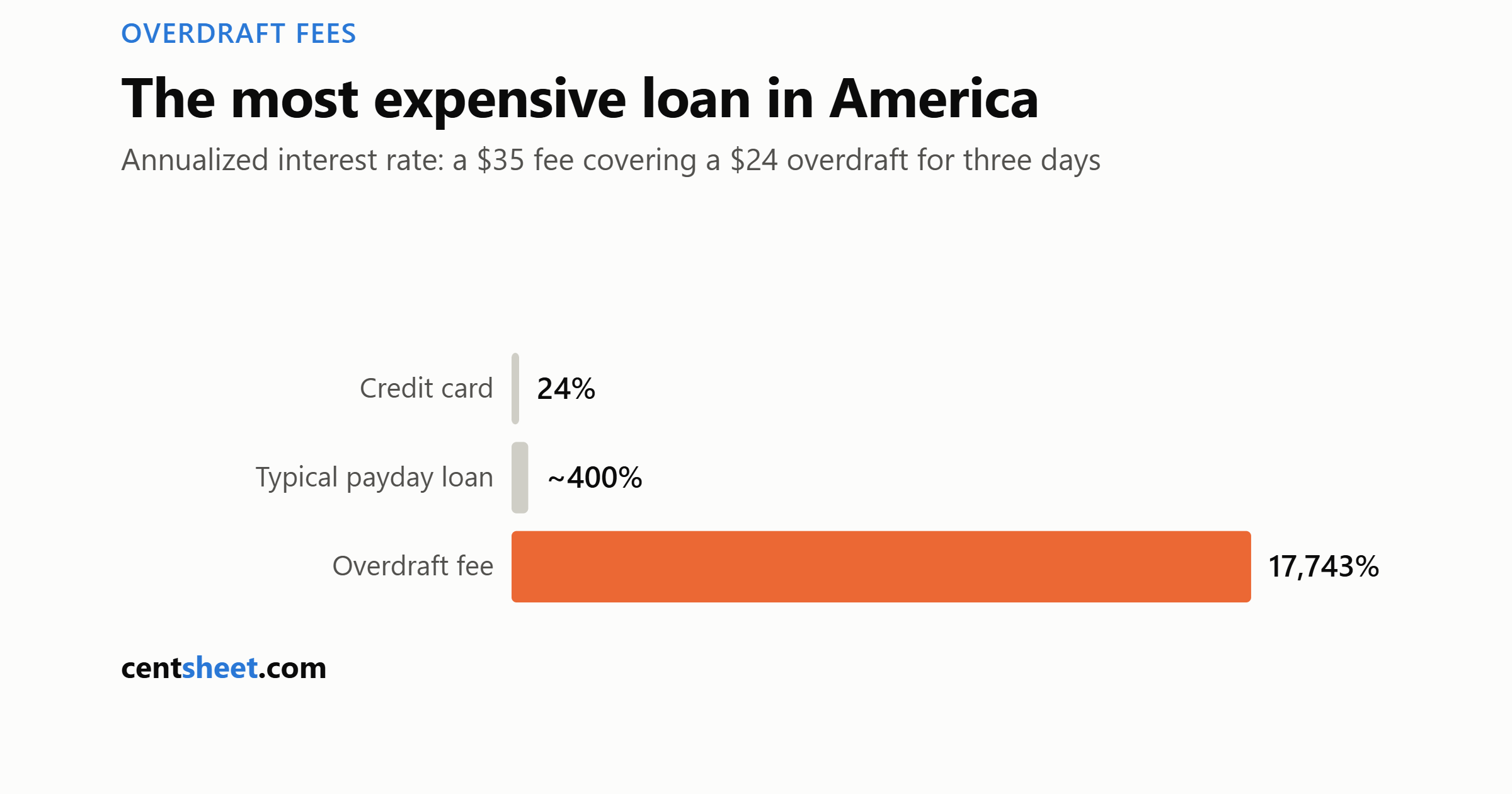
The most expensive credit product in America isn’t a payday loan. It’s the “courtesy” your bank enrolls you in with friendly language about being “covered”: overdraft protection.
The mechanics: your account hits zero, a $24 debit comes through, the bank approves it anyway and charges a fee — classically $35 (many banks have lowered or dropped fees in recent years; plenty haven’t). Your negative balance gets cleared three days later when your paycheck lands.
Run that as a loan, because it is one: $35 to borrow $24 for 3 days annualizes to roughly 17,743%. The number is absurd to even type. A payday lender’s triple-digit APR is, by comparison, a discount product.
The design, plainly
Overdraft fees are engineered around three features:
The fee doesn’t scale with the shortfall. $35 whether you overdrew by $6 or $600 — which means the smallest, most trivial slips are the most obscenely priced. The classic $40 coffee is the fee on a $5 overdraft.
Fees stack per transaction. One bad afternoon — four small debits after an unnoticed zero — can be four fees, $140, before you’ve seen a single alert. Some banks also re-order or batch processing in ways that historically maximized fee events; regulation and lawsuits have curbed the worst of it, but per-transaction stacking remains standard.
The people who pay are the people with the least. Fee revenue concentrates overwhelmingly in a small share of accounts — the ones living closest to zero, paycheck-to-paycheck by the timing definition. It’s a tax on having no slack, collected at the moment of least slack.
The part banks under-explain: you can just say no
For everyday debit-card purchases, overdraft coverage is opt-in under US rules. Decline it (or opt out today — one message or call) and a purchase against insufficient funds is simply declined. Cost: $0, plus a moment of checkout awkwardness that is worth exactly $35 more than the alternative.
Two footnotes: checks and scheduled ACH payments work differently — those can still trigger either an overdraft fee or a returned-payment fee even if you’ve opted out of debit coverage. And some banks now offer genuine grace features (small no-fee cushions, 24-hour cure windows). Read yours; “overdraft protection” and “overdraft grace” are different products wearing one name.
The free replacement stack
1. Opt out of debit overdraft coverage. The default answer for almost everyone. 2. Low-balance alert at a real threshold — $100, not $0 — so the phone buzzes before the danger zone. 3. Linked-savings transfer as backstop: pulls from your own savings to cover a slip, free or nearly so at most banks. This is the only thing properly called protection — it’s your money protecting you. 4. The structural fix: a half-month buffer in checking makes the entire category unhittable. Overdraft fees are a symptom; timing slack is the cure.
If you’ve paid fees recently: call and ask for a refund. First-time and occasional offenders get fees waived routinely — it’s the cheapest negotiation in banking, a two-minute call with a better hourly rate than your job.
CentSheet publishes educational content, not personalized financial advice. Fee amounts and policies vary by bank and have shifted meaningfully in recent years; your bank’s current fee schedule is the authority.
Get the CentSheet Money Brief
Email me CentSheet weekly: practical money decisions, new calculators, and useful worksheets. Unsubscribe anytime.