The down payment is the wall most first-time buyers hit, and the arithmetic is unforgiving in a way that vague advice (“save aggressively!”) obscures. So let’s do the actual timeline.
The table
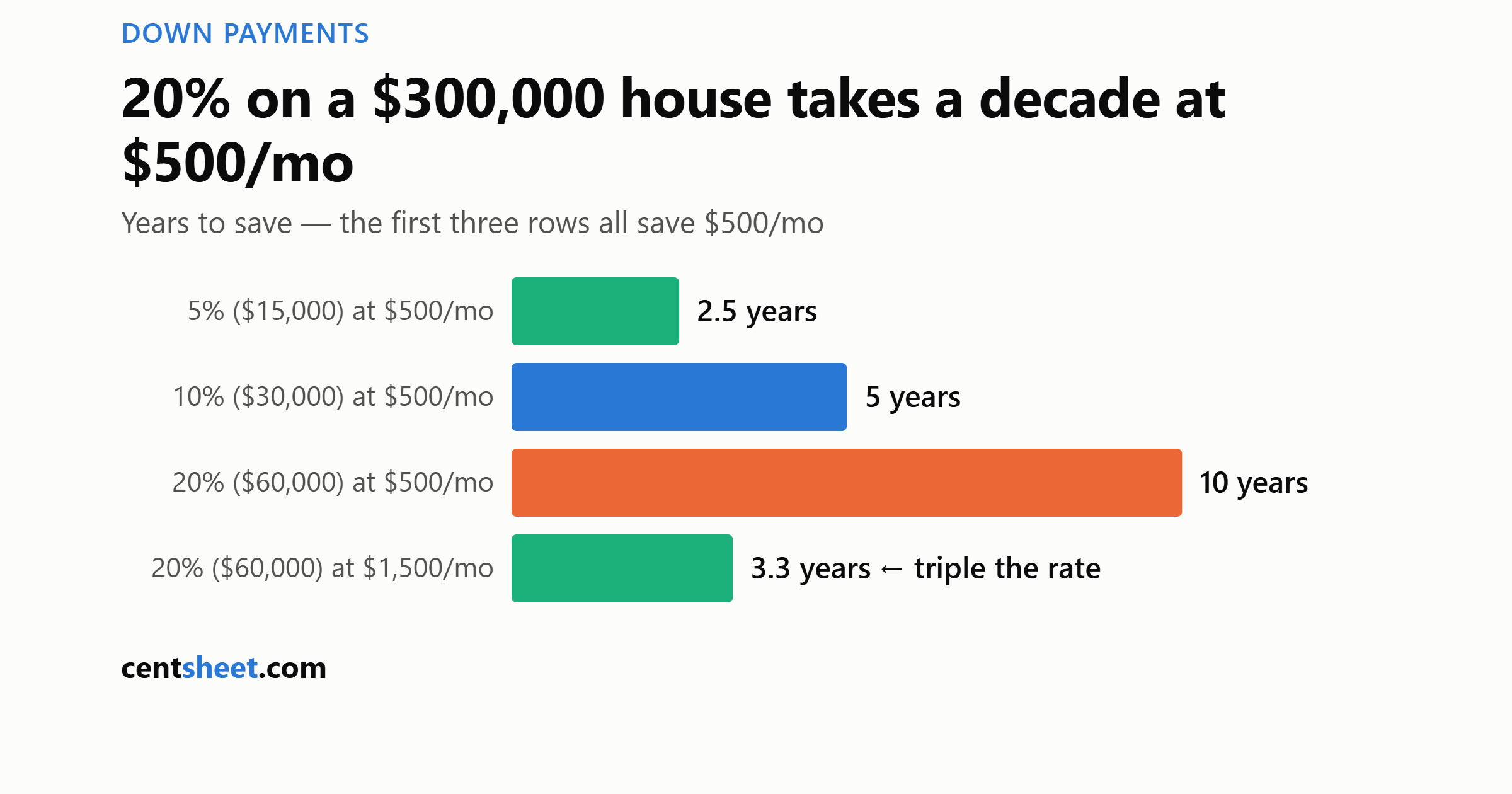
A $300,000 house. Years to save, by monthly amount:
| Down payment | Amount | At $500/mo | At $1,000/mo | At $1,500/mo |
|---|---|---|---|---|
| 5% | $15,000 | 2.5 years | 1.2 years | 0.8 years |
| 10% | $30,000 | 5.0 years | 2.5 years | 1.7 years |
| 20% | $60,000 | 10.0 years | 5.0 years | 3.3 years |
(Straight division — no growth assumed, which is deliberate; see below.)
The 20%-at-$500 row is why this feels impossible to a lot of people. Ten years is not a plan, it’s a decade. Which makes the next section the most useful part of this article.
20% is a convention, not a requirement
The 20% figure is widely treated as the price of entry. It isn’t. It’s the threshold at which conventional loans typically stop requiring private mortgage insurance (PMI) — a monthly charge that protects the lender, not you.
Several loan programs allow far less down; some government-backed programs go to very low single digits, and many lenders offer conventional loans below 20% with PMI attached. The real trade is this:
- Less down = buy sooner, smaller cash barrier, but a bigger loan, higher monthly payment, and PMI until you build enough equity.
- More down = wait longer, but lower payment, less interest over the life of the loan, no PMI.
Neither is universally correct. The honest comparison is: what does waiting five more years actually cost you in rent, and what does PMI actually cost per month? Sometimes buying at 10% and dropping PMI later beats renting for five more years. Sometimes it doesn’t. It depends on your market’s rent and prices, and anyone who answers it without asking about both is guessing.
The down payment is not the whole cash requirement
Two more lines, both routinely forgotten:
Closing costs typically run in the low single-digit percentages of the purchase price — on $300,000, plan for roughly $6,000–$15,000. This is separate from the down payment and due at the same time.
Reserves. Lenders often want to see you still have money after closing, and beyond that, buying a house is the single worst moment to have an empty emergency fund. Houses generate expenses immediately and without asking.
So the real target on a 10%-down $300,000 purchase is closer to $30,000 + $10,000 + a maintained emergency fund — not $30,000.
Where the money sits while it waits
This is where the timeline changes the answer, and it’s the question most “save for a house” articles skip:
Buying within about 3 years? Cash equivalents — a high-yield savings account, CDs, or T-bills. Not the stock market. A 30% drawdown the quarter you were going to buy doesn’t delay your purchase; it cancels it. Certainty of value beats expected return when the money has a date.
Five or more years out? The conversation legitimately changes, and some market exposure becomes defensible — but this is genuinely a personal-circumstances question, and the closer you get, the more the money should shift toward cash.
That’s also why the table above assumes no growth: for a goal inside three years, growth is not something to plan around. Anything the account earns is a bonus that shortens the timeline slightly.
How to actually accelerate it
Ranked honestly:
1. Income. Uncomfortable but true: the gap between $500/month and $1,000/month halves a decade. On this particular goal, a raise or side income moves the date more than any spending optimization can. 2. Housing cost now. The largest expense is the one funding the goal’s biggest competitor. A roommate or cheaper unit for two years can be worth tens of thousands toward the down payment. 3. Automate it into a separate account on payday, same mechanism as every other goal on this site — out of checking, out of mind. 4. Windfalls go entirely to the goal. Tax refunds, bonuses, gifts. These are what actually compress timelines in practice. 5. Check first-time buyer assistance programs in your state and city. Down-payment assistance is real, underused, and varies enormously by location — worth an afternoon of research given the sums involved.
The summary
Pick the target percentage deliberately rather than defaulting to 20%; add closing costs and reserves to the number; keep it in cash if the date is inside three years; automate the transfer; and be honest that income is the fastest lever. Ten years at $500 is a real answer to a real question — but it’s rarely the only answer available.
CentSheet publishes educational content, not personalized financial advice. Loan program requirements, PMI rules and assistance programs vary; verify current terms with a lender or HUD-approved housing counselor.
Get the CentSheet Money Brief
Email me CentSheet weekly: practical money decisions, new calculators, and useful worksheets. Unsubscribe anytime.