Most budget “surprises” aren’t surprises. Car insurance comes due every six months, on a date printed on the policy. December happens every year. Cars need tires on a schedule you can roughly predict. Yet these predictable irregulars are what blow up most budgets — and then get charged to a card, or worse, pulled from the emergency fund.
The fix is old, unglamorous, and nearly foolproof: the sinking fund. You take every large irregular expense, divide it by the months until it arrives, and set that amount aside monthly. The lump sum stops being a spike and becomes a flat line item.
The mechanic, with real numbers
| Irregular expense | Timing | Monthly set-aside |
|---|---|---|
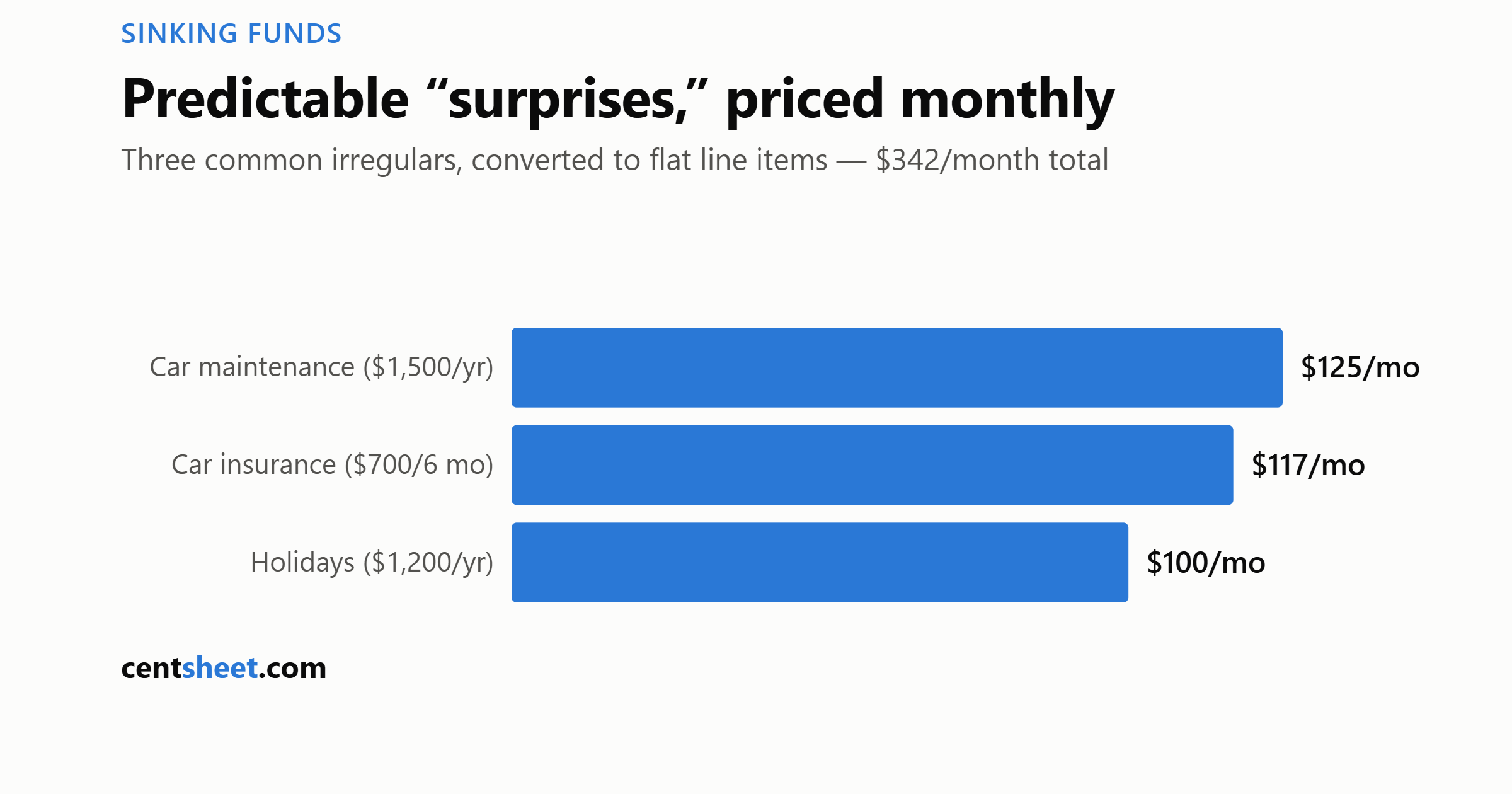
| $700 car insurance premium | every 6 months | $117 |
| $1,200 holiday season (gifts, travel, hosting) | yearly | $100 |
| $1,500 car maintenance & repairs | yearly, lumpy | $125 |
Three funds, $342/month combined — and three of the most common budget-wreckers simply stop being events. When the insurance bill lands, the money is sitting there with the bill’s name on it. Nothing is borrowed, nothing is “found,” no month gets wrecked.
That’s the entire trick. The rest is implementation detail — but the details decide whether it sticks.
Sinking fund vs. emergency fund — the line that matters
Both are cash set aside, which is why people blur them. The distinction:
- Emergency fund: for events you can’t schedule — job loss, medical, the transmission. Unknown timing, unknown size. (Sizing it is its own question.)
- Sinking funds: for events you can schedule — premiums, holidays, annual subscriptions, the next set of tires. Known-ish timing, estimable size.
The blur is expensive in one specific way: every predictable expense you don’t sink eventually presents itself as an “emergency,” drains the emergency fund, and trains you to think emergencies happen monthly. They don’t. Decembers do.
How to find yours in fifteen minutes
Scroll twelve months of bank and card statements and write down every expense that was over ~$200 and not monthly. Common catches:
- Insurance premiums (auto, home, life) paid semi-annually or annually — often with a discount vs. monthly billing that sinking makes claimable
- Holidays and birthdays — the calendar’s most predictable “surprise”
- Car registration, maintenance, tires
- Annual subscriptions and memberships
- Back-to-school, travel to family, pet vet visits
- Home maintenance, if you own — the roof is not an emergency; it’s a slow bill
Divide each by months-until-due. Sum them. That number — often $250–500/month for a typical household — is how much your “normal” months were quietly borrowing from your “disaster” months.
Implementation: fewer buckets than you think
The failure mode of sinking funds is administrative sprawl — seventeen named accounts, abandoned by March. What works:
One separate savings account, one spreadsheet row per fund. A single high-yield savings account holds all sinking money; a simple tracker (or your bank’s built-in “buckets,” which several online banks offer) splits it on paper. Transfers automate on payday. The account earns interest while it waits, which monthly-billed premiums never do.
Start with the worst three offenders, not all twelve. The point is the habit; coverage can grow.
When the bill arrives, pay it from the fund and restart the clock. No ceremony.
The quiet payoff
A budget with sinking funds behaves differently in a way that compounds: months become boring. Boring months are what make any budget ratio you follow actually hold, because the ratios stop being demolished quarterly by a bill you technically knew about. Budgets rarely fail from small leaks; they fail from scheduled explosions treated as acts of God.
$342 a month, in this example, buys the end of that.
CentSheet publishes educational content, not personalized financial advice.
Get the CentSheet Money Brief
Email me CentSheet weekly: practical money decisions, new calculators, and useful worksheets. Unsubscribe anytime.