Yes, 700 is a good credit score. It is also below the national average, two tiers from the top of FICO’s scale, and four pricing bands below the best conventional mortgage rate.
All of those are true simultaneously, and holding them together is the only way to answer the question usefully.
Where 700 actually sits
Every major tiering system puts a 700 in the middle, not the top:
| System | Where 700 lands | Top tier |
|---|---|---|
| FICO | Good (670–739) — tier 3 of 5 | Exceptional, 800+ |
| VantageScore | Prime (661–780) — tier 3 of 4 | Superprime, 781+ |
| CFPB (on FICO 8) | Prime (660–719) | Super-prime, 720+ |
| CFPB card market report | Prime (660–719) | Superprime, 800+ |
| Conventional mortgage pricing | 700–719 band | 780+ |
Two things stand out. Under the CFPB’s consumer credit classification, a 700 misses super-prime by twenty points. And in the card market report the CFPB uses a six-tier split — it broke the old 720+ superprime tier apart specifically because scores of 720 and above had come to make up nearly two-thirds of cardholders. When the top tier gets that crowded, the definition of “top” moves.
If you have seen a summary claiming 700 is “Very Good” on FICO: it isn’t. Very Good starts at 740.
It is below the national average
The average US FICO Score is 714. A 700 is fourteen points under it.
That is not a criticism — it is calibration. Roughly 70% of consumers score 670 or above and about 50% are at 740 or above, so a 700 puts you inside the majority but in the lower half of it. FICO’s own published high-score benchmark is 750, where a record 48.1% of consumers now sit.
(You will find claims that “67% of Americans are above 700.” That figure comes from an undated Experian page and does not reconcile with Experian’s own dated band distribution. We are not using it, and neither should you.)
The fairest one-line description, and Experian’s own: lenders treat the Good range as acceptable — you will be offered a variety of products, just not necessarily at the lowest rates available.
What 700 costs you on a mortgage
Here is the concrete version. myFICO publishes rate tiers sourced from Curinos; as of August 5, 2026, on a $300,000 30-year fixed at 80% LTV:
| Tier | Rate | Monthly | Lifetime interest |
|---|---|---|---|
| 780+ | 6.76% | $1,948 | $401,204 |
| 760+ | 6.82% | $1,960 | $405,519 |
| 740+ | 6.89% | $1,974 | $410,566 |
| 720+ | 6.99% | $1,994 | $417,802 |
| 700+ | 7.02% | $2,000 | $419,978 |
| 680+ | 7.15% | $2,026 | $429,439 |
| 660+ | 7.17% | $2,030 | $430,899 |
| 620+ | 7.45% | $2,087 | $451,457 |
Moving from the 700 tier to the 760 tier is worth 0.20 percentage points — about $40 a month and $14,459 over the life of the loan. Getting all the way to the top 780 tier is worth 0.26 points, $52 a month and $18,774.
But look closely at the step immediately above you. 700 to 720 is worth almost nothing — three hundredths of a point. The next step that actually pays on a mortgage is 740, worth 0.13 points, $26 a month and about $9,400. If you are at 700 and shopping for a house, targeting 720 is not a goal. Targeting 740 is.
On an auto loan, 700 is a completely different story
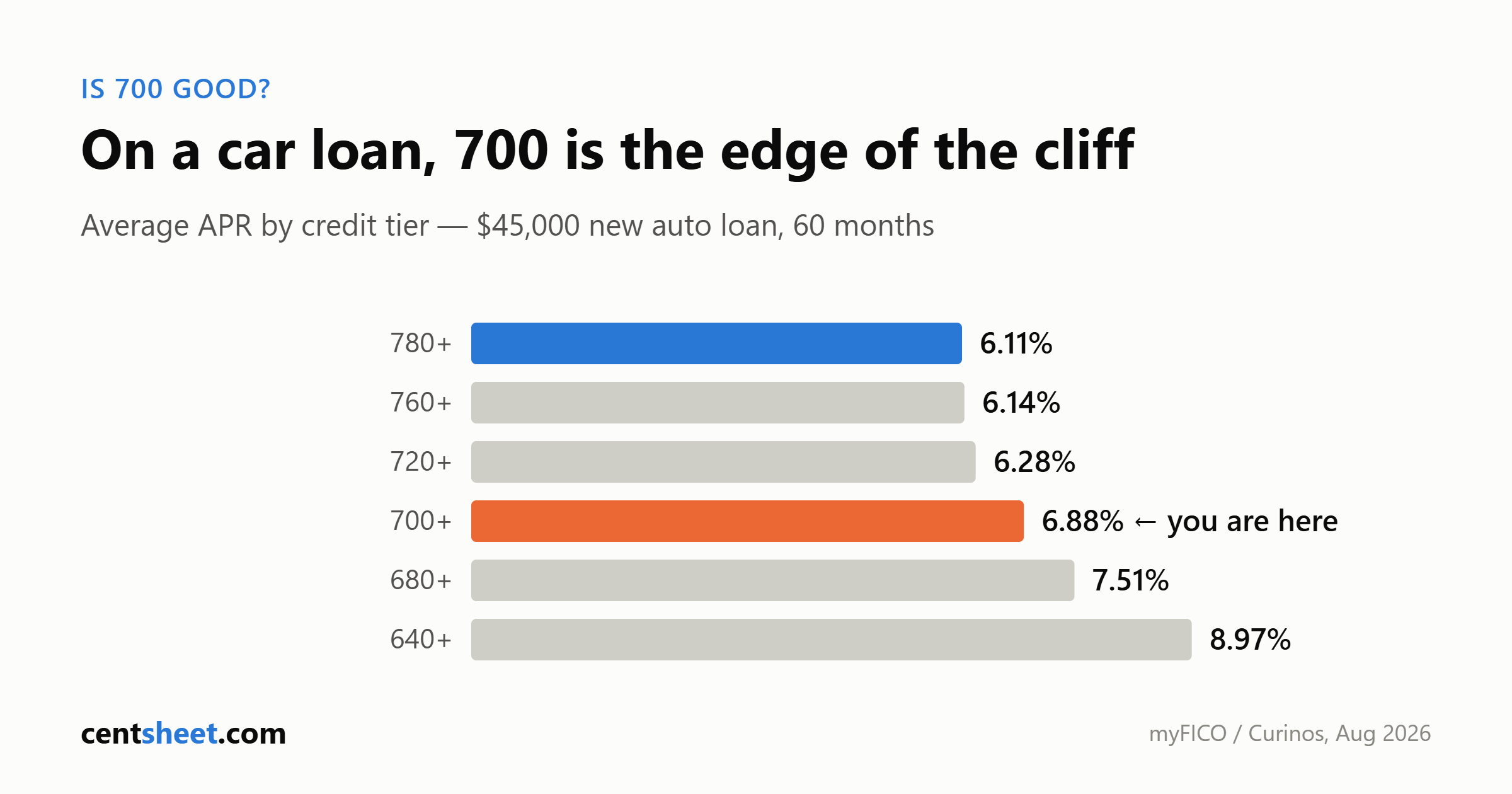
This is the part almost nobody tells you. The same rate tables, for a $45,000 60-month new auto loan:
| Tier | Rate | Monthly | Total interest |
|---|---|---|---|
| 780+ | 6.11% | $872 | $7,337 |
| 760+ | 6.14% | $873 | $7,375 |
| 720+ | 6.28% | $876 | $7,551 |
| 740+ | 6.33% | $877 | $7,614 |
| 700+ | 6.88% | $889 | $8,311 |
| 680+ | 7.51% | $902 | $9,115 |
| 660+ | 8.05% | $914 | $9,811 |
| 640+ | 8.97% | $933 | $11,008 |
The mortgage table has a 0.69-point spread top to bottom. The auto table has nearly 2.9 points. Auto lenders price credit risk far more aggressively than mortgage lenders do, because there is no property to foreclose on and the collateral depreciates.
And 700 sits right on the edge of the steepest part. Dropping from 700 to 680 costs 0.63 points. Rising from 700 to 720 gains 0.60 points — the single largest step anywhere in that table. On a car loan, 700 is one of the most valuable lines in the whole range, in both directions.
One caveat we will not smooth over: the table is not a clean staircase. The 740+ tier prices worse than 720+ (6.33% versus 6.28%). That is survey noise in the underlying rate data, and it is a useful reminder that these are averages of what lenders actually offered, not a formula. Your quote will not land exactly on any of these lines.
What 700 clears easily
For home loans, a 700 is comfortably above every program floor that still exists. FHA’s thresholds are 580 (for 3.5% down) and 500. VA sets no minimum at all. USDA publishes no single hard minimum — its underwriting system evaluates credit holistically rather than against a stated cutoff.
At 700 you are not fighting for approval on any of these. You are negotiating price. That is a genuinely different problem, and it is the one worth spending your energy on — the full breakdown of what each program requires and what each band costs is here.
One thing 700 does not do
It does not set your insurance premium — at least not directly. Credit-based insurance scores are a separate model built to predict claim likelihood, not loan repayment. Your FICO 700 is an input to a different calculation, not the calculation itself.
State law also constrains how insurers may use them. In most states an insurer cannot use a credit-based insurance score as the sole reason to raise your rate or to deny, cancel, or refuse to renew a policy, and several states restrict the practice further or ban it outright for some lines. The NAIC maintains a state-by-state chart; check yours before assuming anything.
So: is it good?
It is good in the plain-English sense — you will get approved for most things, at ordinary prices. It is not good in the sense of “done.”
What 700 really means is that you have cleared every gate and are now paying a middling price. Whether that is worth improving depends entirely on what you are about to borrow:
- Buying a car soon? 700 to 720 is one of the highest-value moves available to you. Do it before you shop.
- Buying a house soon? Skip 720. Aim at 740, then 780 if you have time.
- Not borrowing anything? Then 700 is fine and the marginal points buy you very little. Leave it alone.
- Carrying a balance? The interest you are paying dwarfs any rate benefit a score increase would earn you. Fix that first.
The fastest-moving lever in all three cases is utilization, which updates within a statement cycle or two. But nobody — not us, not FICO, not any site quoting you “+40 points” — can tell you what any single action will do to your specific number. Both major models are proprietary, and both companies say plainly that the effect depends on your entire file.
CentSheet publishes educational content, not personalized financial advice. Rate tiers are survey averages as of the date cited, are not offers, and change frequently.
Get the CentSheet Money Brief
Email me CentSheet weekly: practical money decisions, new calculators, and useful worksheets. Unsubscribe anytime.