The 2026 IRA contribution limit is $7,500, or $8,600 if you are 50 or older. Those numbers are settled. The traditional-versus-Roth choice is not, and it never will be, because it turns on a figure that does not exist yet: your marginal tax rate in the year you take the money out.
One side of this ledger is knowable to the dollar. The other is a forecast about federal tax policy and your own income decades out. Anyone selling a simple rule — Roth always wins when you’re young — is selling that forecast with a confident face on it. A firm that manages money has an administrative reason to prefer one default for everybody. That preference is not a finding about you.
Here is the part that can be pinned down: the 2026 limits, the phase-outs including the trap Congress never indexed, the catch-up rule that starts biting high earners this year, and three tiebreakers we are not going to state as fact because our sources do not cover them.
The mechanical difference
Both account types draw on the same $7,500 for 2026. That is a combined limit across all your traditional and Roth IRAs, not a per-account limit, per IRS Notice 2025-67 as published in Internal Revenue Bulletin 2025-49. The age-50 IRA catch-up rises to $1,100 for 2026 from $1,000 in 2025 — the first increase since SECURE 2.0 made it indexable — which is how the over-50 figure gets to $8,600.
The difference is when the tax lands. A traditional contribution may be deductible in the year you make it, subject to phase-outs keyed to workplace retirement plan coverage. A Roth contribution is not deductible. Tax now, or tax later.
We are not going to model which one wins. No IRS source supports a projection of future tax rates, and a break-even calculation is only as good as the rate you plug into the far end of it. What we can do is price the near end.
What the deduction is worth this year
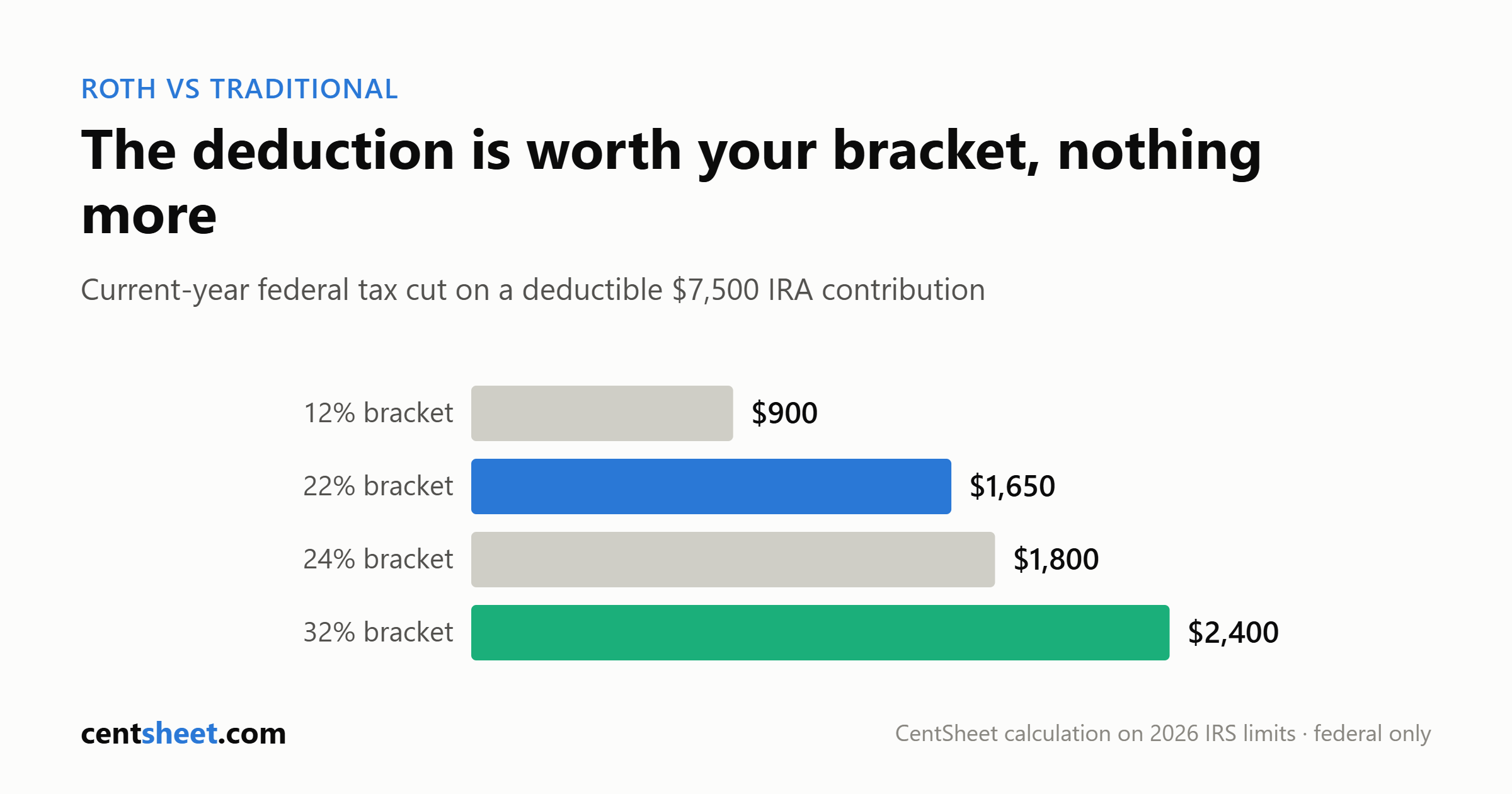
If a traditional contribution is fully deductible, its value in the current year is the contribution multiplied by your marginal rate. That is the half of the comparison that is arithmetic rather than guesswork.
| Marginal federal rate now | Current-year federal tax reduction on a fully deductible $7,500 |
|---|---|
| 12% | $900 |
| 22% | $1,650 |
| 24% | $1,800 |
| 32% | $2,400 |
CentSheet calculation using the 2026 statutory rates. Assumptions: the full $7,500 is deductible, the entire amount falls within a single bracket, and federal income tax only — state treatment of retirement contributions is outside the scope of the IRS sources here. A Roth contribution produces none of this. That is the price of the trade, and the only number in the comparison you can verify today.
Where your marginal rate sits now
Brackets apply to taxable income — after the standard deduction, which for 2026 is $32,200 married filing jointly, $16,100 single or married filing separately, and $24,150 head of household.
| Rate | Single (taxable income over) | Married filing jointly | Head of household |
|---|---|---|---|
| 10% | $0 | $0 | $0 |
| 12% | $12,400 | $24,800 | $17,700 |
| 22% | $50,400 | $100,800 | $67,450 |
| 24% | $105,700 | $211,400 | $105,700 |
| 32% | $201,775 | $403,550 | $201,750 |
| 35% | $256,225 | $512,450 | $256,200 |
| 37% | $640,600 | $768,700 | $640,600 |
Tax year 2026, from Rev. Proc. 2025-32 in IRB 2025-45 and IRS release IR-2025-103, both dated October 9, 2025.
Married filing separately is missing from that table on purpose. We verified only two of its 2026 thresholds from the primary source: the 10% bracket runs up to $12,400 and the 37% bracket starts above $384,350. We are not publishing the middle four, and you should not assume they are half the joint numbers — that shortcut happens to work at the top and is not a rule.
The Roth phase-outs, and the separate-filer trap
Roth eligibility phases out on modified AGI. For 2026:
| Filing status | 2026 Roth phase-out (MAGI) | 2025 |
|---|---|---|
| Single or head of household | $153,000–$168,000 | $150,000–$165,000 |
| Married filing jointly | $242,000–$252,000 | $236,000–$246,000 |
| Married filing separately | $0–$10,000 | $0–$10,000 |
That last row is not a typo. Notice 2025-67 states the applicable amount for married filing separately “is not subject to an annual cost-of-living adjustment and remains $0.” The joint range has climbed with inflation year after year and now sits above a quarter of a million dollars; the separate-filer range has never moved. A married person filing separately with roughly $10,000 or more of modified AGI is phased out of Roth IRA contributions entirely.
Nobody defends this design — it is a number Congress declined to index. If you file separately, for student loan reasons or during a separation or for anything else, check this before you fund a Roth IRA, not after.
Traditional deduction phase-outs are a different set of rules
These apply to the deductibility of a traditional contribution, and every range the IRS published for 2026 is conditioned on someone being covered by a workplace retirement plan.
| Situation, tax year 2026 | MAGI phase-out | 2025 |
|---|---|---|
| Single or head of household, covered by a workplace plan | $81,000–$91,000 | $79,000–$89,000 |
| Married filing jointly, contributing spouse covered | $129,000–$149,000 | $126,000–$146,000 |
| Married filing jointly, you are not covered but your spouse is | $242,000–$252,000 | $236,000–$246,000 |
| Married filing separately, covered | $0–$10,000 | not indexed |
Two warnings. First, the third row is numerically identical to the joint Roth range for 2026. That is a coincidence of this year’s indexing, not a shared rule — one governs whether a traditional contribution is deductible, the other whether a Roth contribution is allowed at all. Second, if neither you nor a spouse is covered by a workplace plan, none of these ranges applies to you; check Publication 590-A rather than assuming.
If the real question is which account to fund first when you also have a workplace plan, that is a different one — see 401(k) vs IRA.
On the backdoor Roth
Readers over the phase-out ask about this constantly, and we are not describing the mechanics here. The ranges above are contribution phase-outs from the 2026 inflation guidance; the workaround turns on conversion rules and the pro-rata treatment of existing pre-tax IRA balances, neither of which this source set covers. The in-plan version turns on whether your employer permits after-tax contributions at all — a legal ceiling is not a guarantee that your plan offers the feature. Get that from Publication 590-A or a preparer looking at your actual balances.
The 2026 Roth catch-up rule for higher earners
This applies to workplace plans rather than IRAs, but it takes the tax-now-or-later decision away from some savers over 50 entirely.
For 2026, the Roth catch-up wage threshold is $150,000, measured against 2025 wages. Notice 2025-67 sets it as the amount “used to determine whether an individual’s catch-up contributions to an applicable employer plan (other than a plan described in section 408(k) or (p)) for 2026 must be designated as Roth contributions.” Three details that secondary coverage routinely mangles:
- It is a prior-year wage test — 2025 FICA wages from the employer sponsoring the plan. Not 2026 wages, not AGI, not household income, and it is measured per employer.
- SEP plans under 408(k) and SIMPLE plans under 408(p) are expressly excluded.
- The rule bites only for plans that have a Roth feature and offer catch-ups. What happens in a plan with no designated Roth account is a separate question we did not verify from a primary source, so we are not describing it.
The relevant catch-up amounts for 2026: $8,000 at age 50 and over, and $11,250 for participants who attain age 60, 61, 62 or 63 during 2026 — unchanged from 2025, and replacing rather than stacking with the $8,000.
The effective date is genuinely contested, and both IRS statements are worth seeing. IRS release IR-2025-91, dated September 15, 2025, says “the provisions in the final regulations relating to the Roth catch-up requirement generally apply to contributions in taxable years beginning after Dec. 31, 2026.” The same release says the Notice 2023-62 administrative transition period “generally ends on Dec. 31, 2025,” and the IRS participant-facing catch-up page, last reviewed May 7, 2026, says that beginning in 2026 affected participants must make catch-up contributions on a Roth basis. Our reading: the statutory requirement is live for 2026 while the detailed regulations bind from 2027, and for 2026 the IRS permits plans to use “a reasonable, good faith interpretation of statutory provisions.” So how this shows up in your payroll deduction this year may differ from one plan to the next. Ask your plan administrator, not the internet.
The Saver’s Credit numbers on the IRS website are two years stale
For 2026, the credit’s AGI ceilings under Notice 2025-67 are $48,500 (50% rate), $52,500 (20%) and $80,500 (10%) for joint filers; $36,375 / $39,375 / $60,375 for heads of household; and $24,250 / $26,250 / $40,250 for everyone else.
When we checked the IRS Saver’s Credit landing page on August 6, 2026, it still displayed a 2024 tax year table — a 50% band topping out at $46,000 joint, $34,500 head of household and $23,000 for others, with full phase-out at $76,500 / $57,375 / $38,250. Those are not 2026 numbers. Use Notice 2025-67, and check Form 8880 for which contribution types qualify — that part we did not verify.
Three tiebreakers we are not going to state as fact
Tax diversification, the absence of required minimum distributions on Roth IRAs, and the flexibility to withdraw contributions are the arguments that show up in every version of this article. They may all be good ones. None is verifiable from the source set behind this piece — the IRS’s 2026 inflation-adjustment guidance and the Roth catch-up regulations are documents about limits, not distributions. We would rather say so than repeat rules we have not read this year. Publications 590-A and 590-B are the primary sources for distribution treatment.
The short version
1. For 2026 you can contribute $7,500 across all your IRAs combined, or $8,600 at 50 or older. The traditional/Roth split is your choice within that one limit. 2. Compute the knowable half. At a 22% marginal rate, a fully deductible $7,500 cuts this year’s federal tax by $1,650 (CentSheet calculation, single-bracket assumption, federal only). Roth gives that up today. 3. Do not let anyone sell you the unknowable half. Your rate in retirement is a forecast, not an input. 4. Check the Roth phase-out for your filing status: $153,000–$168,000 single, $242,000–$252,000 joint, $0–$10,000 married filing separately. 5. Check the traditional deduction phase-outs separately — they are keyed to workplace-plan coverage and are not the same rule. 6. If you are over 50 and earned more than $150,000 in 2025 wages from your plan’s sponsor, expect your workplace catch-up to be Roth this year, and ask the plan how it is implementing. 7. Before either account, make sure this is not money you need soon. An IRA is not an emergency fund, and what you hold inside the wrapper is a separate decision — see index funds for beginners.
CentSheet publishes educational content, not personalized financial advice, and nothing here is tax or legal advice.
Get the CentSheet Money Brief
Email me CentSheet weekly: practical money decisions, new calculators, and useful worksheets. Unsubscribe anytime.