The American Council of Life Insurers, tabulating NAIC regulatory data in its 2025 Fact Book, puts the voluntary termination rate for individual life insurance in the United States at 5.8 percent in 2024, measured by face amount. Of the policies voluntarily terminated, 19 percent were surrendered rather than simply allowed to lapse.
That number matters more than any premium quote. A term policy that lapses stops covering you. A permanent policy that lapses stops covering you and returns less than you paid — sometimes far less, depending on when you quit.
One limit up front: nobody publishes a current permanent-only lapse rate. That 5.8 percent covers all individual life insurance, term included. A universal life study hosted on NAIC’s site — SOA Research Institute and LIMRA, 2015 to 2021, 24 companies, 33.5 million policy exposures, 1.3 million lapse terminations — publishes no headline rate in its free document. Those numbers sit behind a paid package. The two sources measure different products on different bases and cannot be reconciled.
What each product is
The California Department of Insurance guide, revised March 2018, gives term premiums as “Low; but increase w/age” and whole life as “Level.” FINRA and Texas DOI agree.
| Term | Whole life | |
|---|---|---|
| Premium at the start | Low | Higher than term |
| Premium over time | Rises with age or at renewal | Level |
| Cash value | None | Builds over time |
| Policy loans | No | Yes, at the policy’s rate |
| Duration | A fixed period | For life, while premiums are paid |
New York DFS lists among its stated cons of whole life that premiums “substantially exceed those of term policies” and that it “Could be costly if coverage lapses early.”
Where the extra premium goes
California DOI explains the mechanic. The part of the premium not needed to cover the death benefit accumulates with interest as a reserve — the cash value — which helps pay for the policy in later years, when the cost of protection rises above the premium. Level premiums are not magic. They are averaging.
Which is why early cash value is small. Texas DOI says whole life policies usually have little to no cash value in the first few years. The NAIC Buyer’s Guide is more careful: in some cash value policies values are low early and build later, in others they build gradually. There is no universal rule that year one is zero. New York DFS adds that the face amount exceeds the cash value, especially early — surrender and you get the cash value; your beneficiary would have got the face amount.
The VA publishes figures for its VALife whole life product: enrolling at age 50 for $10,000 of coverage builds $4,822 of cash value in 20 years, none of it in the first two, at $32.50 a month locked at that age. CentSheet’s arithmetic, not the VA’s: $32.50 for 240 months is $7,800 paid in against $4,822 of cash value at year 20, assuming every payment made, no loans, no lapse. That gap is not a loss. It bought 20 years of a $10,000 death benefit with no medical underwriting. Cash value is a reserve inside an insurance contract, not a savings account — see what money compounds like and how index funds work. The VALife rate page was last updated 2024-01-17, and the VA sells what it describes.
Surrender charges
California DOI: it is “not a good idea to buy a cash value life insurance policy if you plan to surrender early due to substantial surrender penalties.” Texas DOI warns of the same fee. The SEC’s variable life investor bulletin, dated 2018-10-30, says surrender charges are typically higher in the early years and exist to compensate the insurer for sales expenses — and that swapping policies can trigger a charge on the old one and start a fresh surrender period on the new one.
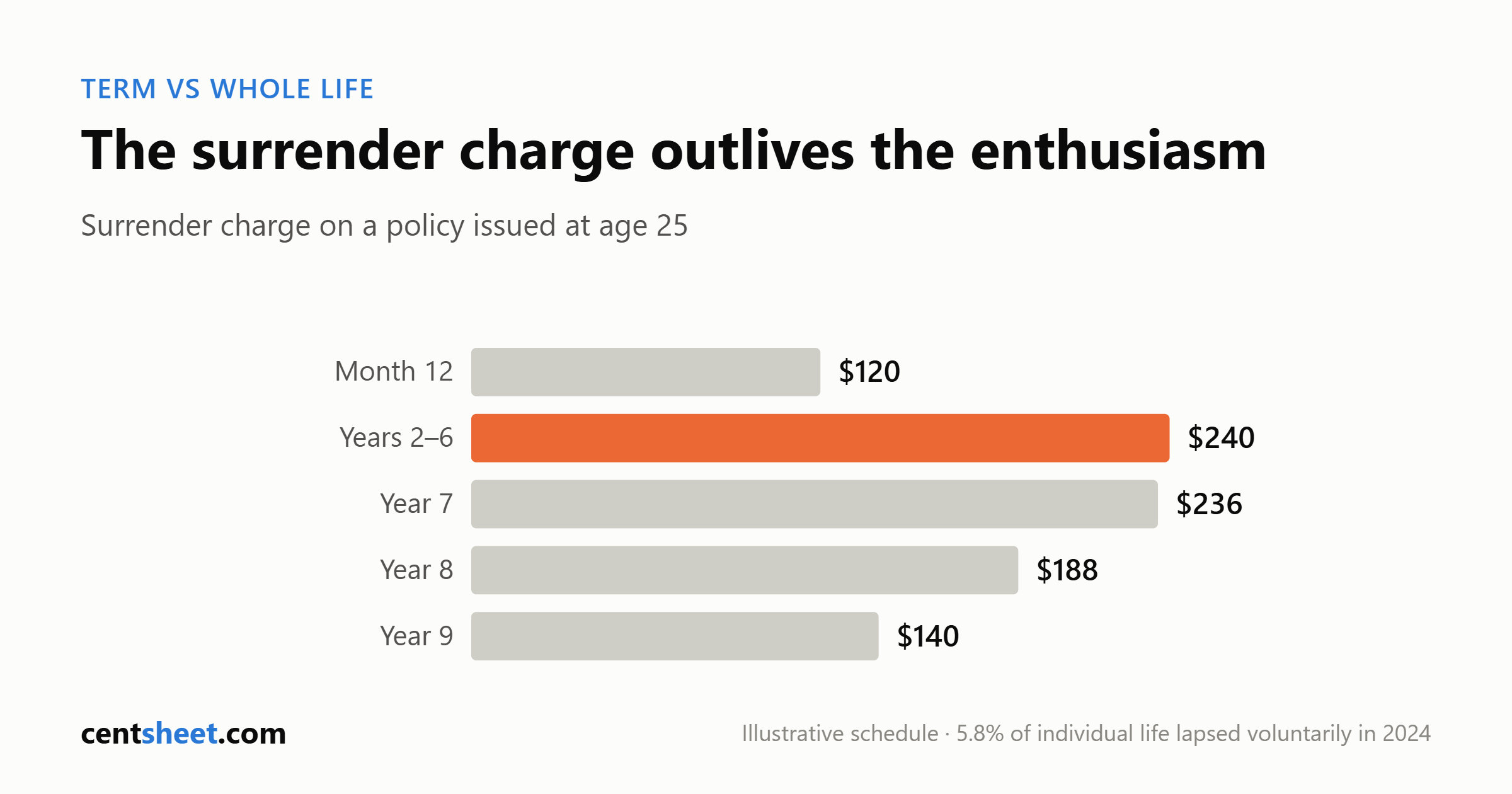
Dollar figures exist only for variable universal life, which is SEC-registered; whole life is not, so no prospectus discloses whole life numbers. The table below is variable universal life, not whole life — from a State Farm prospectus filed 2026-04-30, Appendix B, on $100,000 of initial Basic Amount:
| Point in the policy | Issued at age 25 | Issued at age 50 |
|---|---|---|
| Month 12 | $120.00 | $636.00 |
| Years 2 through 6 | $240.00 | $1,272.00 |
| Year 7 | $236.00 | $1,250.80 |
| Year 8 | $188.00 | $996.40 |
| Year 9 | $140.00 | $742.00 |
| Year 10 | $92.00 | $487.60 |
| Year 11 onward | $0.00 | $0.00 |
The charge plateaus for five full years, runs 10 policy years, and caps at $21 per $1,000 of Basic Amount at ages 70 to 80. That filing — insurer-authored, and interested — also discloses a 5% charge on every premium payment, a mortality and expense risk charge at a current 0.80% of average daily net assets (0.90% guaranteed maximum), and an $8 monthly expense charge.
Stopping payment does not leave you with nothing. NAIC says state laws mandate nonforfeiture benefits on lapse; New York DFS is specific that the insurer must offer either extended term protection or reduced paid-up coverage, its choice which. Loans work against this — the SEC notes they reduce cash value and raise the likelihood of lapse.
Tax treatment
The death benefit rule is the strong one. The IRS states that proceeds received by a beneficiary because of the insured’s death are generally not includable in gross income. Publication 525 (2025 edition, governing tax year 2025 returns) names the carve-outs: the exclusion does not apply in the ordinary way if the policy “was turned over to you for a price or was acquired in a reportable policy sale,” and interest on proceeds is taxable.
Cash value grows untaxed inside the policy, per NAIC. Surrendering changes that. Publication 525: “If you surrender a life insurance policy for cash, you must include in income any proceeds that are more than the cost of the life insurance policy.” Basis is premiums paid less refunded premiums, rebates, dividends and unrepaid loans not already included in your income. The SEC adds that gains inside a policy are taxed at ordinary income rates, not capital gains rates.
Our only source for the rule that policy loans are “not generally considered taxable events” unless the policy lapses with a loan outstanding is that SEC bulletin — no IRS page says it in those terms. Nor could we source from the IRS how modified endowment contract distributions are taxed, so we are not stating that either.
Estate tax is separate. New York DFS: proceeds not typically subject to income taxation “may be subject to federal estate taxation,” and if you own part or all of the policy at death its value can be included in your gross estate. The basic exclusion is $15,000,000 for decedents dying in 2026, up from $13,990,000 for 2025 deaths, and Form 706 is due nine months after death, with an automatic six-month extension on Form 4768.
Who gets paid
California DOI’s guide mentions agent pay exactly once: agents earn a commission on your business. NAIC Model Regulation 580 (2018) bars producers from using titles like “financial planner” or “investment advisor” in a way implying compensation unrelated to sales — a rule that exists because sales-related compensation is the norm.
The only sourceable commission figures are again from that variable universal life filing. Under one of its two alternative distributor schedules, commissions will not exceed 40% of premiums up to the Primary Compensation Premium, and 3.50% thereafter. Where that money comes from is stated outright: “Commissions and other incentives are recouped through fees and charges deducted under the Policy.” The SEC-mandated conflicts section is blunter still: “This financial incentive may influence your investment professional to recommend this Policy over another investment for which the investment professional is not compensated or compensated less.” A separate line flags the same incentive to replace a policy you already own.
Model 580 entitles you, before the insurer accepts your initial premium — or with the policy where it carries a refund right of at least 10 days — to the Buyer’s Guide and to a policy summary showing the annual premium and the guaranteed cash surrender value at each year end for at least the first five policy years. Guaranteed is not illustrated; illustrations are projections, not outcomes.
When permanent coverage has a real job
New York DFS states the test as duration: “Whole life insurance is generally used when the need for life insurance is lifelong, or permanent.” NAIC frames it as cost-effectiveness — term provides lower-cost coverage for a specific period, and for a lifetime, cash value insurance may be more cost effective.
California DOI lists recognized purposes, two of which are inherently permanent: funds to pay estate taxes or other final obligations, and business insurance to compensate a company on the death of a key employee. The others it names have end dates: income replacement, a mortgage, burial expenses. Estate liquidity carries a clock: nine months to file Form 706, against assets that may not be sellable in nine months.
Special-needs planning for a lifelong dependent is the third case usually named, and it fits the DFS duration test. We flag it as our reading, not a sourced claim: the DFS FAQ makes no reference to disabled children or lifelong dependents.
What nobody publishes
- A like-for-like premium multiple. No regulator or primary source we found compares whole life to term for the same insured, face amount and health class; all describe it qualitatively. If you see “whole life costs 10x term,” ask where it came from.
- A whole life commission percentage. The 50%-to-110%-of-first-year-premium figures repeated online could not be verified, and no term commission figure is public at all — term is not SEC-registered. That permanent pays more, because commission is a share of a much larger premium, is reasoning, not a sourced fact.
- The share of policies that never pay a death benefit. The commonly cited 85% to 88% traces to sources we did not verify.
- Whether the insurer keeps the cash value at death. A real feature of many traditional whole life designs, but no regulator source we fetched says so.
On term escalation we can be concrete: the VA’s current VGLI table, effective 2025-07-01, prices $500,000 of coverage at $30.00 a month at ages 29 and under, $95.00 at 45 to 49 and $2,200.00 at 80 and over. A second, still-live VA page serves 2014 rates for the same product with no notice.
The short version
1. Decide how long the need lasts before deciding what covers it. NAIC and New York DFS both frame the choice as duration. 2. Ask for the guaranteed cash surrender value column for the first five years. Model 580 exists so you can see it before paying. 3. Ask what the surrender charge is in each of the first ten years, in dollars, and how long it holds at maximum. Treat a proposed replacement of a policy you own as a red flag. 4. Do not buy permanent coverage you cannot confidently fund indefinitely. Early lapse is the failure mode both New York DFS and California DOI name. 5. Get the cheap coverage in place first. Renters insurance and a funded emergency fund cover likelier events for far less. 6. For estate liquidity, key-employee coverage or a lifelong dependent, involve an attorney.
CentSheet publishes educational content, not personalized financial advice, and nothing here is legal, tax or insurance advice. We do not recommend or rank insurers or policies.
Get the CentSheet Money Brief
Email me CentSheet weekly: practical money decisions, new calculators, and useful worksheets. Unsubscribe anytime.