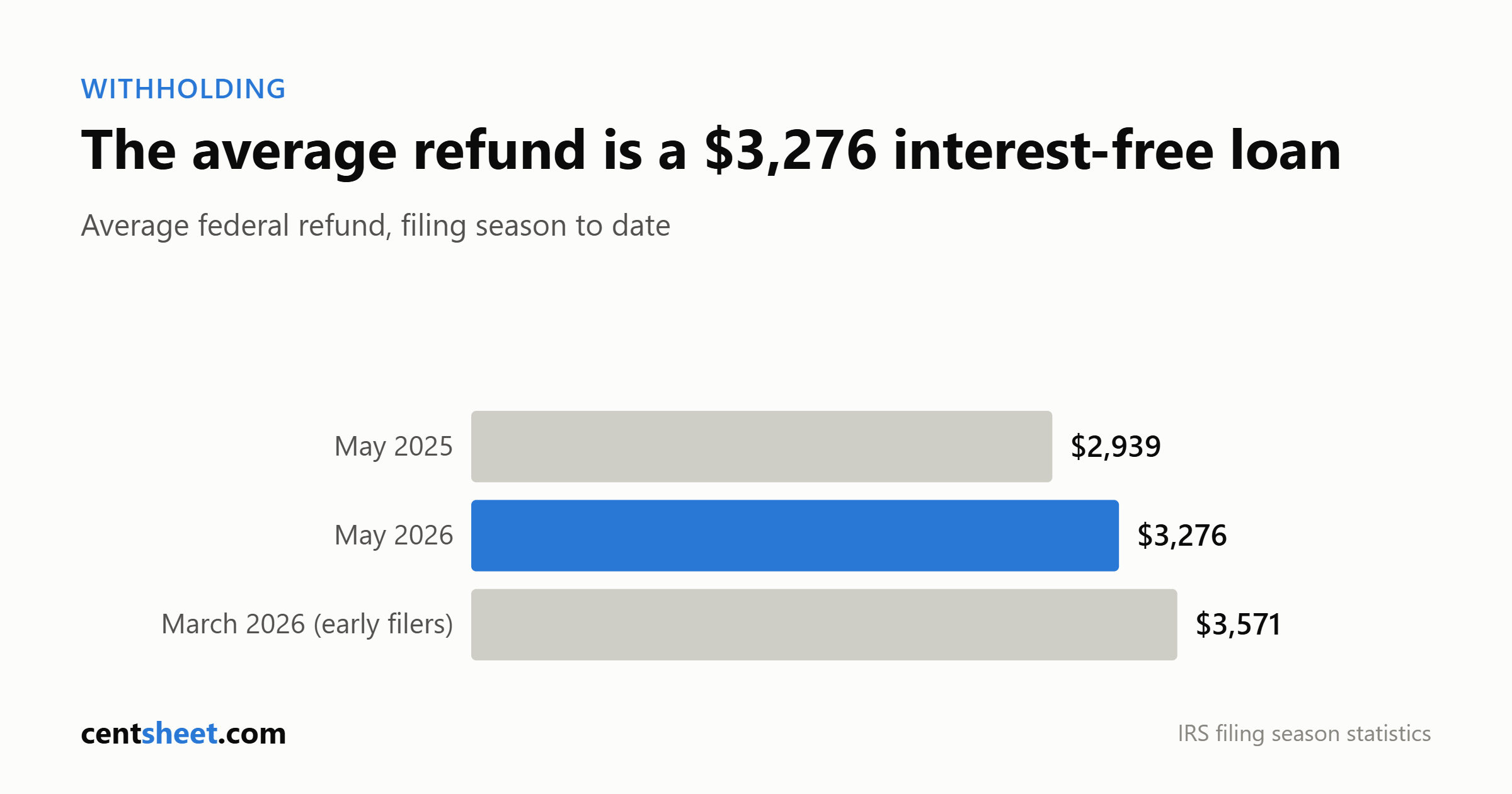
Through the week ending May 8, 2026, the IRS had issued 99,138,000 refunds on tax year 2025 returns, worth $324.757 billion, for an average of $3,276. Those are cumulative season-to-date figures, not final totals — extension filers run to October, and the agency counts only current-year returns received and processed in 2026.
None of that was a payment from the government. It was money already earned and handed over, held until filing season, and returned without adjustment.
That is the case against a big refund, and this magazine holds it — as our editorial position, not the IRS’s. The IRS is deliberately neutral: a 2025 tax tip presents its Estimator as a way to avoid “an unexpectedly large tax bill or a substantial refund,” two symmetrical surprises, and the W-4 FAQ accommodates people who would rather have extra withheld and collect it later.
The average refund moves inside a single season
An average refund quoted without a date is already stale.
| Cumulative through | Refunds issued | Total refunded | Average refund |
|---|---|---|---|
| March 20, 2026 | 56,729,000 | $202.595 billion | $3,571 |
| May 8, 2026 | 99,138,000 | $324.757 billion | $3,276 |
| May 9, 2025 (prior year) | 93,569,000 | $274.979 billion | $2,939 |
Early filers skew toward refunds, lifting the March average and dragging it down as the season fills in. Against the comparable week a year earlier, refund count was up 6.0%, dollars up 18.1%, average up 11.5%. We report those moves without explaining them — 2026 was the first season under P.L. 119-21, and no source we consulted establishes a cause.
One number you will see quoted that does not exist: the share of filers who get a refund. The IRS publishes refunds issued (99,138,000) and returns processed (143,925,000) but no percentage, and the two are not a clean numerator and denominator — the agency footnotes that refunds issued cover current-year returns only.
What the overpayment looks like per paycheck
Our arithmetic, not the IRS’s: a $3,276 refund is $126 per paycheck across 26 biweekly pay periods, or $273 a month. That assumes the overpayment accrued evenly and that a season average resembles your own, which for most readers it will not.
The IRS makes the same connection in the manual it gives employers. Publication 15-T (2026) describes the deductions step as letting an employee “receive more money in each paycheck instead of waiting until filing their income tax return.” For a household running the month on a knife edge, $126 a fortnight on schedule is a different asset from $3,276 in April — an argument strongest for people living close to the paycheck line.
What we cannot tell you is what the overpayment costs. The IRS rate for the third quarter of 2026 is 7% on individual underpayments and 7% on individual overpayments, but we found no IRS source stating that over-withheld money earns you interest. Conflating those two is a common error. The real cost is whatever the money would have done in your hands instead, which is not an IRS rate.
The post-2020 W-4, in the IRS’s own terms
The current revision is the 2026 Form W-4. Allowances are gone — the IRS’s explanation is that allowance values were tied to personal exemptions, which taxpayers can no longer claim under current law. If you filed a W-4 before 2020 and never touched it, you are not out of compliance: “Employees who have furnished Form W-4 in any year before 2020 are not required to furnish a new form merely because of the redesign.” You are, however, running on a form whose assumptions may no longer match your life.
| Where | What it controls | Detail the IRS specifies |
|---|---|---|
| Step 2 | Multiple jobs or a working spouse | Three routes: the Tax Withholding Estimator (the IRS calls it most accurate), the Multiple Jobs Worksheet, or the checkbox — which is for exactly two jobs, must be checked on both W-4s, and splits the standard deduction and brackets between them |
| Step 4(a) | Income not from a job | Optional. The IRS: “You are not required to have tax on non-job income withheld from your paycheck. Instead, you can pay estimated tax on this income using Form 1040-ES” |
| Step 4(b) | Deductions | Reduces the annual wages subject to income tax withholding by the amount entered |
| Step 4(c) | Extra withholding | A flat dollar amount per pay period, covering credits, deductions or outside income without telling your employer why. The escape hatch for anyone the form does not model — including people who want a refund on purpose |
The Step 2 checkbox is the most common source of a surprise bill in dual-income households: checked on one job and not the other, the arithmetic breaks.
Step 4(b) is where the new P.L. 119-21 deductions reach 2026 withholding. Pub 15-T states that for tax years beginning after 2024 and ending before 2029, workers may deduct up to $25,000 of qualified tips — in occupations that customarily and regularly received tips on or before December 31, 2024 — and up to $12,500 of qualified overtime pay ($25,000 married filing jointly). The IRS updated its Estimator in March 2026 (IR-2026-35) for these, the senior deduction, car loan interest, and changes to family credits, homeownership and charitable giving.
That Estimator has limits: about 25 minutes, W-2 employment or a pension or annuity with federal withholding, and no use by nonresidents. The W-4 does not compute self-employment tax — if you have income that varies month to month, Form 1040-ES is the right instrument.
Safe harbor: the floor you cannot fall through
Cutting withholding raises a fair worry: ending up under-withheld and penalized. The rules are public and specific.
| Rule | Threshold | Who it applies to |
|---|---|---|
| De minimis | Owe less than $1,000 after subtracting withholding and refundable credits | Everyone |
| Current-year | 90% of the current year’s tax | Everyone |
| Prior-year | 100% of the tax shown on the prior year’s return | Prior-year AGI at or below $150,000 ($75,000 MFS) |
| Prior-year, higher income | 110% of the prior year’s tax | Prior-year AGI above $150,000 ($75,000 MFS) |
The IRS states the general rule as paying at least 90% of the current year’s tax or 100% of the prior year’s, “whichever is smaller.” Publication 505 puts the higher-income version directly for 2026: if your 2025 AGI exceeded $150,000 ($75,000 if married filing separately), “you must pay the smaller of 90% of your 2026 tax or 110% of your 2025 tax.” The Form 2210 instructions state the identical rule for 2025 against 2024 AGI — one rule applied to two years, not two competing numbers. The threshold is always tested on the prior year’s AGI. Whether it is indexed for inflation, we could not verify.
The penalty is interest, not a flat fine. For the third quarter of 2026 — July 1 through September 30 — the rate on non-corporate underpayments is 7%, set by Rev. Rul. 2026-10 from a federal short-term rate of 4% determined in April 2026, plus three percentage points, compounded daily. It resets quarterly. A caveat on our own reporting: the IRS rate table appears to show different individual underpayment rates earlier in 2026, but we verified only the third-quarter figure against its revenue ruling, so we are not printing the others.
Waivers exist — casualty or disaster, and retirement after age 62 or disability with reasonable cause. Form 2210 figures the penalty. And note the limit: safe harbor prevents the penalty. It says nothing about whether over-withholding was a good idea.
The forced-savings argument, taken seriously
The standard advice — zero out your refund — assumes the money arrives in your account and stays there. For many households that is false, and the advice fails on contact.
An NBER working paper from April 2019 (Gelman, Kariv, Shapiro and Silverman, WP 25757) frames the puzzle exactly: households “tend to spend tax refunds as if they valued liquidity, yet do not act to increase liquidity by reducing their income tax withholding.” The authors answer with a model of rational cash management under income uncertainty, in which low liquidity and a high marginal propensity to consume are tightly linked. That is an alternative to a purely behavioral self-control story, not a refutation of forced savings — and it is a seven-year-old working paper, not current evidence.
How many people over-withhold deliberately, and why? Nobody publishes that number. We looked.
A related strand: the CFPB ran a field experiment with H&R Block in 2019 on encouraging filers to save part of their refund, with particular interest in Earned Income Tax Credit recipients. That studies whether the refund becomes savings once it exists — not whether over-withholding is a good strategy. Neither the CFPB nor the IRS says it is.
Where the standard advice is straightforwardly wrong
If your refund is largely refundable credits — the EITC, or the refundable portion of the child credit — it is not an overpayment at all. It is how a benefit gets delivered. You cannot withhold your way out of it. Tuning your W-4 there solves a problem you do not have.
What matters instead is timing, and that rule is statutory. The IRS: “By law, we can’t issue EITC or ACTC refunds before mid-February,” and “This includes your entire refund, not just the part that’s related to the credit you claimed on your tax return.” For the 2026 filing season the IRS told filers claiming those credits to expect their refund by March 2 if they filed online, chose direct deposit and had no issues with the return. That date is republished each year; only the mid-February floor is durable.
The second case is narrower but common: households for whom the lump sum is the only moment in the year when meaningful cash exists in one place. If $273 a month reliably disappears, and $3,276 in April becomes the emergency fund or clears a debt, the refund is doing work the paycheck version would not. The honest response is not to moralize but to ask whether an automatic transfer produces the same result — and to change tack if it does not.
What to actually do
1. Check withholding every January, per IRS guidance, and again after a job change, marriage or divorce, a birth or adoption, or an income change. 2. Run the Estimator rather than guessing — about 25 minutes, and it does not cover nonresidents or self-employment tax. 3. If two people in the household work and you used the Step 2 checkbox, confirm it is checked on both W-4s. 4. Work out which safe harbor applies before cutting withholding: 90% of the current year, or 100% of last year’s tax — 110% if prior-year AGI was over $150,000 ($75,000 married filing separately). Owing under $1,000 after withholding and refundable credits avoids the penalty anyway. 5. Use Step 4(c) in either direction. The IRS built it for people who deliberately want more withheld. Wanting a refund is a legitimate use of the form. 6. Decide where the extra money goes before you cut withholding, and automate it that day. Put the target in the savings goal calculator and set the transfer to land on payday. If the money will not survive contact with the month, the larger refund is the better outcome, and there is no shame in that.
The rule “never give the government an interest-free loan” is repeated so often it has stopped being examined. It is true as arithmetic and wrong as advice for a meaningful share of households — and it costs nothing to repeat, because nobody repeating it lives with the outcome.
CentSheet publishes educational content, not personalized financial advice, and nothing here is tax or legal advice.
Get the CentSheet Money Brief
Email me CentSheet weekly: practical money decisions, new calculators, and useful worksheets. Unsubscribe anytime.