Every budgeting method assumes a number you don’t have: a predictable monthly income. For freelancers, commission earners, tipped workers, seasonal trades and anyone on variable hours, the standard advice quietly breaks.
The fix is a single change of input.
Budget the floor, not the average
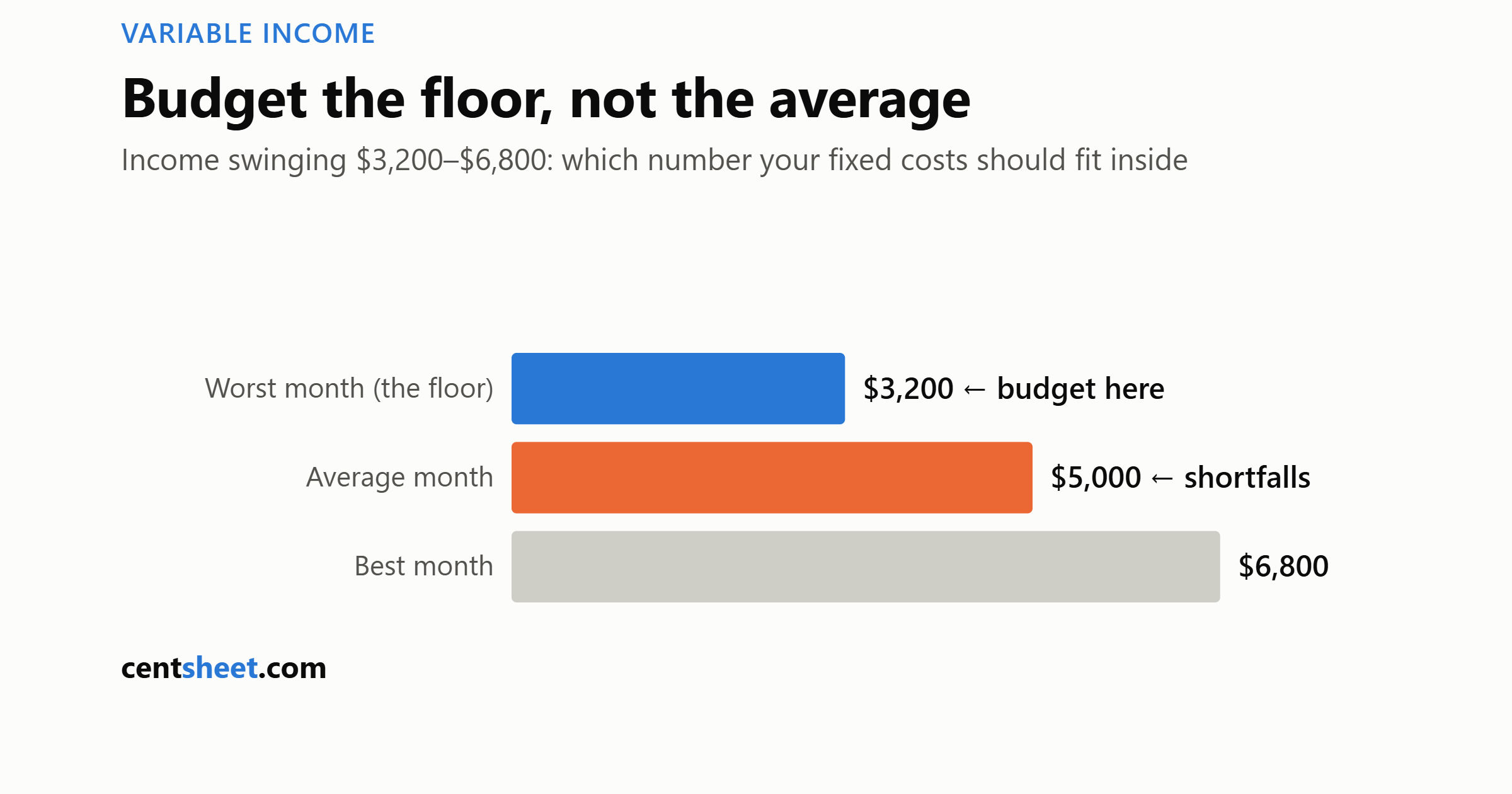
Say your income over the past year ranged from $3,200 in the worst month to $6,800 in the best, averaging $5,000.
Budgeting on $5,000 feels reasonable and fails predictably: every month below average produces a shortfall, and those shortfalls go on credit or eat savings. You end the year having earned $60,000 and borrowed anyway.
Budgeting on the floor — $3,200 — inverts it. Your fixed commitments fit inside your worst month, so no month is a crisis. Everything above the floor, up to $3,600 in a good month, arrives as surplus with a job to do.
The psychological trade is real: it means living, structurally, like you earn less than you do. What you buy with that is never having a bad month.
Set the floor honestly
Use the lowest month in the last 12 — not the lowest you can imagine coping with. If you have less than a year of history, use the lowest you’ve seen and revise as data accumulates. If your work is seasonal with a genuinely dead quarter, that quarter is your floor.
Then check that your survival expenses actually fit inside it. If they don’t, that’s the finding, and it’s a structural one: the fixed costs are too high for this income pattern, and the fix is lowering the fixed costs — not budgeting harder.
Where the surplus goes
Decide the order before the good month arrives, because a surplus with no assigned job becomes lifestyle:
1. Fill the income-smoothing buffer first. This is the variable-income equivalent of the half-month buffer, except it needs to be bigger — enough to cover the gap between the floor and a normal month, for several months. This is the account that makes the floor budget work. 2. Then the emergency fund, sized at the upper end of the range — self-employment sits in the 9–12 month band precisely because income falls gradually rather than stopping cleanly. 3. Then tax. If you’re self-employed, a fixed percentage of every payment goes to a separate tax account the moment it lands. Not monthly, not quarterly — immediately. Money that has been in your checking account for six weeks does not feel like the government’s. 4. Then debt and long-term saving.
Pay yourself a salary
The advanced version, and the one most self-employed people eventually adopt: income lands in a business or holding account, and you transfer a fixed amount to your personal account on a fixed date, like a paycheck.
The buffer absorbs the variance so your household budget sees a steady number. Every budgeting tool on this site — 50/30/20, zero-based, sinking funds — then works normally, because you’ve manufactured the predictable income they assume.
Raise your salary when the buffer is comfortably full and the floor has genuinely risen. Not when one good quarter happens.
The honest caveat
This all assumes the floor clears your survival expenses. Where income is both variable and insufficient, no budgeting structure fixes it — and the leverage is on the income side or the fixed-cost side, as the 50/30/20 stress test describes. Budgeting technique is a tool for managing money you have; it is not a substitute for enough of it.
CentSheet publishes educational content, not personalized financial advice. Tax handling for self-employment varies by jurisdiction and situation; consult a tax professional.
Get the CentSheet Money Brief
Email me CentSheet weekly: practical money decisions, new calculators, and useful worksheets. Unsubscribe anytime.