Zero-based budgeting has one rule: income minus everything equals zero. Before the month starts, every dollar you expect to receive gets assigned a job — rent, groceries, debt, savings, fun — until nothing is left unassigned. Not spent. Assigned.
It is the most effective budgeting method we know of. It is also the one people quit fastest. Both facts matter, and most articles only tell you one of them.
The idea in one table
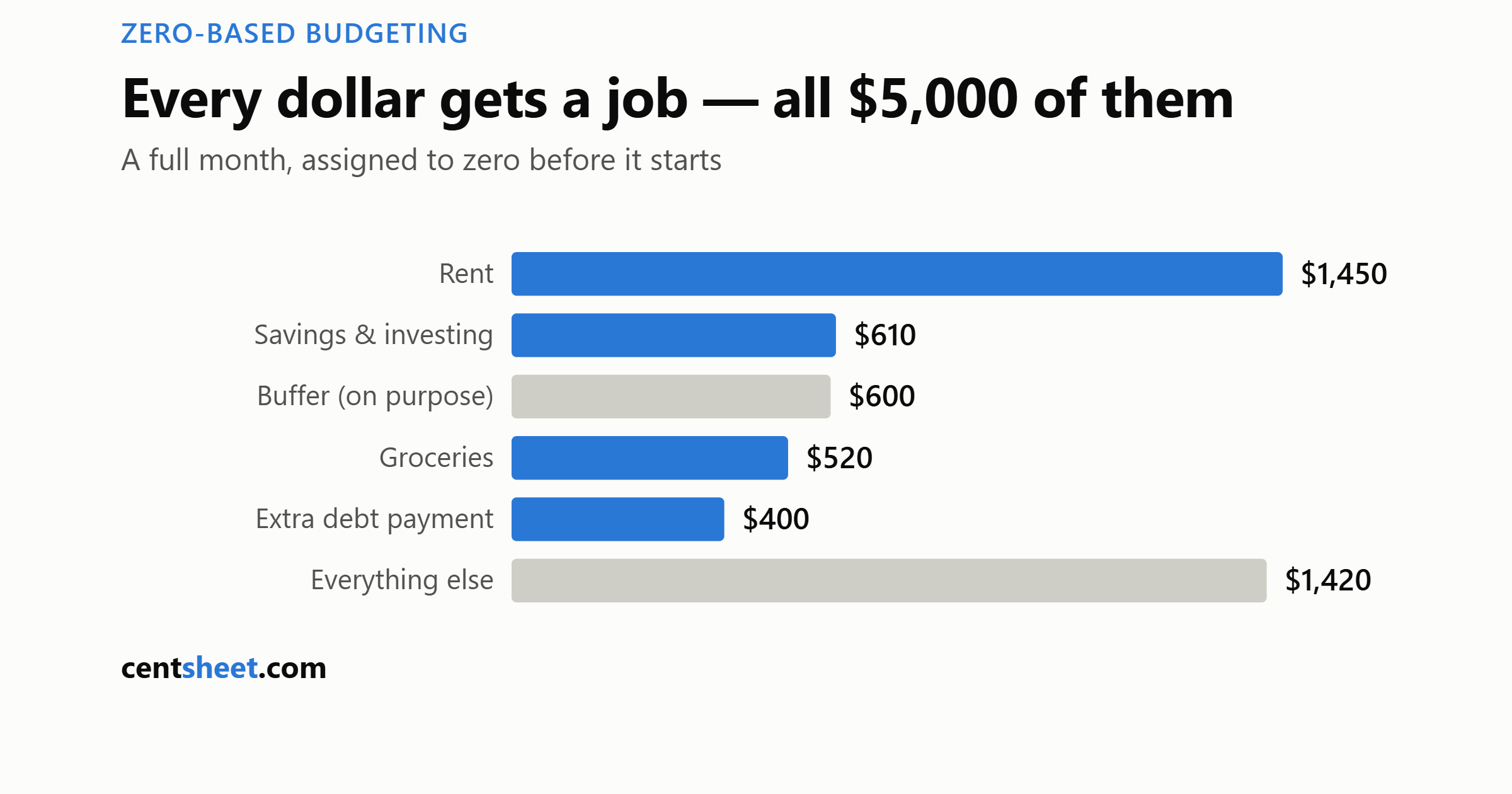
Take-home pay of $5,000/month, fully allocated before day one:
| Job | Assigned |
|---|---|
| Rent | $1,450 |
| Utilities & internet | $320 |
| Groceries | $520 |
| Transport | $260 |
| Insurance | $180 |
| Subscriptions | $140 |
| Debt payments beyond minimums | $400 |
| Sinking funds (car, holidays, repairs) | $300 |
| Savings & investing | $610 |
| Dining & fun | $220 |
| Buffer / unassigned-on-purpose | $600 |
| Total | $5,000 |
The last line is the whole method. When the total must hit exactly $5,000, every additional dollar to one category is visibly a dollar taken from another. Trade-offs stop being abstract — that’s the mechanism that makes this work where percentage rules stay vague.
Why it works when it works
It converts “can I afford this?” into a factual question. Under zero-based budgeting the answer is whatever the category says. If Dining shows $40 left, the question isn’t philosophical.
It finds leaks percentage budgets can’t see. A 50/30/20 budget can be “on target” while $200/month dribbles away across a dozen small wants. Zero-based forces each dribble to have a name.
It handles irregular expenses natively. The sinking-funds row isn’t an add-on; assigning ahead is the entire worldview.
The buffer line is legal. Assigning $600 to “unassigned, on purpose” is a valid job. Beginners skip this and then treat the first surprise as proof the method failed. The buffer is a category.
Why people quit
Honesty section. Zero-based budgeting fails in practice for three predictable reasons:
The maintenance cost is real. This is not a set-and-forget system. Transactions need categorizing and categories need adjusting — call it 15–30 minutes a week once you’re fluent, more at first. That’s cheap for what it buys, but it is not zero, and pretending otherwise is how people end up feeling like failures in week three.
Perfectionism kills it. The month never goes to plan. Zero-based budgeting’s actual skill is reassigning mid-month — moving $60 from Dining to cover the pharmacy trip — without treating it as defeat. People who need the plan to survive contact with reality quit by month two.
Couples need buy-in, not compliance. One partner running a zero-based budget the other merely tolerates produces resentment with a spreadsheet attached.
Who should actually use it
Strong fit: variable or tight income where every dollar’s job matters; anyone escaping paycheck-to-paycheck; anyone whose 50/30/20 diagnostic showed a wants-leak they can’t locate; detail-tolerant people who like closed systems.
Poor fit: high savings rate already on autopilot and no leaks — a simple automated split beats the overhead. Honestly: if you save 30%+ automatically and bills are handled, zero-based budgeting buys you little beyond precision you don’t need.
The middle path most people land on: zero-based for two or three months as a diagnostic deep-clean, then relax back to an automated system with the insights kept. That’s not quitting; that’s using the tool for what it’s best at.
Tooling, briefly
You don’t need software — a spreadsheet works, and the discipline matters more than the app. Purpose-built tools (the YNAB school of apps) automate the mechanics and sync couples; their cost is real money and their method opinions are strong. Start with a spreadsheet for one month before paying anyone. If the habit sticks on paper, an app makes it easier; no app makes it exist.
Bottom line
Zero-based budgeting is the power tool of personal budgeting: highest control, highest effort, genuinely transformative for the situations that need it, overkill for the ones that don’t. Run it for ninety days before you judge it — and if you keep only the sinking funds and the leak-findings, you still come out ahead.
CentSheet publishes educational content, not personalized financial advice.
Get the CentSheet Money Brief
Email me CentSheet weekly: practical money decisions, new calculators, and useful worksheets. Unsubscribe anytime.