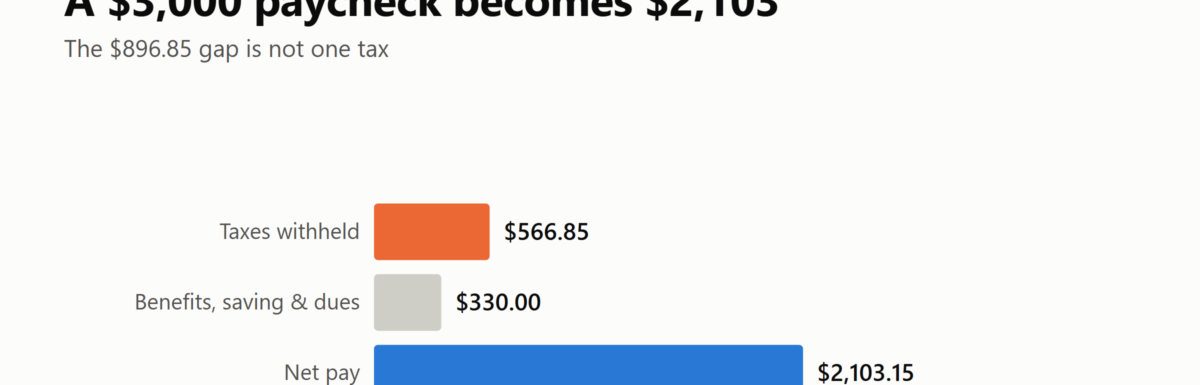
Gross pay is what you earned before payroll takes anything out. Net pay is what reaches your bank account after taxes, benefits, retirement contributions, and other deductions. The gap is not one tax. It is a stack of lines that do different jobs and sometimes use different versions of “wages.”
Consider a hypothetical employee earning $78,000 a year on a biweekly schedule. Gross pay is exactly $3,000 per paycheck: $78,000 divided by 26. In the worked pay stub below, the deposit is $2,103.15. That does not mean the employee has a 29.9% tax rate. Only $566.85 of the $896.85 gap is tax withholding; the other $330 is money directed to retirement, health coverage, and dues.
That distinction is the point of reading a pay stub line by line.
The paycheck bridge
Every ordinary pay statement can be reconciled with one equation:
Gross pay − employee taxes − employee deductions = net pay
The labels vary by payroll provider, but the roles do not.
| Pay-stub layer | What it means | Does it reach checking? |
|---|---|---|
| Gross pay | Earnings for this pay period before deductions | No—not yet |
| Pretax deductions | Benefits or contributions that reduce at least one tax base | No |
| Taxes withheld | Payroll taxes plus estimated federal, state, or local income tax | No |
| Post-tax deductions | Amounts taken after the relevant taxes are calculated | No |
| Net pay | The remainder after every employee deduction | Yes |
Employer-paid costs do not belong in this subtraction. An employer retirement match, the employer's share of health coverage, and the employer's share of payroll tax may appear elsewhere on the statement, but they are not amounts taken from the employee's gross pay.
Convert annual salary to one pay period
An annual salary is not divided by 12 unless the employee is paid monthly. Use the actual number of pay periods:
| Schedule | Gross pay per check | Checks per year |
|---|---|---|
| Weekly | Annual salary ÷ 52 | 52 |
| Biweekly | Annual salary ÷ 26 | 26 |
| Semimonthly | Annual salary ÷ 24 | 24 |
| Monthly | Annual salary ÷ 12 | 12 |
Biweekly and semimonthly are not interchangeable. A biweekly employee usually receives 26 checks, including two months with a third check. A semimonthly employee receives 24 checks, normally two each month. At the same $78,000 salary, that is $3,000 biweekly versus $3,250 semimonthly.
For an hourly worker, start with the hours actually paid. Forty hours at $24 is $960 of regular gross pay. Covered, nonexempt employees generally earn at least one and one-half times their regular rate after 40 hours in a workweek under the Department of Labor's overtime rule, but exemptions, state rules, bonuses, and the definition of the regular rate can change the calculation. Do not infer overtime entitlement from the word “salary” or from a pay-stub layout.
Gross wages can split into three tax bases
The most confusing part of a pay statement is that “gross” may be followed by federal taxable wages, Social Security wages, and Medicare wages—and the three need not match.
For wages paid in 2026, IRS Publication 15 states that employees generally pay:
- 6.2% Social Security tax on Social Security wages up to the annual wage base.
- 1.45% Medicare tax on Medicare wages, with no annual wage cap.
- An additional 0.9% Medicare tax withholding after one employer pays an employee more than $200,000 in a calendar year. That withholding trigger is not the same as the employee's final joint-return tax threshold.
The Social Security Administration's 2026 table sets the 2026 Social Security wage base at $184,500. Once one employer has paid wages above that amount in 2026, that employer stops the employee's 6.2% Social Security withholding for the rest of the year. Medicare withholding continues.
Federal income tax withholding is different. It is a prepayment toward the employee's eventual income-tax bill, calculated from wages, payroll period, and Form W-4 inputs under IRS Publication 15-T. It is not the employee's final effective tax rate, and one unusually large check can have unusually large withholding without proving that the extra earnings are taxed at that same percentage when the return is filed.
“Pretax” does not always mean pretax for everything
A deduction can reduce federal income-tax wages while remaining subject to Social Security and Medicare tax.
Traditional 401(k) salary deferrals are the clean example. The IRS retirement-plan withholding table says an employee's pretax deferral is excluded from current federal income-tax withholding but remains included in Social Security and Medicare wages. A designated Roth contribution is included in all three bases.
Health, dental, flexible-spending, commuter, and other benefit deductions can receive different treatment depending on the benefit and the employer's plan. A label saying “pre-tax” is not enough to reconstruct the payroll calculation. Compare the federal, Social Security, and Medicare wage boxes on the pay statement, then check the plan document or payroll department.
This is also why gross pay minus “all pretax deductions” is not a reliable shortcut for calculating FICA. Each deduction must be assigned to the bases it actually reduces.
A worked $3,000 pay stub
This is a CentSheet illustration, not a market average or tax estimate. Assumptions: $78,000 annual salary, 26 equal checks, no overtime, and the employee remains below the 2026 Social Security wage base. The hypothetical employer treats the $100 health deduction as excluded from federal income-tax, Social Security, and Medicare wages. The $150 traditional 401(k) deferral reduces federal taxable wages but not Social Security or Medicare wages. Actual plan treatment controls.
| Line | Calculation | Amount |
|---|---|---|
| Gross pay | $78,000 ÷ 26 | $3,000.00 |
| Traditional 401(k) | 5% × $3,000 | −$150.00 |
| Health-plan deduction | Hypothetical plan amount | −$100.00 |
| Roth 401(k) | 2% × $3,000 | −$60.00 |
| Federal income-tax withholding | Hypothetical W-4 result | −$240.00 |
| State income-tax withholding | Hypothetical pay-stub input | −$105.00 |
| Social Security tax | 6.2% × $2,900 | −$179.80 |
| Medicare tax | 1.45% × $2,900 | −$42.05 |
| Post-tax dues | Hypothetical deduction | −$20.00 |
| Net pay | Gross minus every line above | $2,103.15 |
The separate tax bases are:
- Federal income-tax wages: $3,000 − $150 traditional 401(k) − $100 health = $2,750.
- Social Security and Medicare wages: $3,000 − $100 health = $2,900.
- Net pay: $3,000 − $896.85 of taxes and deductions = $2,103.15.
The $60 Roth contribution reduces the deposit but not current taxable wages. The $150 traditional contribution reduces current federal taxable wages but still attracts payroll tax. Neither contribution vanished; both moved from checking to retirement savings.
Bonuses and overtime make withholding look stranger
A larger gross check can produce a much larger withholding line. Payroll systems may treat separately identified bonuses, commissions, overtime, and other supplemental wages under special federal withholding methods described in Publication 15. State treatment can differ.
Two cautions follow:
- A withholding percentage on one bonus check is not automatically the marginal tax rate that will apply to the bonus on the tax return.
- A tax deduction for qualifying overtime on a federal return does not make the overtime exempt from payroll tax. The 2026 IRS withholding guidance says overtime compensation generally remains subject to the employee and employer shares of Social Security and Medicare tax.
If the check varies because hours, tips, commissions, or bonuses vary, use several statements rather than annualizing the largest one. That same smoothing principle drives budgeting with variable income.
Budget from net pay, but audit gross pay
Gross pay is the right number for comparing compensation and for calculations such as a lender's debt-to-income ratio. Net pay is the number available for this month's rent, food, transfers, and debt payments.
For a biweekly worker, do not estimate monthly take-home as one check times two. The worked example produces $2,103.15 × 26 ÷ 12 = $4,556.83 average monthly net pay, a CentSheet calculation. Multiplying by two gives $4,206.30 and silently ignores the two extra checks each year.
For a conservative monthly plan, it can still make sense to build the monthly budget around two checks and assign the two extra checks to irregular expenses or goals. The point is to make that choice deliberately rather than confuse a biweekly schedule with a 24-check year.
Changes to deductions also deserve separate treatment:
- A higher retirement contribution lowers spendable net pay but raises saving; it is not a spending increase.
- A withholding change moves the timing of tax payments and may change the refund or balance due; it does not change gross earnings. The tax-withholding guide owns that decision.
- An employer benefit or match shown outside the deduction column is part of compensation but not current cash flow.
What to actually do
- Confirm the pay period. Count 52, 26, 24, or 12 checks before converting an annual salary.
- Reconcile gross earnings first. Check hours, rate, salary allocation, overtime, commissions, paid leave, and retroactive pay before looking at taxes.
- Group every subtraction. Mark each line as tax, pretax benefit, retirement saving, or post-tax deduction.
- Compare the tax bases. If federal, Social Security, and Medicare wages differ, identify exactly which benefit created each difference.
- Keep employer-paid amounts out of the subtraction. A match or employer premium contribution can add to compensation without reducing net pay.
- Recompute the deposit. Gross pay minus every employee tax and deduction should equal net pay, allowing only for rounding.
- Use the actual deposit for the spending plan. If two checks barely cover the month, the paycheck-to-paycheck exit plan shows how to build timing room without pretending gross salary is spendable.
- Ask payroll promptly about a mismatch. Keep the pay statement, time record, benefit election, and prior statement so the question is specific.
Gross pay tells you what the employer paid for your work. Net pay tells you what the current payroll setup released to you. The bridge between them is where taxes, insurance, and saving decisions live—and once every line has a category, the deposit stops being a mystery.
CentSheet publishes educational content, not personalized financial advice. This article is not tax or legal advice. Payroll and benefit treatment depends on current law, your location, and your employer's plan documents; verify disputed amounts with payroll or a qualified professional.
Get the CentSheet Money Brief
Email me CentSheet weekly: practical money decisions, new calculators, and useful worksheets. Unsubscribe anytime.