Banks pay real money for new customers — commonly $200–500 for opening a checking account and meeting a few requirements. Most people ignore these offers on instinct: it sounds like a gimmick, and gimmicks in finance usually cost you.
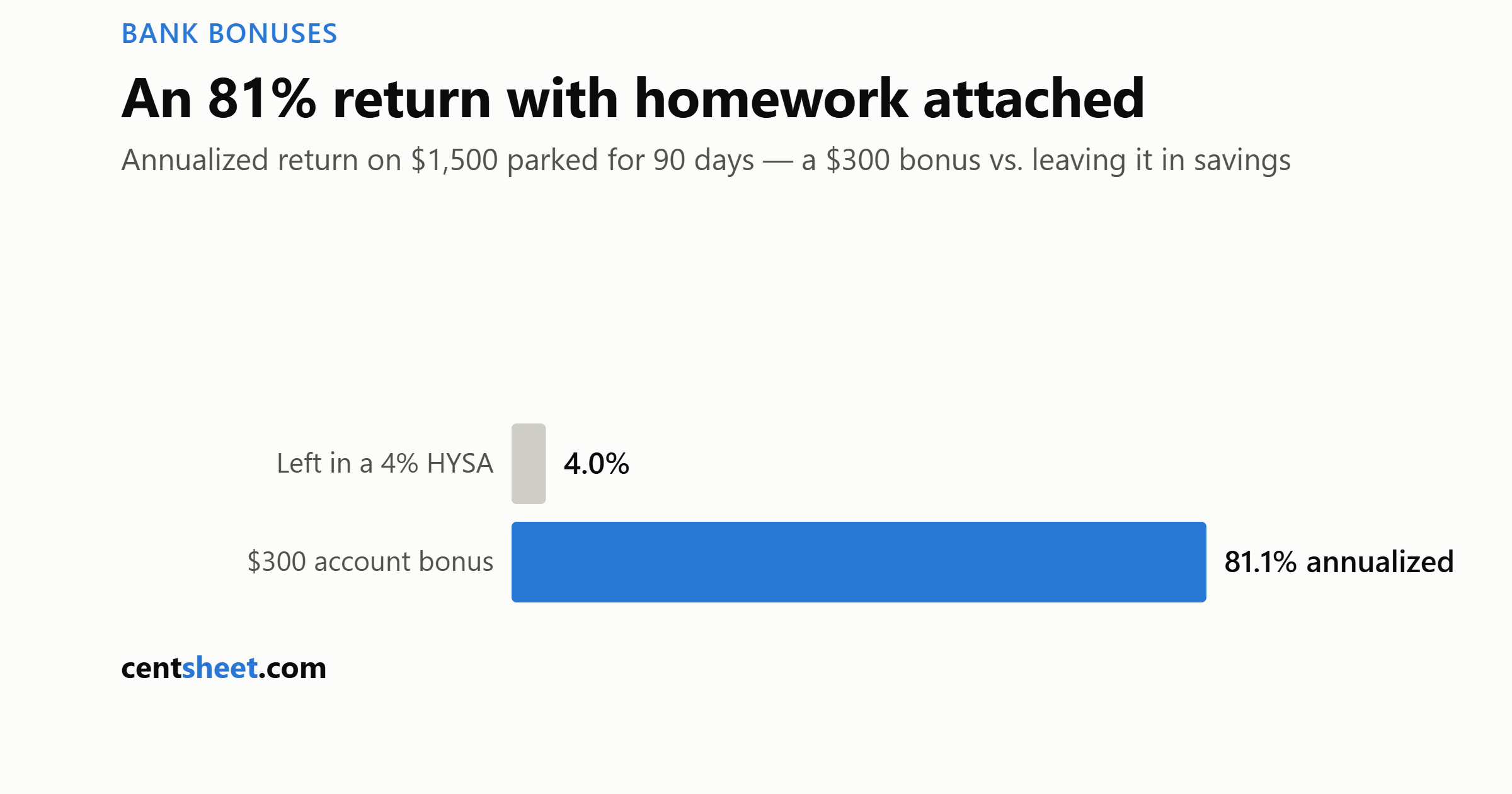
This one mostly doesn’t. Run the number: a $300 bonus for keeping $1,500 in a new account for 90 days works out to an 81% annualized return on that money. No legitimate investment touches that. The catch isn’t hidden fees — it’s homework, and whether you’ll actually do it.
How the offers actually work
The standard shape: open the account, complete a qualifying activity, receive the bonus within some window. Qualifying activities are usually one of:
- Direct deposit of a minimum amount (the most common gate — often $500–2,000 within 60–90 days)
- Minimum balance held for a set period
- A number of debit transactions in the first months
Every offer has fine print that matters more than the headline: the qualifying window, the monthly maintenance fee and how to waive it, how long the account must stay open (closing early often claws back the bonus), and whether recent customers are excluded.
The three real catches
1. The bonus is taxable. Bank bonuses are interest income — expect a 1099-INT and give up your marginal tax rate’s worth. A $300 bonus at a 24% bracket nets $228. Still excellent; just not the sticker number.
2. Direct-deposit requirements assume flexibility you may not have. If your employer’s payroll makes splitting or redirecting deposits a hassle, the “easy” bonus becomes a two-month administrative project. Some payroll systems make this trivial; know yours before you commit.
3. The fee can eat the bonus. A $12/month maintenance fee on an account you keep for the required six months is $72 gone. Always identify the fee-waiver condition (usually a balance floor or direct deposit) and confirm you’ll meet it every month.
Churning, and why we’d pump the brakes
Doing this once or twice for banks you might genuinely use is straightforward money. Doing it systematically — “churning” — is a real hobby with real complications: banks track serial bonus-takers, some report account-opening activity to ChexSystems, and a trail of opened-and-closed accounts can complicate things when you later want a relationship product like a mortgage. The money is real, but past two or three offers a year you’re running a part-time job with paperwork.
There’s also a compatibility question with credit-building: bank deposit accounts don’t touch your credit report, but some banks run credit inquiries for overdraft lines attached to checking. Decline those.
A sane approach
1. Pick offers from banks you’d plausibly keep — an account you’d have opened anyway makes the bonus pure upside. 2. Read the fee-waiver and early-closure terms before anything else. 3. Calendar the qualifying deadline and the minimum-open-period date. 4. Route the bonus somewhere deliberate — a sinking fund or your emergency fund — because found money that lands in checking evaporates. 5. Stop while it’s still easy. Two good offers a year, done cleanly, beats six done sloppily.
CentSheet publishes educational content, not personalized financial advice. Offer terms change constantly; the current terms page is the only version that counts.
Get the CentSheet Money Brief
Email me CentSheet weekly: practical money decisions, new calculators, and useful worksheets. Unsubscribe anytime.