The case for a CD is the locked rate. The case against is the lock itself — break one early and the penalty can eat the advantage. The ladder is the standard trick for keeping most of the first without all of the second, and it takes fifteen minutes to set up.
The mechanic
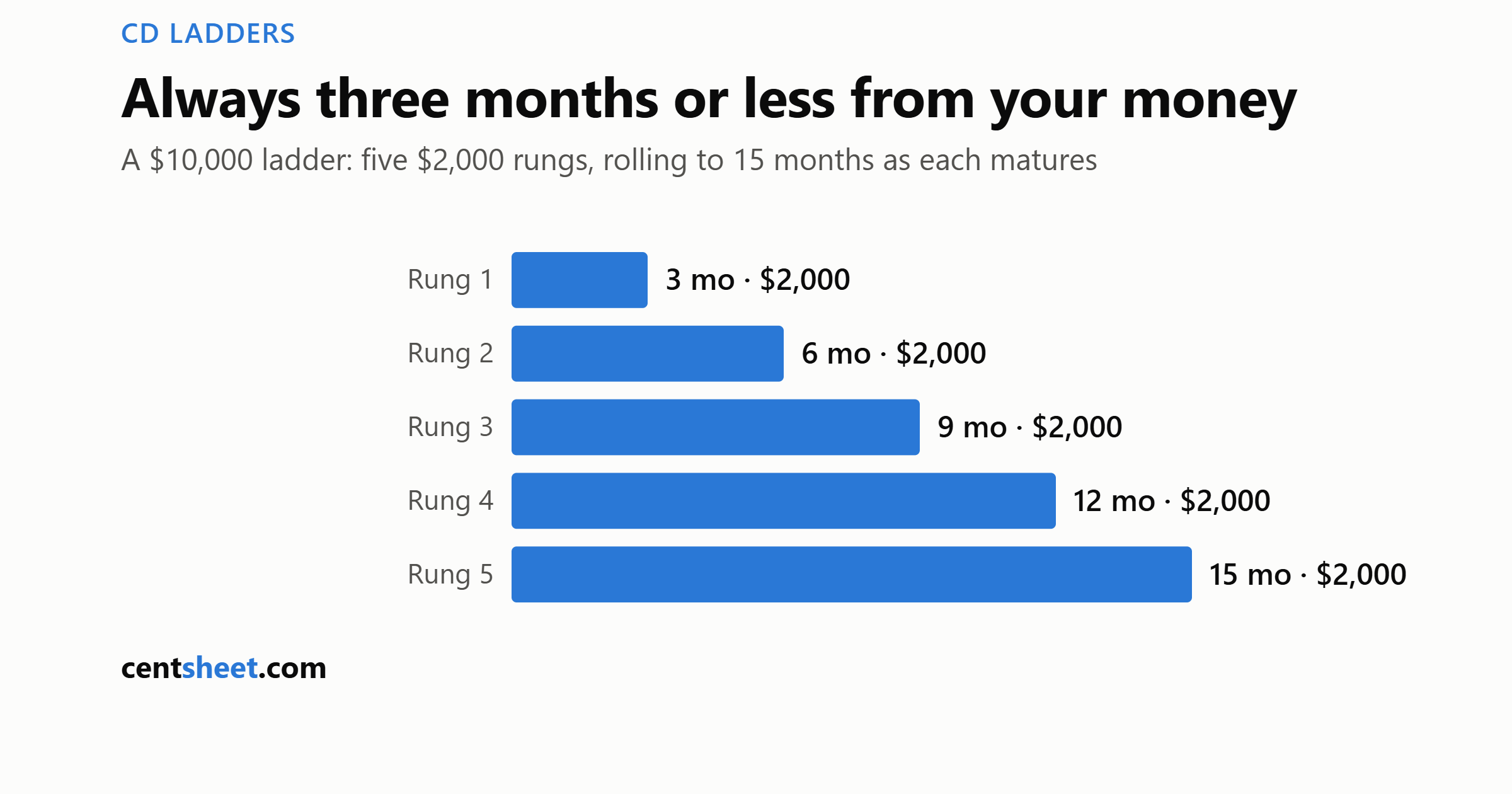
Split the money across CDs of staggered lengths. The classic 5-rung version with $10,000:
| Rung | Amount | Term |
|---|---|---|
| 1 | $2,000 | 3 months |
| 2 | $2,000 | 6 months |
| 3 | $2,000 | 9 months |
| 4 | $2,000 | 12 months |
| 5 | $2,000 | 15 months |
From day one, some rung is always ≤3 months from maturing. At each maturity, roll the money into a new CD at the longest term of your ladder (here, 15 months). After the first cycle, every dollar earns the long-term rate, yet $2,000 still unlocks every three months — no penalty, no forecasting, no decisions.
That’s the entire design: long-rate earnings, short-rate access, on autopilot.
Why bother, when HYSAs pay about the same?
Fair question — as of August 2026 top savings accounts, 1-year CDs and T-bills all cluster around 4%. The ladder’s argument isn’t today’s spread; it’s rate insurance. An HYSA rate is a floating promise the bank can cut any Tuesday — and when market rates fall, savings rates follow within weeks. A laddered CD keeps paying its locked rate to maturity. You’d build a ladder today because rates could fall, not because the sticker beats the HYSA right now.
The reverse risk is real too: if rates rise, your locked rungs underperform — but only until each matures, which is exactly what the stagger limits. The ladder is a hedge in both directions, which is another way of saying it’s boring. That’s the compliment.
Execution notes
- Where: any bank or brokerage. Brokered CDs (bought inside a brokerage account) make multi-bank shopping easy; bank CDs are simpler to auto-renew. Either works — but turn off blind auto-renew at banks, which love rolling maturities into whatever rate suits them. Calendar each maturity; decide at each one.
- The T-bill variant: in a state with income tax, the same ladder built from Treasury bills usually nets more after tax, and T-bills have no early-withdrawal penalty at all — just market price if you sell. For 4–52 week money the mechanics are nearly identical.
- Match the ladder to a date, not a vibe: tuition in 18 months, a car in two years, a house fund parked while you decide. Money with a deadline is ladder money.
When a ladder is the wrong tool
- Emergency funds. The fund’s job is same-week availability; even a laddered lock fights that. HYSA, full stop — though months 6–12 of an extra-long runway can reasonably sit in rungs.
- Long horizons. Money you won’t touch for 10+ years shouldn’t be earning CD rates at all — that’s compounding territory, and the “safe” choice has its own cost over decades.
- Amounts under about $5,000, where the rungs get too small to matter and one HYSA does the job with less ceremony.
CentSheet publishes educational content, not personalized financial advice. Rates referenced are as of August 2026 and will move.
Get the CentSheet Money Brief
Email me CentSheet weekly: practical money decisions, new calculators, and useful worksheets. Unsubscribe anytime.