Groceries are the budget line people feel guiltiest about and benchmark least. Rent is public, car payments are fixed — but food spending happens across forty small transactions a month, and almost nobody knows whether their total is normal, high, or heroic.
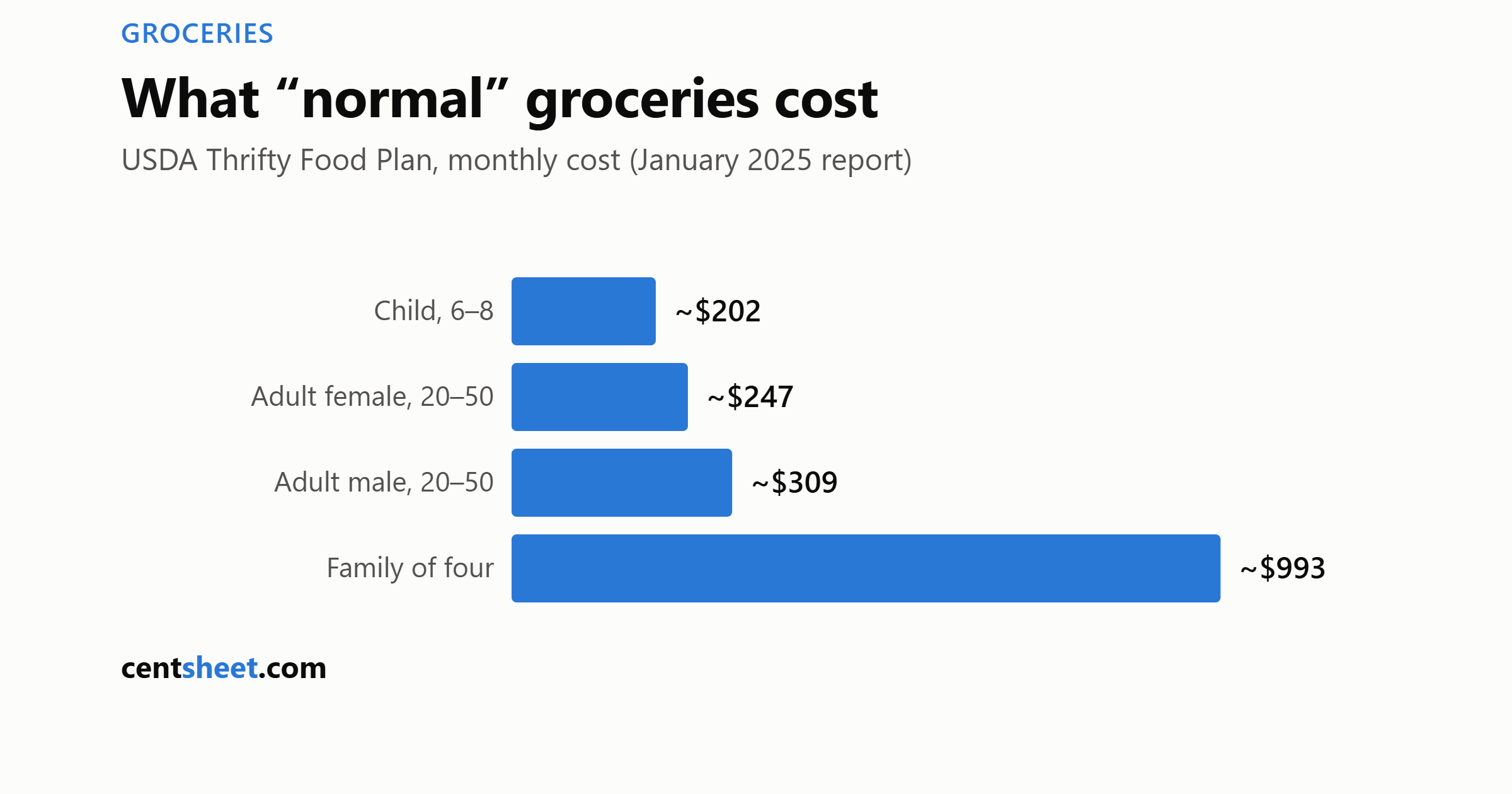
There is an official-ish benchmark. The USDA has published Food Plans for decades — the cost of a nutritionally adequate diet at four spending levels (Thrifty, Low-Cost, Moderate, Liberal), by age, sex, and household size, updated monthly. From the January 2025 Cost of Food report, the Thrifty plan — the floor, the one food-assistance benefits are built on — prices out like this:
| Who | Weekly | Monthly |
|---|---|---|
| Adult male, 20–50 | $71.40 | ~$309 |
| Adult female, 20–50 | $57.00 | ~$247 |
| Child, 6–8 | $46.70 | ~$202 |
| Family of four (couple + two kids) | $229.20 | ~$993 |
Remember these are the cheapest adequate-diet numbers the USDA models — the Low-Cost, Moderate and Liberal plans step up from here, with the top plan roughly double the Thrifty floor.
Two things make the benchmark framework useful beyond the specific figures:
The spread between levels is roughly 2× from bottom to top. The Liberal plan runs about double the Thrifty plan for the same household. That’s the honest range of “normal” — a couple can be nutritionally fine anywhere in a band hundreds of dollars wide. Where you sit in the band is a preferences-and-effort dial, not a virtue test.
Your comparison must be per-person and age-adjusted. A household of two adults and a teenage athlete is not “a family of three” — the USDA tables price a teenage boy’s diet above an adult’s for good reason.
Benchmarking yourself honestly
One month, one number: every supermarket run, the corner-store milk, the delivery-app groceries. Exclude restaurants and takeout — mixing them hides both problems (this is the classic zero-based budgeting discovery). Compare against the USDA level that matches your intent. Over the Liberal plan for your household composition? You’re not buying groceries at that point; you’re buying convenience, waste, or premium habits — all legitimate, none mandatory.
The three levers, ranked by actual yield
1. Waste. US households throw away a meaningful fraction of the food they buy — for a $700/month household, plausibly $100+ in the trash. The fix is unglamorous: shop from a list built off meals, eat leftovers on purpose, and buy the smaller size when the big one historically rots. Waste reduction is the only grocery lever that costs zero lifestyle.
2. The protein and beverage lines. Meat and drinks (soda, alcohol, the delivery coffee) dominate most receipts. One or two bean-or-egg dinners a week and drinking more tap water move totals more than a hundred coupon decisions.
3. Store and brand switching. Same list, discount grocer vs premium chain, routinely differs 20–30%. Store brands run 20–40% under name brands at equal (often literally identical-factory) quality. This lever is big and one-time — switch defaults once, save monthly forever, the same principle as bill negotiation: attack the recurring, not the incidental.
What’s not on the list: micro-optimizing coupons for products you wouldn’t otherwise buy, and shame. The USDA’s own Thrifty plan assumes cooking skill, planning time, and store access that not every household has — structural constraints are real here too.
Making it stick
Give groceries a zero-based envelope — a hard monthly number aligned to your chosen USDA level, checked weekly, with a small sinking fund for the genuine stock-up months (holidays, bulk restock). The benchmark ends the guilt; the envelope ends the drift.
CentSheet publishes educational content, not personalized financial advice.
Get the CentSheet Money Brief
Email me CentSheet weekly: practical money decisions, new calculators, and useful worksheets. Unsubscribe anytime.