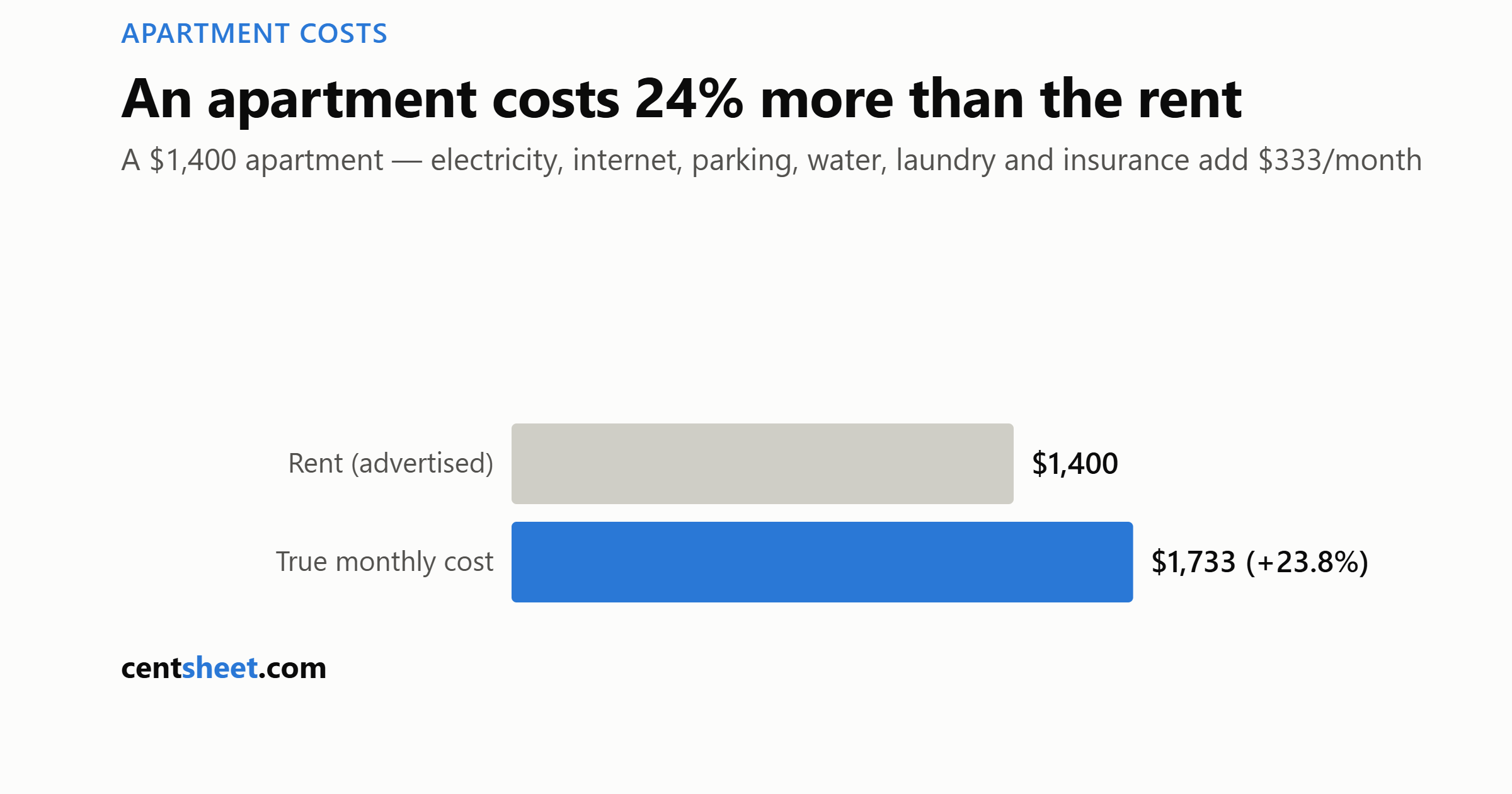
Apartment hunting is conducted in rent. Apartment living is conducted in the total, and the two differ by about a quarter.
The real monthly number
A $1,400 apartment, fully costed:
| Line | Monthly |
|---|---|
| Rent | $1,400 |
| Electricity | $95 |
| Internet | $65 |
| Water, sewer, trash | $55 |
| Parking | $75 |
| Renters insurance | $13 |
| Laundry | $30 |
| True monthly cost | $1,733 |
That’s 23.8% above the advertised rent — and it’s the number your budget actually has to absorb.
Two consequences. First, the “can I afford it?” test should run against $1,733, not $1,400. Second, and less obvious: the cheaper apartment isn’t always cheaper.
How to compare two apartments honestly
A $1,300 unit with tenant-paid heat, no parking included, and no in-unit laundry can easily cost more per month than a $1,400 unit with heat and parking bundled. Rent alone tells you nothing about which is which.
Before signing, get answers to these — they’re the variables that move the total by $100+/month:
- Which utilities are included? Heat is the one that matters most; an electric-heat unit in a cold climate can add $150+ in winter months.
- Is parking included, extra, or unavailable? “Unavailable” has a cost too — permits, or time.
- In-unit laundry, on-site, or laundromat? Roughly a $30/month swing, plus hours.
- What’s the pet rent? Often $25–50/month on top of a deposit, and it’s easy to miss in the paperwork.
- Is there a mandatory amenity or “community” fee? Increasingly common, sometimes $20–75/month.
- How old are the windows and the HVAC? This is an energy-bill question wearing a maintenance costume.
Ask for a recent utility bill for the specific unit. Good landlords have it; the reluctance to provide it is itself information.
The seasonal trap
Sign a lease in June and the electricity line looks tame. Then heating season arrives and the bill triples for four months.
Budget utilities on the annual average, not on the month you moved in — or better, treat winter overage as a sinking fund: set aside a fixed monthly amount year-round so January’s bill doesn’t detonate January’s budget. Many utilities offer budget billing that does exactly this automatically; it’s worth taking.
Where this fits in the budget
Under the 50/30/20 diagnostic, housing is the largest single item in the “needs” half, and the true cost — not the rent — is what belongs there. At $1,733 all-in, the rule wants take-home of roughly $3,466/month for housing to sit comfortably inside 50%.
If it doesn’t fit, that’s a structural finding, not a personal failing: housing is the line where budgets are actually decided, and no amount of spending discipline elsewhere offsets a housing cost that’s 45% of take-home. The levers are a roommate, a different unit, a different neighborhood, or income — and they’re worth more than a year of careful coupon use.
The one-line version
Add roughly 25% to any advertised rent to get the number your budget will actually feel. Compare apartments on that figure, not the headline, and the “cheap” one occasionally turns out to be the expensive one.
CentSheet publishes educational content, not personalized financial advice. Utility and fee figures are illustrative and vary substantially by region, building and season.
Get the CentSheet Money Brief
Email me CentSheet weekly: practical money decisions, new calculators, and useful worksheets. Unsubscribe anytime.