Two acronyms, one letter apart, and the difference is engineered to be confusing — because each side of the financial industry quotes whichever one flatters its product.
APR (annual percentage rate) is the simple yearly rate before compounding. APY (annual percentage yield) is what you actually earn or pay after compounding. Same underlying reality, different sticker.
The pattern to memorize: lenders lead with APR (smaller-looking number for what you pay), banks lead with APY (bigger-looking number for what you earn). Neither is lying; both are choosing the flattering unit.
The credit card example
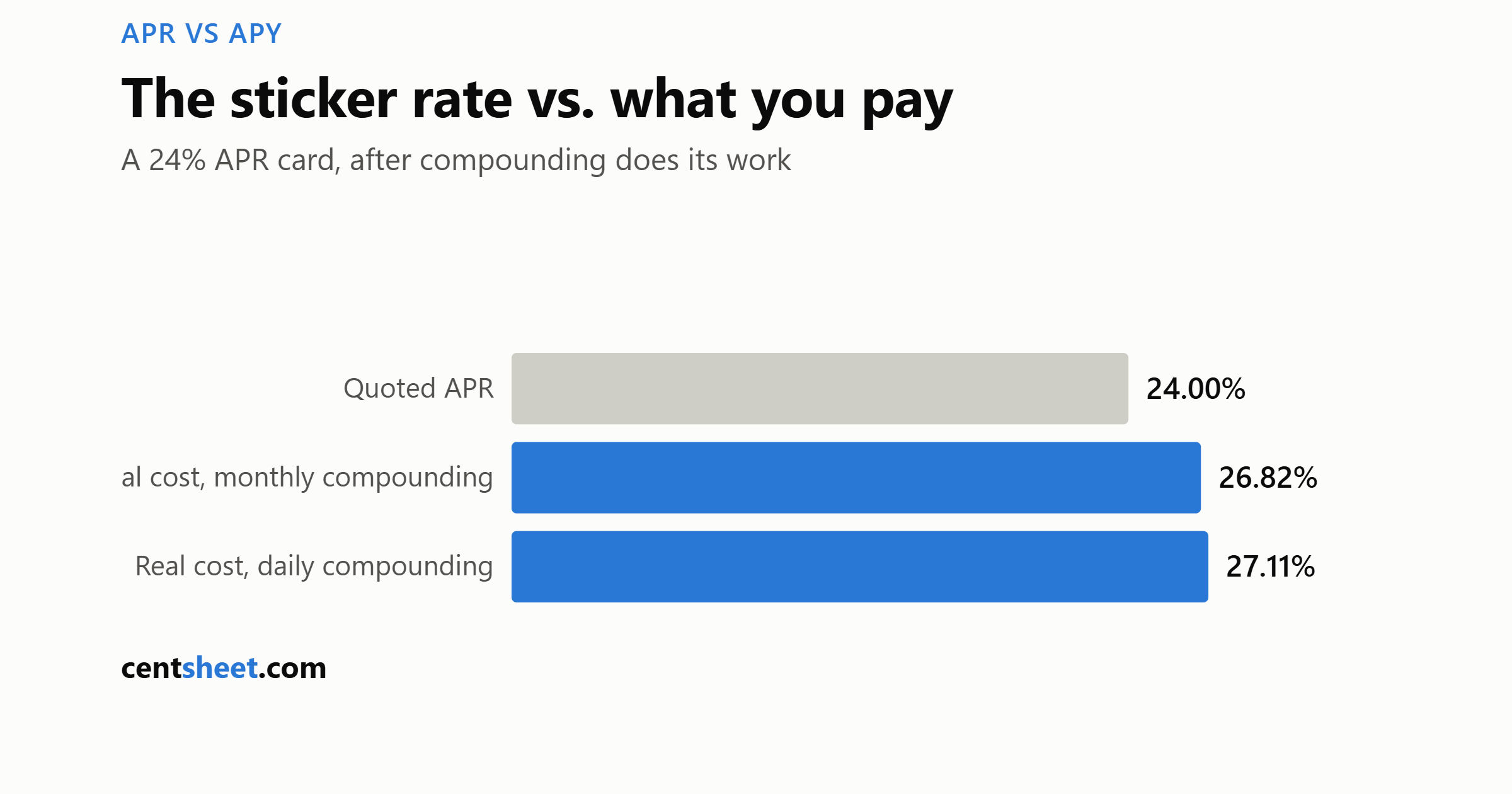
Your card says 24% APR. Interest compounds monthly (daily on many cards, which is slightly worse). What that costs you over a year of carrying a balance:
| Quoted | Compounding | True annual cost (APY) |
|---|---|---|
| 24% APR | monthly | 26.82% |
| 24% APR | daily | 27.11% |
That’s roughly three extra percentage points hiding in the compounding — on a $8,000 carried balance, about $240/year that the sticker rate doesn’t show. It’s the same compounding engine that builds wealth, just pointed at you.
The savings example, reversed
A savings account advertising 4.00% APY with daily compounding has an underlying APR of about 3.92%. The bank quotes the 4.00% — the after-compounding number — because it’s larger. For deposits this flattery works in your favor: APY is the honest what-you’ll-actually-get figure, and comparing accounts by APY is correct.
The asymmetry is the tell: the industry quotes loans before compounding and deposits after it. Once you see it, you can’t unsee it.
The comparison rules
1. Comparing savings accounts or CDs? Use APY, and only APY. It’s compounding-inclusive, so it’s apples-to-apples regardless of whether one bank compounds daily and another monthly. 2. Comparing loans? APR is the standard — but check what it includes. For mortgages, APR bundles certain fees and points, which is why the mortgage APR sits above the note rate; for cards, APR is just the rate. Two “24% APR” cards with different compounding differ slightly in true cost. 3. Never compare an APR to an APY. That’s the classic apples-to-oranges error, worth real money in the wrong direction. 4. For card debt, think in APY when deciding how urgent payoff is. Your 24% card is a guaranteed 26.82%-a-year fire. Nothing in your portfolio reliably outruns it — which is why the payoff-first logic is so robust.
Why the gap grows with the rate
Compounding’s flattery is proportional to the rate. At 4%, APR and APY differ by ~0.08 points — rounding noise. At 24%, they differ by ~2.8 points. At payday-loan rates, the two numbers live on different planets. The practical rule: the higher the quoted rate, the more the missing letters matter, and the more skeptical of the sticker you should be.
CentSheet publishes educational content, not personalized financial advice.
Get the CentSheet Money Brief
Email me CentSheet weekly: practical money decisions, new calculators, and useful worksheets. Unsubscribe anytime.