A balance transfer card moves debt from another account onto a credit card offering a temporary low or 0% APR. The rate can save real money. The transfer is rarely free.
The decision has two tests:
- Can you pay the transferred balance plus the fee before the promotion ends?
- Is the fee plus any post-promotion interest lower than the interest the old debt would have charged over the same payoff path?
If either answer is no, the 0% headline is doing more work than the math.
Transfer fee = amount transferred × fee percentage
Payment needed inside promotion = (transfer + fee) ÷ promotional months
An $8,000 transfer with a 4% fee creates a $320 fee and, if the fee is added to the card balance, $8,320 to repay. Over 15 months at 0%, that requires $554.67 a month—not $533.33. Forgetting to finance the fee into the payoff target is the first common mistake.
What a balance transfer card actually changes
A transfer does not erase or settle debt. It changes the account holding the debt and, for a defined period, may change its interest rate.
The CFPB's balance-transfer fee explanation confirms that an issuer may charge a fee even when the promotional APR is 0%. The fee may be a percentage, a flat amount, or a percentage subject to a minimum; the offer's Schumer box and agreement provide the actual formula.
The CFPB's 2025 Consumer Credit Card Market Report found that balance transfers among the largest 25 issuers carried an average fee of 4.3% in the second half of 2024, with a $5.51 average minimum fee. Those are dated market averages, not a quote and not a prediction. The examples below use a hypothetical 4% fee because your offer must be tested on its own terms.
A transfer can change four things:
| Item | Old account | Transfer account |
|---|---|---|
| Principal | Existing balance | Existing balance plus any financed fee |
| APR | Current debt APR | Promotional APR, then stated go-to APR |
| Deadline | Existing payoff path | Promotion expiration date |
| Risk | Ongoing interest | Fee now and higher interest later if balance remains |
It does not create a payment plan automatically. The card may state only a small minimum, even when that minimum cannot finish the transfer before the promotion expires.
A transfer can be partial or arrive after the due date
Approval for a card does not guarantee that its usable transfer limit will cover the requested debt. The fee may consume part of the new credit line, an issuer may cap transfers below the line, and some offers exclude transfers between accounts from the same issuer. The written offer decides.
Suppose only $5,000 of an $8,000 old balance transfers under the same hypothetical 4% fee. The new payoff target is $5,200, while $3,000 remains on the old card. Clearing the transfer within 15 months requires $346.67 a month in addition to the payment on the old balance:
($5,000 + $200 fee) ÷ 15 = $346.67
That is a CentSheet calculation, rounded up by one cent. Treat the result as two debts until both issuers show their posted balances. Do not use an “approved” transfer confirmation as permission to skip the old card's required payment.
Transfers also take time to process. Keep paying the old account by its due date until the credit actually posts, then inspect the following statement for residual interest or a small remaining balance. A transfer that misses an old due date can create a late-payment problem before the promotional plan even starts.
The payoff deadline is the real product
Suppose the offer is:
- $8,000 transferred
- 4% fee added to the balance: $320
- Starting transfer balance: $8,320
- 0% promotional APR for 15 months
- 25% APR after the promotion
- No new purchases, cash advances, or other fees
Here is what different fixed payments do:
| Monthly payment | Balance after month 15 | Approximate payoff | Interest after promotion | Fee + post-promo interest |
|---|---|---|---|---|
| $832.00 | $0 | 10 months | $0 | $320.00 |
| $554.67 | $0 | 15 months | $0 | $320.00 |
| $450.00 | $1,570 | 19 months total | $77.94 | $397.94 |
| $300.00 | $3,820 | 30 months total | $665.21 | $985.21 |
These are CentSheet calculations. During the 0% period, each payment reduces principal dollar for dollar. After month 15, the model applies 25% APR monthly to the remaining balance, then subtracts the fixed payment. It rounds displayed figures to cents, assumes payments arrive once monthly, and excludes issuer daily-balance timing, new charges, late fees, changing rates, and minimum-payment formulas. Actual statements will differ.
The $300 plan still benefits from the promotion in this illustration, but it leaves almost half the starting debt exposed to 25% APR. The best use of a promotional window is not merely moving debt; it is setting a payment that makes the deadline real.
Use the debt payoff calculator with the go-to APR as a stress test. If the planned payment cannot clear a remaining balance at that rate, the offer is postponing the problem.
Compare the transfer with the debt you already have
Now assume the $8,000 remains on its old card at a fixed 24% APR and receives the same monthly payments. A monthly approximation produces:
| Monthly payment | Old card payoff | Old-card interest | Transfer fee + modeled interest | Modeled saving from transfer |
|---|---|---|---|---|
| $832.00 | 11 months | $974.62 | $320.00 | $654.62 |
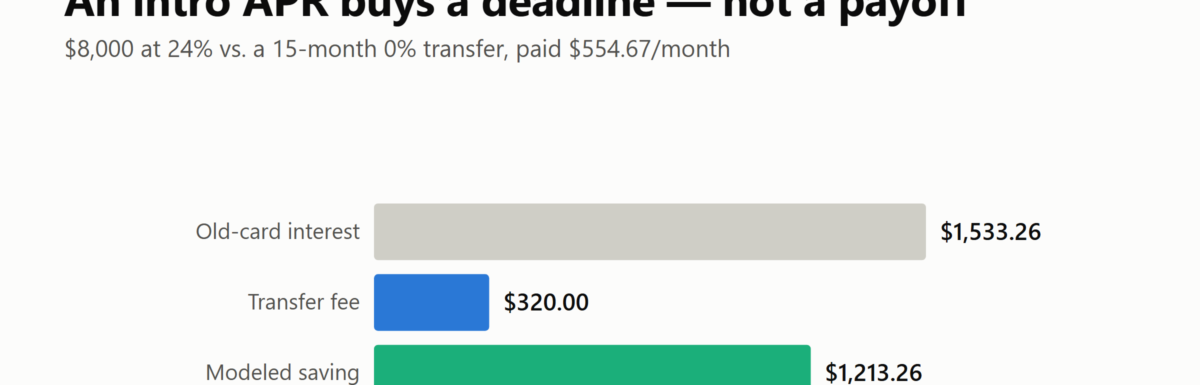
| $554.67 | 18 months | $1,533.26 | $320.00 | $1,213.26 |
| $450.00 | 23 months | $1,984.96 | $397.94 | $1,587.02 |
| $300.00 | 39 months | $3,546.79 | $985.21 | $2,561.58 |
Again, these are CentSheet illustrations, not card quotes. The old-card model applies 24% APR monthly to the outstanding balance, assumes no new charges, and uses the displayed fixed payment until the final smaller payment. The transfer model uses the assumptions in the previous table.
The general break-even rule is:
Interest avoided on old debt > transfer fee + post-promo interest + other transfer costs
Do not compare only APRs. Compare total dollars under the payment you can actually sustain. Our APR-versus-APY guide explains why the APR is a price input rather than a complete payoff answer.
A rough shortcut—fee divided by the old balance's first-month interest—can be misleading because interest falls as principal falls. Amortize the balance instead.
New purchases can break the clean comparison
The transferred balance and new purchases may have different APRs and different grace-period treatment.
The CFPB's consolidation guidance warns that using a balance-transfer card for new purchases can mean those purchases receive no grace period until the entire balance, including the transfer, is paid. An offer that also promotes purchases may work differently. Read the agreement rather than assuming the 0% transfer rate applies to everything.
The safest operating rule is simple: use the transfer card as a closed payoff account. Put no purchases on it. Keep ordinary spending inside the cash budget or on a separate card that is paid in full, if using another card does not restart the debt cycle.
Payment allocation also matters when one card contains balances at different APRs. Federal rules generally direct amounts above the minimum toward the highest-APR balance first, while the issuer has more discretion over the minimum portion. That does not guarantee the allocation you expected in every promotional situation.
If the basic mechanics of statement balances and grace periods are not yet automatic, revisit the first-credit-card playbook before combining multiple APR buckets on one account.
What happens when the promotion expires
For a standard 0% APR offer, an unpaid remainder generally begins accruing at the disclosed post-promotion rate after the offer ends. That is different from deferred-interest financing, which can impose previously accrued interest when a balance is not cleared by a deadline. Read the exact wording; “0% intro APR” and “no interest if paid in full” are not interchangeable promises.
As of August 14, 2026, Regulation Z's rate-increase rule generally requires an introductory rate to last at least six months, subject to exceptions. That legal floor is not your payoff term. The actual expiration date and go-to APR belong in the written offer and agreement.
Late payments create another layer of risk. The CFPB says that when a payment becomes more than 60 days late, an issuer may increase the rate on existing balances, including a transferred balance. A shorter delay may still cause a late fee, loss of account privileges, or other consequences under the agreement. Do not paraphrase “late once” into a universal immediate cancellation rule; inspect the terms.
Set autopay for at least the required minimum as a backstop, then schedule the larger payoff amount separately. Autopay does not fix a plan whose payment is too small.
The CFPB maintains a searchable credit-card agreement database. The agreement specific to your account may differ from the public generic version, so request it from the issuer when terms are unclear.
A transfer is a rate tactic, not a debt strategy
The debt avalanche ranks balances by cost. A transfer can improve that plan by lowering the APR on one balance. It cannot supply the monthly surplus that makes balances fall.
Before applying, ask:
- Will the approved transfer limit cover the intended amount? An application does not guarantee it.
- Can the transfer complete before the old payment is due? Keep paying the old account until it confirms a zero balance.
- Does the fee count against the new card's credit limit?
- What exact date ends the promotion?
- What APR applies afterward, and is it variable?
- What payment clears the fee-inclusive balance one month early?
- Can old cards remain unused after their balances move?
Moving $8,000 and then adding $3,000 of fresh spending to the old cards produces $11,000 of debt. The spreadsheet can be correct while the behavior defeats it.
What to actually do
- Copy the transfer amount, fee formula, promotional APR, expiration date, and go-to APR from the written offer.
- Add the fee to the payoff target if it will be financed.
- Divide that target by one fewer month than the promotion allows; the spare month absorbs timing errors.
- Compare the transfer's total modeled fee and interest with the old debt's interest under the same payment.
- Confirm how purchases, cash advances, late payments, and payment allocation work under the agreement.
- Keep paying the old account until the transfer posts and the old issuer confirms the remaining balance.
- Put no new purchases on the transfer card and track progress against the deadline every statement.
CentSheet publishes educational content, not personalized financial advice. This is not a credit-card recommendation, application, or loan offer. Promotional terms, approval, limits, fees, rates, grace periods, and payment allocation vary by issuer and account. Examples are mathematical illustrations based on stated assumptions.
Get the CentSheet Money Brief
Email me CentSheet weekly: practical money decisions, new calculators, and useful worksheets. Unsubscribe anytime.