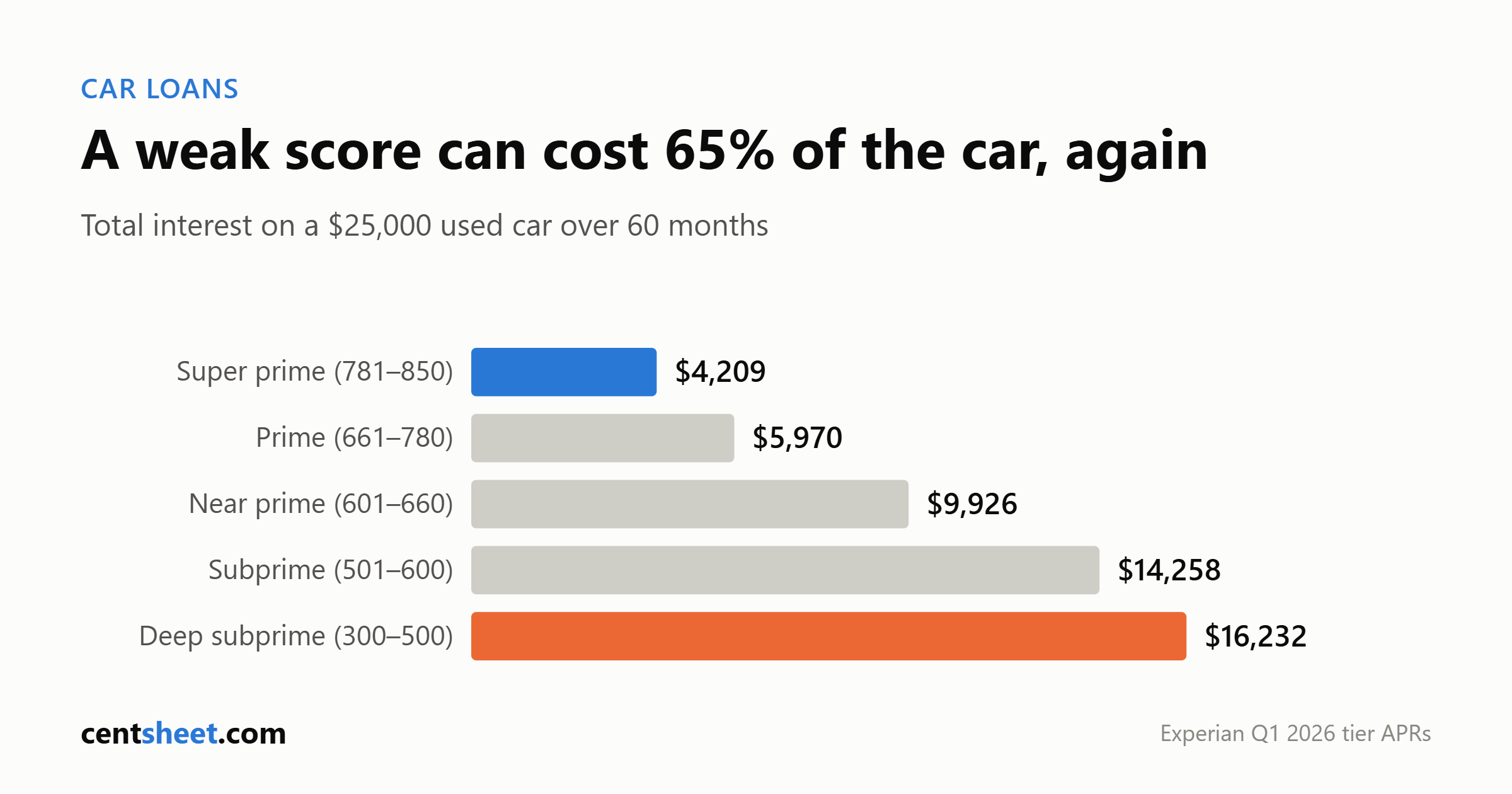
There is no minimum credit score for a car loan. Not a low one — none at all. Experian says so plainly, and the market backs it up: subprime borrowers made up 15.75% of vehicle financing in Q1 2026, up from 14.40% a year earlier.
You can get approved at almost any score. That is precisely why the question people ask — “what score do I need?” — is the wrong one. The right one is what each score costs, and the answer is larger than almost anyone expects.
The rate by tier
Experian’s Q1 2026 State of the Automotive Finance Market, the most recent available as of August 2026:
| Tier (VantageScore 4.0) | New car | Used car |
|---|---|---|
| Super prime (781–850) | 4.55% | 6.30% |
| Prime (661–780) | 6.23% | 8.77% |
| Near prime (601–660) | 9.67% | 14.03% |
| Subprime (501–600) | 13.44% | 19.42% |
| Deep subprime (300–500) | 16.01% | 21.77% |
| All borrowers | 6.39% | 11.43% |
Top to bottom that is a 11.5-point spread on new cars and a 15.5-point spread on used. A deep subprime borrower pays roughly 3.5 times the super prime rate on a used car.
Note the tier labels are built on VantageScore 4.0. This matters more than it sounds — see below.
What the spread costs in dollars
On a $30,000 new car financed over 60 months:
| Tier | Payment | Total interest |
|---|---|---|
| Super prime | $560 | $3,598 |
| Prime | $583 | $4,992 |
| Near prime | $633 | $7,953 |
| Subprime | $689 | $11,362 |
| Deep subprime | $730 | $13,782 |
The gap between the top and bottom is $170 a month and $10,184 in interest — on the identical car.
On a $25,000 used car over 60 months it is worse: $487/month at super prime versus $687 at deep subprime, and $16,232 in interest. That deep subprime borrower pays 65% of the car’s price again, in interest alone, over five years.
The used-car penalty is not flat — it grows as your score falls
Everyone knows used-car loans cost more than new. Almost nobody notices that the penalty scales with your credit:
| Tier | New | Used | Used penalty |
|---|---|---|---|
| Super prime | 4.55% | 6.30% | +1.75 pts |
| Prime | 6.23% | 8.77% | +2.54 pts |
| Near prime | 9.67% | 14.03% | +4.36 pts |
| Subprime | 13.44% | 19.42% | +5.98 pts |
| Deep subprime | 16.01% | 21.77% | +5.76 pts |
A super prime borrower pays under two extra points to buy used. A subprime borrower pays six.
This is a trap with a nasty shape. The borrower with weak credit is steered toward a used car because the sticker price is lower — and that is exactly the market where their credit costs the most. The cheaper car can easily carry the more expensive loan.
It does not mean subprime borrowers should buy new. It means the comparison has to be run on total cost including financing, not on sticker price. Our car affordability calculator works backwards from income to a price you can actually carry, and How Much Car Can You Actually Afford? walks through the 20/4/10 math.
The score they pull is not the score you have
Auto lenders mostly do not use the base FICO Score you see in an app. They use FICO Auto Scores, an industry-specific model that runs on a 250–900 scale rather than 300–850 — and there are multiple versions at each bureau (Auto Score 9, 8, and a bureau-specific older one).
So two things are true at once: the number the dealer quotes may be unfamiliar, and it may not be wrong. FICO says the Auto Scores are used in the majority of auto financing evaluations.
There is a second definitional problem. Experian’s tier table above uses VantageScore 4.0 cutoffs. The CFPB publishes auto-lending tiers on FICO Score 8 with different boundaries entirely:
| Tier | Experian / VantageScore 4.0 | CFPB / FICO 8 |
|---|---|---|
| Super prime | 781–850 | 720+ |
| Prime | 661–780 | 660–719 |
| Near prime | 601–660 | 620–659 |
| Subprime | 501–600 | 580–619 |
| Deep subprime | 300–500 | below 580 |
A 600 is subprime under Experian’s scheme and near-prime under the CFPB’s. Same person, same day. Whenever you see a tier label attached to a rate, find out which definition it is using — otherwise you are comparing a rate to the wrong row.
Where you borrow may matter as much as your score
The CFPB found that subprime auto rates cluster by lender type — banks on one level, finance companies and buy-here-pay-here dealers substantially higher — and that the differences were not fully explained by differences in default risk.
That analysis is from 2021 and its rate levels are far too old to quote as current pricing. The structural point still stands, and it is actionable: get a credit union or bank pre-approval before you walk onto a lot, so dealer-arranged financing has to beat a real number instead of being your only option. Subprime borrowers can source from credit unions, banks, online lenders and captives — not just the lots that advertise to them.
If your score is low right now
Two facts make this less bleak than the table suggests.
First, the loan is not permanent. Auto refinancing in Q1 2026 cut borrowers’ rates by an average of 2.2 percentage points — from 10.29% to 8.05% — saving an average of $81 a month. Buying at a bad rate and refinancing after your score recovers is a legitimate, common strategy. It works best if you avoid a long term and stay ahead of depreciation.
Second, the term is the trap, not the rate. Average new-car loans now run 69.5 months, with nearly a third of all terms longer than six years. A long term makes any rate feel affordable and quietly maximizes total interest while keeping you underwater for years. If a lender solves your affordability problem by stretching the term, they have not solved it.
For context on what the market looks like: the average amount financed in Q1 2026 was $43,925 new and $27,070 used, with average payments of $770 and $531.
What to actually do
1. Get pre-approved before shopping. A real offer in hand converts the dealer’s finance office from a gatekeeper into a competitor. 2. Find out which score they pulled. Ask for the model and version. Your app score may be a different model on a different scale. 3. Fix utilization first if you have a month. It is the fastest-responding major factor — details here. 4. Negotiate price and financing separately. Settle the car’s price first; a good rate on an inflated price is not a win. 5. Cap the term at 48–60 months. If the payment only works at 72 or 84, the car is too expensive. That is information, not an obstacle. 6. Plan the refinance. If you must borrow at a subprime rate, note the date you expect your score to recover and check rates then.
One caveat on every number above: these are averages from Experian’s Q1 2026 report, not offers. Lenders price on income, debt-to-income, down payment, vehicle age, term and state as well as score. And no honest source will tell you how many points any single action is worth — the models are proprietary, and both FICO and VantageScore say the effect depends on your entire file.
CentSheet publishes educational content, not personalized financial advice. Auto finance figures are Experian’s Q1 2026 report and change quarterly.
Get the CentSheet Money Brief
Email me CentSheet weekly: practical money decisions, new calculators, and useful worksheets. Unsubscribe anytime.