The dealership will never ask what car you can afford. It asks what monthly payment you’re comfortable with — and then engineers a loan, of whatever length necessary, that hits the number. That’s how people earning $4,000 a month end up in $45,000 trucks, technically on budget.
The countermeasure is a rule with teeth: 20/4/10.
The rule
- 20% down — real skin in the game, and protection against being underwater the moment you drive off
- 4 years maximum on the loan
- All monthly vehicle costs under 10% of gross monthly income — payment plus insurance plus fuel
That last clause is the one the payment-question hides: a car costs its loan payment plus insurance, fuel, and maintenance, and the 10% cap has to hold after those.
What the loan term actually does
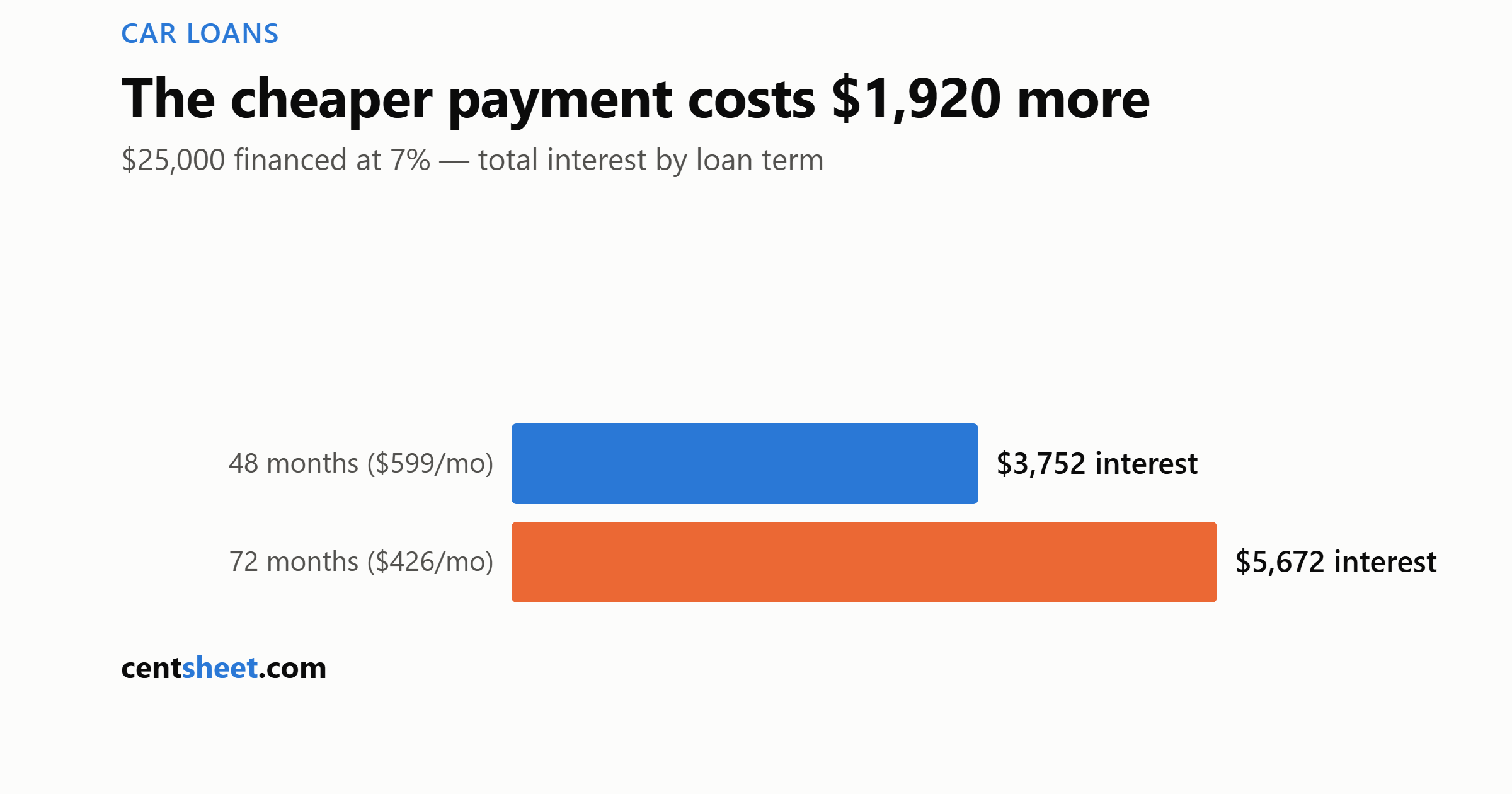
The industry’s favorite lever is the term, because stretching it shrinks the payment while growing the cost. $25,000 financed at 7%:
| Term | Payment | Total interest |
|---|---|---|
| 48 months | $599 | $3,752 |
| 72 months | $426 | $5,672 |
The 72-month loan “saves” $173 a month and costs $1,920 more — while keeping you underwater (owing more than the depreciating car is worth) for most of its life. Long loans are how unaffordable cars are made to feel affordable. The 4-year cap isn’t arbitrary; it’s the tell: if the payment only works at 72 or 84 months, the car doesn’t fit.
Run the math backwards
The honest direction: start from your income, end at a sticker price.
Gross income $5,000/month → all-in vehicle budget $500 (10%). Reserve realistic insurance + fuel — call it $250 [your quotes will vary; get one before shopping, not after] — leaving $250 for the payment. At 7% for 48 months, $250/month services about $10,400 of loan; with 20% down, that’s roughly a $13,000 car.
That number lands well below showroom expectations, which is the point. (At $500 of pure payment — no insurance set-aside — 48 months at 7% services about $20,900, which is how the same income gets sold a $26,000 car instead.)
The escape hatches, honestly ranked
1. Buy used and drive it long. Depreciation is the largest real cost of car ownership; a 3–5 year old car hands that bill to the first owner. The 20/4/10 math opens up dramatically at used prices. 2. Keep the paid-off car and bank the phantom payment. The months after a loan ends are the cheapest driving you’ll ever do — redirecting the dead payment into a sinking fund prepays the next car and shrinks the next loan. 3. What doesn’t work: the 84-month loan, the lease-because-the-payment-is-lower (a topic of its own — you’re renting the steepest depreciation years), and rolling an underwater trade-in into the new loan, which is paying for two cars while driving one.
The uncomfortable summary: for most budgets, the affordable car is more boring than the approved car. The approval was never the constraint — the rest of your budget was.
CentSheet publishes educational content, not personalized financial advice. Rates and figures are illustrative; your loan terms will differ.
Get the CentSheet Money Brief
Email me CentSheet weekly: practical money decisions, new calculators, and useful worksheets. Unsubscribe anytime.