Debt consolidation can be a good idea when it lowers the all-in cost, keeps or shortens the payoff date, and leaves a payment the borrower can sustain. It is a bad idea when the lower monthly bill comes mainly from adding years, when a teaser rate hides the later cost, or when unsecured card debt becomes a loan that can cost the borrower a home.
One payment is simpler. Simpler is not automatically cheaper.
Use three tests:
| Test | A consolidation should pass |
|---|---|
| Total-cost test | New interest and fees are lower than the old plan's interest and fees |
| Time test | The payoff date stays the same or moves earlier |
| Risk test | The restructure does not add unacceptable collateral, variable-rate, or behavior risk |
If an offer advertises only its monthly payment, it has not shown enough information to pass any of them.
Start with the debts you already have
Make an inventory before shopping for a new loan:
| Debt | Current balance | APR | Required payment | Planned payment | Payoff quote/date |
|---|---|---|---|---|---|
| Card A | |||||
| Card B | |||||
| Personal loan |
Do not compare a consolidation offer with the sum of minimum payments only. Compare it with the fixed total payment you would actually keep sending under the current plan.
A quick weighted APR can help describe multiple balances:
Weighted APR = sum of each balance × its APR ÷ total balance
For example, $8,000 at 24%, $5,000 at 19%, and $2,000 at 29% produce a 23% balance-weighted APR:
(($8,000 × 24%) + ($5,000 × 19%) + ($2,000 × 29%)) ÷ $15,000 = 23%
That is a CentSheet calculation and a screening tool, not an exact combined payoff rate. Each account accrues separately, minimum-payment formulas differ, and payment order changes the result. Model the debts individually in the debt payoff calculator.
The existing avalanche-versus-snowball analysis owns the payoff-order decision. Consolidation is a different question: whether changing the contracts improves the plan.
Compare total dollars, not just payments
Consider a deliberately simplified example:
- Existing card debt: $15,000
- Existing APR: fixed 24%
- Existing planned payment: $600 monthly
- Consolidation offer: 14% fixed contract rate
- Origination fee: 5%, or $750, added to the amount financed
- New starting principal: $15,750
- No new charges, late fees, or rate changes
Here are two terms for the same hypothetical consolidation:
| Plan | Monthly payment | Payoff time | Total paid | Cost above original $15,000 |
|---|---|---|---|---|
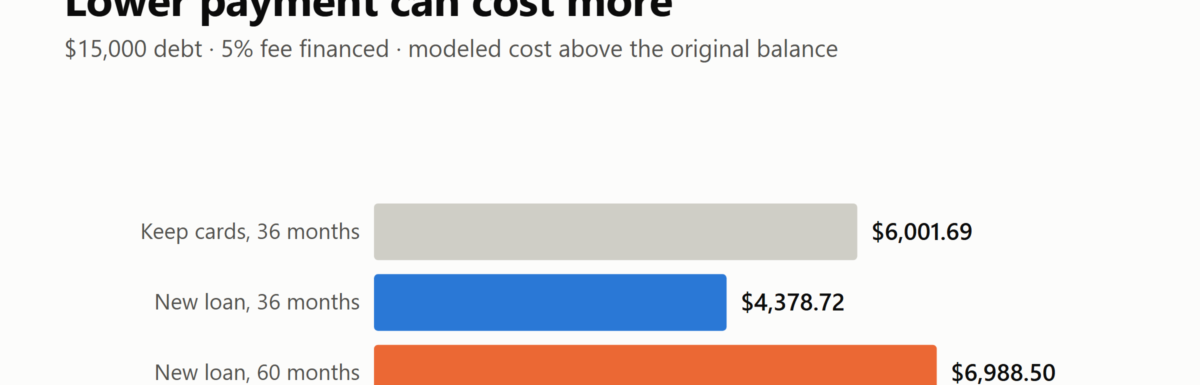
| Keep card at 24%, pay $600 | $600.00 | 36 months | $21,001.69 | $6,001.69 |
| Consolidation at 14% for 36 months | $538.30 | 36 months | $19,378.72 | $4,378.72 |
| Consolidation at 14% for 60 months | $366.47 | 60 months | $21,988.50 | $6,988.50 |
These are CentSheet calculations using monthly amortization. The loan examples finance the $750 fee, so loan interest also accrues on that fee. The model assumes payments at monthly intervals, fixed rates, no prepayment, and a final smaller card payment. It excludes daily-interest timing, other fees, taxes, insurance, and new borrowing.
The 36-month consolidation lowers the monthly payment by $61.70 and lowers total modeled cost by $1,622.97 while preserving the payoff date.
The 60-month version lowers the payment by $233.53 but costs $986.81 more than keeping the card plan and remains for two extra years. A lower payment has disguised a more expensive result.
Read the Truth in Lending disclosure for the APR, finance charge, amount financed, total of payments, and payment schedule. A quoted interest rate and a loan APR are not necessarily the same when an origination fee is a finance charge. The example keeps the contract rate and fee separate so their dollars remain visible.
Fees and teaser rates can erase the headline saving
Consolidation can mean several products:
- A fixed-rate unsecured personal loan
- A variable-rate or teaser-rate installment loan
- A low- or 0% balance transfer
- A home-equity loan or line of credit
- A debt management plan administered by a credit counselor
The CFPB's consolidation guidance warns that a low payment can reflect a longer repayment period and that fees, costs, or an expiring teaser rate can make the new debt cost more overall.
Add every compulsory cost:
- Origination or transfer fee
- Closing costs
- Annual or maintenance fees
- Optional add-ons that the quote has bundled in
- Prepayment penalty, if any
- Interest charged on financed fees
Then stress-test the worst contractual rate, not only today's promotional rate. If the payment fails at the post-teaser APR, the restructure depends on a deadline rather than solving the debt.
Before taking new credit, ask existing creditors about hardship options. They may move a due date, waive a fee, reduce a rate, or offer a structured repayment plan. Our bill-negotiation scripts provide a starting conversation without promising that a creditor will agree.
Consolidate the expensive debt, not every convenient balance
“One payment” can tempt a borrower to move cheap debt into a more expensive loan.
Suppose a household owes $8,000 on a card at 24% and $7,000 on an auto loan at 6%. Its balance-weighted rate is 15.6%:
(($8,000 × 24%) + ($7,000 × 6%)) ÷ $15,000 = 15.6%
A 14% consolidation rate looks lower than 15.6%, but it would raise the $7,000 car balance from 6% to 14% and might add a fee to both balances. The cleaner candidate is the 24% card, not automatically the entire $15,000.
This is a CentSheet screening example, not a full payoff comparison. The correct decision still requires separate amortization, fees, remaining terms, collateral, and any prepayment rules. A low-rate loan near the end of its term may be especially poor material for a fresh long-term loan.
Ask whether the lender lets you choose which creditors receive proceeds and whether it pays them directly. Simplicity is valuable, but not enough to justify increasing a balance's rate or restarting its payoff clock.
Do not secure card debt with a home casually
Credit-card and most personal-loan debt is unsecured. A home-equity loan or HELOC is secured by the home.
That can produce a lower rate because the lender has collateral, not because the debt became harmless. The CFPB says a borrower who does not repay a home-equity consolidation loan could lose the home in foreclosure. It also flags closing costs and the risk that falling property value can leave the homeowner underwater.
The restructure therefore changes more than price:
| Before | After home-secured consolidation |
|---|---|
| Card issuer can collect under applicable law | Mortgage lender has a security interest in the home |
| High APR, no home collateral | Potentially lower APR, foreclosure risk |
| Home equity remains available | Equity is consumed by old spending |
Do not treat the interest-rate gap as sufficient compensation for that risk. A plan that works only by pledging essential housing needs a much higher review standard and qualified advice.
Debt settlement is not debt consolidation
Consolidation generally repays old creditors with new borrowing or routes full payments through a debt management plan. Debt settlement seeks creditor agreement to accept less than the amount owed.
The distinction matters because some advertisements use “debt relief” or “consolidation” while selling settlement. The CFPB's comparison of counseling, settlement, consolidation, and credit repair says settlement firms commonly advise consumers to stop paying while money accumulates for offers. During that period, interest and penalties can continue, credit can be damaged, collection can continue, and a creditor can sue. A creditor is not required to accept a settlement.
The FTC's debt guidance likewise warns that settlement can take years and may leave a consumer owing more if creditors do not agree. Forgiven debt can also have tax consequences. Do not sign a settlement contract believing it is a lower-rate consolidation loan.
Red flags include:
- A guarantee that debt will disappear
- Instructions to stop communicating with creditors
- Fees demanded before a promised result
- No written explanation of which creditors have agreed
- A sales pitch that will not show total cost and time
A new loan cannot fix a recurring monthly deficit
Consolidation resets account balances. It does not change groceries, rent, insurance, income, or a pattern of charging expenses that cash cannot cover.
If the old cards are paid off and immediately reused, the household can end with both the consolidation loan and new card balances. Closing every card automatically is not the only answer; closure can affect available credit and account history. But freezing the cards, removing them from shopping accounts, and setting a cash spending rule are reasonable safeguards while the loan is being repaid.
Find the actual monthly surplus before restructuring. The comparison in our side-income-versus-cutting-costs analysis helps separate one-time relief from a recurring change.
If essential expenses already exceed reliable income, a mathematically cheaper loan may still have an unaffordable payment. That is a cash-flow problem before it is an optimization problem.
Credit counseling is a route, not a magic label
Credit counseling organizations are usually nonprofit organizations that provide budgeting and debt education. A debt management plan may collect one payment and distribute it to creditors, sometimes with negotiated rates or fees. It does not erase principal automatically, and counseling organizations may charge fees.
Interview more than one organization. Ask for the setup fee, monthly fee, creditor participation, expected term, missed-payment consequences, and a written statement of services. “Nonprofit” is a tax status, not proof that a service is free or appropriate.
The Department of Justice maintains a list of agencies approved for pre-bankruptcy credit counseling. The U.S. Trustee Program explicitly says that approval is for bankruptcy-related counseling and is not a recommendation or guarantee of an agency's other services. Use the list as one verification point, not a product ranking.
What to actually do
- Inventory every balance, APR, required payment, fee, and payoff amount.
- Model the current plan with a fixed total monthly payment and a payoff date.
- Copy the new offer's APR, contract rate, fees, term, total of payments, and collateral into a second model.
- Reject any comparison that shows only monthly payment without total dollars and months.
- Stress-test teaser and variable rates and include interest on financed fees.
- Avoid converting unsecured debt into home-secured debt without qualified review of the foreclosure risk.
- Confirm that the offer is consolidation, not settlement, and verify any counselor independently.
- Make a rule for the paid-off accounts so new card debt does not grow beside the new loan.
CentSheet publishes educational content, not personalized financial, credit, tax, bankruptcy, or legal advice. This is not a loan offer or debt-relief recommendation. Rates, fees, approval, creditor participation, collateral rights, and tax treatment vary. Examples are mathematical illustrations based on stated assumptions.
Get the CentSheet Money Brief
Email me CentSheet weekly: practical money decisions, new calculators, and useful worksheets. Unsubscribe anytime.