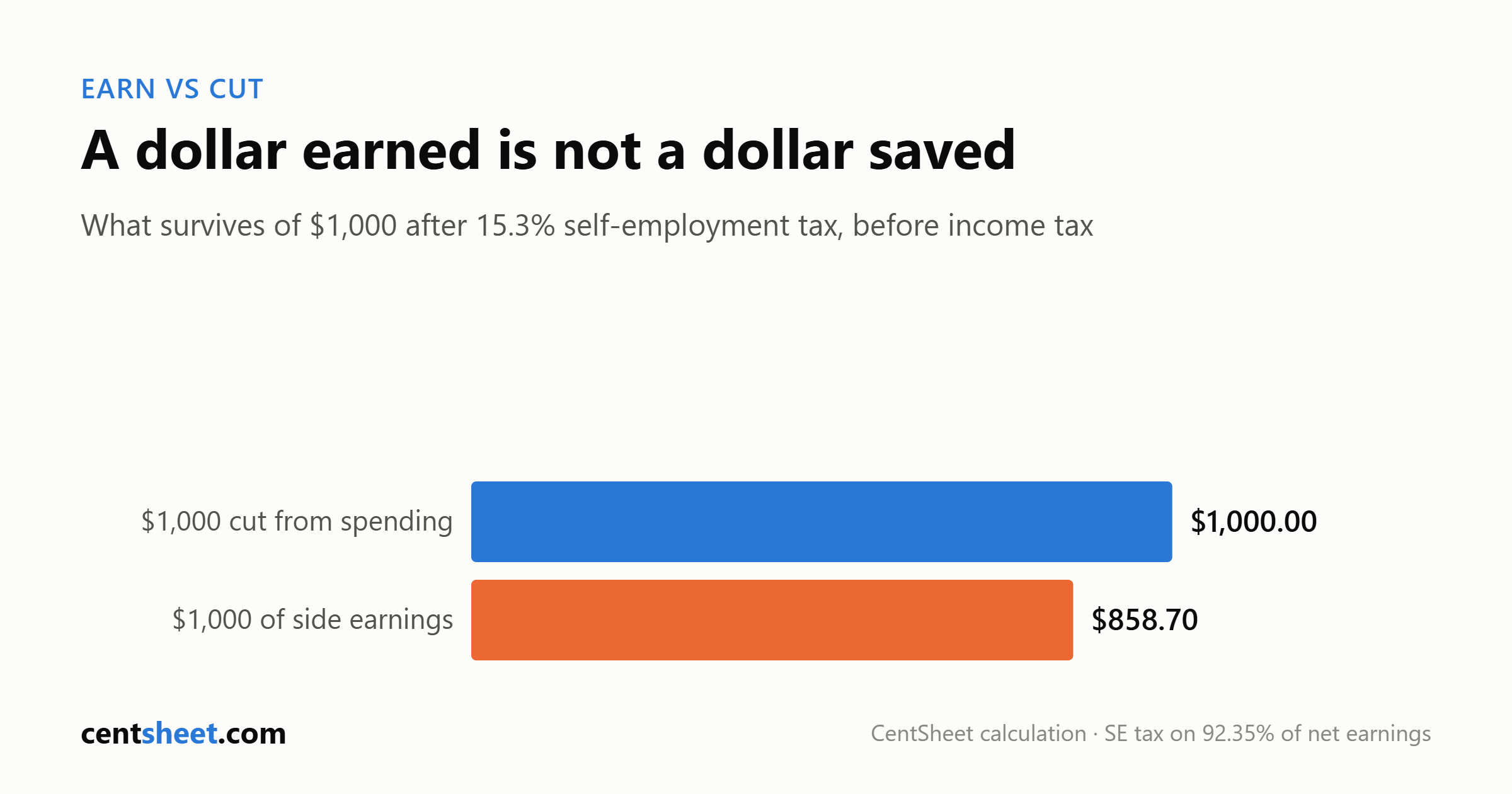
A dollar you stop spending is worth exactly one dollar. A dollar you earn on the side is not. Before a cent of income tax, self-employment tax takes 15.3% of 92.35% of your net earnings — 14.13 cents on the dollar, by our arithmetic — and that is the floor of the friction, not the ceiling. Earning more versus spending less gets framed as a motivational question. It is an arithmetic one, and the arithmetic is lopsided in a way almost nobody shows you.
Cutting is untaxed, instant and hard-capped. Earning is taxed, slow to start and uncapped. Which wins depends on where you sit relative to your own fixed costs.
The floor is real. The ceiling is theoretical.
You cannot cut below your fixed costs. Rent, insurance, the minimum food bill, the car payment you already signed for — these set a hard floor, and near it further cutting stops being a financial strategy and becomes an unpleasant hobby. Every household hits that floor at a different number, and we are not publishing a national figure for how much a typical household can cut, because we could not source one.
Income genuinely has no ceiling. What it has is lag: nothing you start this month pays this month, and the money that does arrive is treated worse by the tax code than money you never spent.
So sequencing matters. If you have never done a subscription audit or a round of bill negotiation — untaxed, one-time effort, recurring benefit — those are the highest-yield hours available. If you have done both and you are still short, cutting is no longer the lever.
What a side-hustle dollar actually keeps
Self-employment tax is 15.3%: 12.4% for Social Security and 2.9% for Medicare, per IRS Topic 554 (updated May 26, 2026). It applies to 92.35% of net earnings from self-employment — revenue minus deductible business expenses — not to gross revenue, and it starts once net earnings reach $400, the same point at which you must file Schedule SE.
Here is the same $1,000 arriving two ways.
| $1,000 cut from spending | $1,000 of net side earnings | |
|---|---|---|
| Amount subject to self-employment tax | $0 | $923.50 (92.35%) |
| Self-employment tax at 15.3% | $0 | −$141.30 |
| Federal income tax | $0 | Your marginal rate, on top |
| State and local income tax | $0 | Whatever your state charges |
| Left before income tax | $1,000.00 | $858.70 |
CentSheet calculation. Assumes net earnings below the 2026 Social Security wage base of $184,500 (SSA), so the full 12.4% applies. Ignores income tax, the above-the-line deduction for half the self-employment tax, the QBI deduction, and the Additional Medicare Tax, which starts at $200,000 for most filers, $250,000 married filing jointly and $125,000 married filing separately.
Run it backwards: to keep $1,000 after self-employment tax alone, you need roughly $1,165 of net earnings, before a dime of income tax. (CentSheet calculation: $1,000 ÷ (1 − 0.1413), same assumptions.)
Two things soften this: one-half of the self-employment tax is deductible above the line when you figure adjusted gross income on Form 1040, and the qualified business income deduction below may cut taxable income further. Neither turns an earned dollar into a saved dollar.
The 2026 reporting thresholds, which most of the internet still has wrong
This is the most stale area of side-income advice on the open web, so take the dates seriously.
| Trigger | The 2026 rule | Source |
|---|---|---|
| Form 1099-K from a payment app or online marketplace | More than $20,000 in gross payments AND more than 200 transactions | IRS FS-2026-07, March 2026 |
| Form 1099-NEC or 1099-MISC from a client | $2,000, for payments made after December 31, 2025 (was $600) | IRS, Working Families Tax Cuts business provisions |
| Owing self-employment tax, filing Schedule SE | Net earnings of $400 or more | IRS Topic 554 |
| Having to make estimated tax payments | You expect to owe $1,000 or more | IRS, Estimated taxes |
Two clarifications, because both get botched constantly.
The 1099-K test is and, not or. $30,000 across 40 transactions triggers nothing; neither does 400 transactions totaling $9,000. The $600 threshold from the American Rescue Plan Act, and the transitional numbers floated for 2025 and 2026, were repealed by the One, Big, Beautiful Bill Act. The IRS calls the reversion retroactive but is vague about how far back, so we are not naming a first affected year.
Not getting a form does not make income untaxed. FS-2026-07 is explicit that you must report all income whether or not an information return arrives. The thresholds govern what the platform or client sends the IRS, not what you owe — a freelancer paid $1,400 by a client in 2026 may get nothing in the mail and still owes tax on $1,400.
Estimated tax is the part that bites
W-2 income is withheld as you earn it. Side income is not. If you expect to owe $1,000 or more when you file, you are generally required to make estimated payments — this is where a good year of side income becomes a bad April.
The four payment periods carry standard due dates of April 15, June 15, September 15 and January 15 of the following year. A due date landing on a Saturday, Sunday or legal holiday moves to the next business day; we have not verified which dates shift in 2026 and 2027, so check the current-year calendar rather than trusting any article, this one included.
The safe harbor is worth knowing precisely. Most taxpayers avoid the underpayment penalty by owing less than $1,000 after withholding and refundable credits, or by paying the smaller of 90% of the current year’s tax or 100% of the prior year’s. Publication 505 (2026 edition) adds the exception that catches people whose side income pushed them up: if adjusted gross income exceeds $150,000, the prior-year figure is 110%, not 100%.
So a chunk of every payment is not yours. Treating it as a sinking fund — set aside on arrival, not at filing time — is the difference between a quarterly transfer and a scramble. If the income is lumpy, budgeting on variable income covers the smoothing problem.
The QBI deduction, and an IRS page arguing with itself
The One, Big, Beautiful Bill Act made the Section 199A qualified business income deduction permanent. It widened the phase-in ranges — from $50,000 to $75,000 for single filers and $100,000 to $150,000 for joint filers — and created a minimum deduction of $400 for any taxpayer with at least $1,000 of net qualified business income from an active business in which they materially participate. Both amounts are fixed for tax year 2026, inflation-adjusted after. FS-2026-07 says the deduction is now permanent for gig workers specifically.
The 2026 thresholds above which the wage and specified-service limitations phase in, per Rev. Proc. 2025-32: $403,500 married filing jointly, $201,775 married filing separately, $201,750 all other returns, with phase-in ranges topping out at $553,500, $276,775 and $276,750. Those are 2026 figures only.
Now the part to know before someone quotes it at you. The IRS’s own evergreen QBI page, updated May 12, 2026, still says the deduction applies to tax years “ending on or before December 31, 2025” and never mentions the new law — contradicting the IRS’s own OBBBA guidance and its own revenue procedure. The statute and Rev. Proc. 2025-32 govern; the evergreen page is stale. We would rather flag that than pretend the record is clean.
Note also what QBI is: a deduction against taxable income, not a credit against tax. A $400 minimum deduction is not $400 in your pocket.
The third door: a raise at the job you already have
A raise is the only version of “earn more” that carries no Schedule SE, no quarterly payments and no bookkeeping. It is also the one where the data is least tidy, because four credible federal measures of wage growth do not agree.
| Measure | Reading | Period | What it actually tracks |
|---|---|---|---|
| BLS Employment Cost Index, wages and salaries, civilian workers | 3.2% | 12 months ending June 2026 (NSA) | Fixed job mix, same jobs over time |
| BLS average hourly earnings, private nonfarm | 3.5% | June 2026 vs June 2025 | Aggregate payroll average, moves with composition |
| Atlanta Fed Wage Growth Tracker | 3.6% | June 2026, 3-month moving average | Median change for the same individuals |
| BLS median usual weekly earnings, full-time | 4.6% | Q2 2026 vs Q2 2025 | Median full-time worker, $1,251/week |
Do not treat any one of these as “the” wage number. They measure different things and they will keep disagreeing.
The inflation comparison splits the same way. Median usual weekly earnings rose 4.6% in Q2 2026 against a 3.9% CPI-U gain over the same period. But the ECI shows inflation-adjusted wages and salaries for private industry workers fell 0.4% over the 12 months ending June 2026, on 3.1% nominal growth. Both are true. Neither supports a blanket claim that wages are beating inflation.
One series is at least directionally consistent: ECI wage growth for civilian workers decelerated from 3.6% in the 12 months ending June 2025 to 3.4% ending March 2026 to 3.2% ending June 2026. The June 2026 backdrop was 4.2% unemployment, payrolls up just 57,000, and 1.9 million people unemployed 27 weeks or longer — 27.3% of all unemployed. Context for your leverage, not a forecast. The next ECI release is October 30, 2026.
On switching versus staying: as of June 2026 the Atlanta Fed tracker showed 4.1% for job changers against 3.4% for stayers, a 0.7 percentage point gap. One dated reading, not a law — the premium is cyclical and has been near zero or inverted recently. The Atlanta Fed also notes its sample was 10% smaller in November and December 2025 than in September 2025, and the October 2025 observation does not exist at all because of the federal government shutdown.
On negotiating, the best current evidence is an NBER working paper (WP 33903, June 2025) covering two field experiments with more than 3,100 US tech-sector job seekers. A light-touch encouragement significantly increased both negotiation attempts and compensation gains; a substantial discount on negotiation coaching did not significantly change whether people negotiated at all. What we cannot give you is the size of the gain — the published abstract states none, and we will not repeat the “negotiating adds $5,000” figures that circulate without a traceable source. Hall and Krueger once found about a third of workers bargained before accepting a job, ranging from roughly 5% of blue-collar workers to 86% of knowledge workers — but that is 2010 data, and it predates every state pay transparency law.
The short version
1. Do the untaxed moves first. A subscription audit and one round of bill negotiation return full dollars — no tax, no reporting, no quarterly payments. 2. Measure your floor. Add up your genuinely fixed costs; the gap between your spending and that number is the entire size of the cutting lever. If it is small, stop optimizing groceries. 3. Discount side income before you count on it. Self-employment tax alone takes 14.13% of net earnings (CentSheet calculation, 15.3% of 92.35%), and income tax stacks on top. 4. Set tax money aside the day it arrives, not in April. Estimated payments are generally required once you expect to owe $1,000 or more. 5. Learn the safe harbor: the smaller of 90% of this year’s tax or 100% of last year’s — 110% of last year’s if your AGI tops $150,000. 6. Never assume no form means no tax. For 2026 the 1099-K threshold is more than $20,000 and more than 200 transactions, and the 1099-NEC threshold rose to $2,000. Income below those lines is still reportable. 7. Price the raise against both. It is the only version of earning more with no tax friction and no startup lag, though as of mid-2026 the wage data is decelerating. 8. If the gap is structural rather than behavioral, read how to exit paycheck to paycheck before taking a second job. A side hustle taxed at 14.13% before income tax is an expensive way to fix a fixed-cost problem.
CentSheet publishes educational content, not personalized financial advice, and nothing here is tax or legal advice. Tax thresholds and wage figures carry the dates shown; verify against the current IRS and BLS releases before acting.
Get the CentSheet Money Brief
Email me CentSheet weekly: practical money decisions, new calculators, and useful worksheets. Unsubscribe anytime.