The average deductible in an ACA Marketplace plan rose about $1,027 per person for 2026, to $3,786 — a 37% jump from $2,759. KFF, which published the figure on 2026-05-19, calls it the steepest increase since the marketplaces launched.
Very little of that came from insurers redesigning plans. It came from people choosing differently: bronze went from 30% of plan selections to 40%, silver fell from 57% to 43%. Millions traded premium for deductible in one season. Whether that was a good trade is arithmetic — and anyone handing you a rule of thumb has quietly assumed seven things about your year.
The pieces, in plain terms
Plain-language explanations, not quoted definitions: every federal glossary we tried to retrieve refused us — healthcare.gov timed out, the DOL and CMS Uniform Glossary returned 403, the Federal Register and eCFR blocked us.
Premium is the fixed monthly charge for holding coverage. It counts toward neither your deductible nor your out-of-pocket maximum.
Deductible is the covered care you pay for yourself before the plan’s normal cost sharing begins. It is not “what you pay before insurance pays anything” — ACA plans cover preventive services with no cost sharing pre-deductible, and many plans put flat copays on visits and prescriptions pre-deductible. After the deductible, coinsurance is the percentage of the allowed charge you keep paying; a copay is a flat per-visit charge. Most plans use both.
Out-of-pocket maximum is the annual ceiling on your cost sharing. Once deductible, coinsurance and copays reach it, the plan covers the rest of the year’s covered in-network care. Premiums do not count toward it; neither do balance-billed charges or uncovered services. Family coverage is widely described as carrying an embedded per-person limit, so no member is exposed beyond the self-only maximum — we could not verify that from any source we could fetch, and it changes family math.
The two ends you can actually compute
Every plan has a floor and a ceiling for the year, both printed in the documents.
- Floor = monthly premium × 12. What the plan costs in a year of no-cost preventive care and nothing else.
- Ceiling = that annual premium plus the out-of-pocket maximum. The most it can cost you, assuming you stay in network and are not balance-billed.
That calculation is ours, and those assumptions are what break it. Run it for each plan and one of two things happens: either one plan is cheaper at both ends, and the decision is made, or they cross — and where they cross depends on your deductible, coinsurance, copay structure, drug tiers, network, any employer HSA contribution and marginal tax rate. There is no universal break-even. The two ends are computable; the middle is not.
A break-even someone else published
Peterson-KFF’s January 2026 brief gives a concrete case: a subsidized silver plan with cost-sharing reductions costing $794 a year in premiums with an $80 deductible, against a $0-premium bronze plan with a $7,476 deductible. Peterson-KFF puts the crossover at roughly $874 of annual health spending — below that, bronze is cheaper; above it, silver is.
Notice what the crossover is: with an $80 deductible, a modest year costs premium plus deductible, and $794 + $80 is $874. That reading of the arithmetic is ours. The lesson is not the $874 but the shape — when a deductible is small, the break-even against a $0-premium plan arrives at a trivial amount of care.
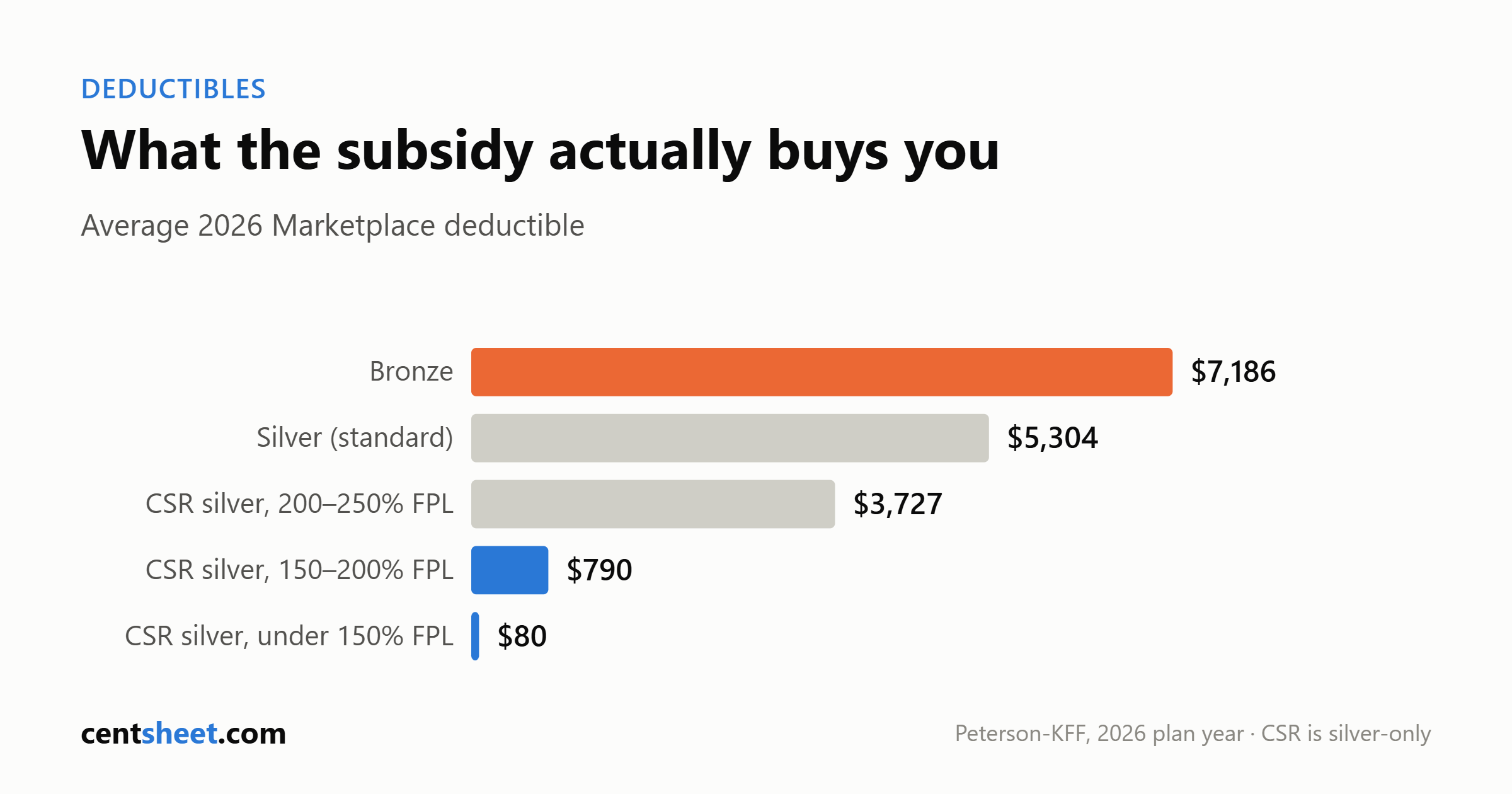
Tier averages for 2026, from the same brief (2026-01-14):
| 2026 average Marketplace deductible | Amount |
|---|---|
| Silver (standard) | $5,304 |
| Bronze | $7,186 — see note |
| CSR silver, under 150% FPL | $80 |
| CSR silver, 150–200% FPL | $790 |
| CSR silver, 200–250% FPL | $3,727 |
The note matters. That same brief yields $7,186 as the average bronze deductible in one place and $7,476 in the worked example and in its under-150%-FPL breakdown — probably different cuts of the data rather than a contradiction, but we could not confirm which is which, so we will not pick one and call it settled.
Cost-sharing reductions are the biggest lever, and they exist only on silver
CSR plans are silver variations that must hit specified actuarial values — 94%, 87% or 73% — under 45 CFR 156.420, and they are available only on silver, and only through the Marketplace. Not bronze, not gold, not off-exchange — and the table above shows the value.
They cut the out-of-pocket ceiling too: KFF’s 2026 self-only figures (as of 2025-09-29) are $3,500 for 100–200% FPL and $8,450 for 201–250% FPL, the lower band sharing one ceiling across two AV tiers. The income floor differs by state (roughly 100% FPL where Medicaid did not expand, above 138% where it did), which we found only in a search snippet. KFF also reports CSR uptake among eligible lowest-income enrollees fell to a record-low 37% in 2026 — most people entitled to the biggest discount in the system did not take it.
On the values themselves — bronze 60%, silver 70%, gold 80%, platinum 90%, under 45 CFR 156.140 — AV is the share of total allowed benefit costs a plan pays on average across a standard modeled population, not the share of your bill. A 60% AV bronze plan does not pay 60% of any given person’s costs. Plans may land slightly off their tier’s exact AV, and we will not state the permitted range: the provision expanding it was stayed nationwide on 2025-08-22 in City of Columbus v. Kennedy, reportedly vacated in June 2026 and under appeal in July.
The 2026 ceilings
Two rulebooks cap cost sharing, and they disagree; the stricter binds.
| 2026 limit | Self-only | Family / other than self-only |
|---|---|---|
| HDHP minimum deductible to be HSA-qualified | $1,700 | $3,400 |
| HDHP maximum out-of-pocket (HSA-qualified) | $8,500 | $17,000 |
| ACA maximum out-of-pocket (non-grandfathered) | $10,600 | $21,200 |
| HSA contribution limit | $4,400 | $8,750 |
The HSA and HDHP rows are the IRS’s, from Rev. Proc. 2025-19 (published 2025-05-19, for calendar 2026). The $1,700/$3,400 line is a floor — a deductible must be at least that to be HSA-qualified — while $8,500/$17,000 is a ceiling, and it is tighter than the ACA’s: an HSA-qualified plan caps your exposure more aggressively than the ACA requires.
The ACA row needs a warning label. CMS announced $10,150 / $20,300 for 2026 in October 2024; the June 2025 Marketplace Integrity and Affordability final rule revised the methodology and raised them to $10,600 / $21,200, about 4.4% higher. The higher pair is operative — the August 2025 court order stayed parts of that rule but declined to stay the premium adjustment percentage change behind these numbers — while the lower pair still circulates on sites published in late 2024. We could not fetch either CMS document (403); this rests on two KFF pages.
Two footnotes. Individual-market bronze and catastrophic plans became HSA-pairable on 1 January 2026 even where they fail the traditional HDHP tests (KFF, 2026-01-05) — not employer plans, and we could not verify the statute. And the $4,400 contribution limit is roughly half the $8,500 ceiling above it: one year of HSA contributions cannot fund a worst-case year.
Employer coverage is the same trade at a different scale
2025 survey-year figures from KFF’s Employer Health Benefits Survey, released 2025-10-22; the 2026 survey was not out at the time of writing.
| KFF 2025 Employer Health Benefits Survey | Single | Family |
|---|---|---|
| Average total annual premium | $9,325 | $26,993 |
| Average annual worker contribution | $1,440 | $6,850 |
| Year-over-year premium change | +5% | +6% |
The contribution row belongs in your break-even; it is what leaves your paycheck. KFF’s 2025 average single deductible was $1,886 among covered workers who have one — up from $1,773, up 17% since 2020 — with 34% facing $2,000 or more, and 53% at small firms. Do not set that against the $3,786 Marketplace average above: different populations, different years, and it excludes plans with no deductible.
The 2026 context, dated on purpose
The enhanced premium tax credits created by ARPA in 2021 and extended by the Inflation Reduction Act through 31 December 2025 expired on 1 January 2026 (KFF, 2026-01-09). Credits reverted to the pre-2021 structure, and the “nobody pays more than 8.5% of income” line went with them: for 2026 the scale tops out at 9.96% of income at 300–400% FPL, with no credit above 400%. We will not give a dollar figure for that cliff: the ones circulating are unverified, and 2026 coverage is measured against the 2025 poverty guidelines, not the 2026 ones ($15,960 for one person, $33,000 for four) that govern 2027.
The result: enrollment falling from 22.3 million in 2025 to roughly 17.5 million projected for 2026, and the average monthly premium payment after subsidy rising from $113 to $178 — up 58%, well below the 114% KFF projected, because people bought thinner coverage instead. Our most recent confirmation that the credits remain expired is KFF’s 2026-05-19 analysis. H.R. 1834, a three-year extension, passed the House 230-196 on 8 January 2026; S. 3385 had already failed to reach 60 votes. We found no evidence of enactment and could not reach congress.gov. Verify before relying on subsidy math.
What to actually do
1. Compute the two ends for every plan. Annual premium is the floor; annual premium plus out-of-pocket maximum is the ceiling. If one plan wins at both ends, stop. 2. If they cross, find where. The annual premium difference is what the richer plan costs you for certain; the deductible, coinsurance and copay rules tell you how much care it takes to earn back. 3. On the Marketplace, if you are in CSR range, price the silver variations first. The 2026 average CSR silver deductible under 150% FPL was $80, and CSRs exist only on silver, only through the Marketplace. 4. Check what your plan pays before the deductible. Preventive care carries no cost sharing, and copays often apply pre-deductible. 5. Confirm the family structure. Whether a per-person limit sits inside the family out-of-pocket maximum changes the math for a household where one member is sick. 6. If you take the high-deductible side, fund the deductible. Premium savings are only savings if the cash exists on the day of the bill; otherwise you converted a fixed cost into a credit-card balance. A sinking fund sized to the deductible is the mechanism, where you park it matters less than that it stays liquid, and it sits alongside your emergency fund. 7. If your employer’s offer costs more than 9.96% of household income for 2026, check the Marketplace. That threshold can make you subsidy-eligible. 8. Re-check the rules each open enrollment. Nothing in the mechanics above changes. Every dollar figure does.
This trade is not unique to health insurance — renters insurance has the same structure: pay more monthly to be exposed to less at once. The difference is scale. A renters deductible is a bad weekend. A 2026 bronze deductible is $7,186 — or $7,476, and we still cannot say which.
CentSheet publishes educational content, not personalized financial advice, and nothing here is legal, tax, or insurance advice. Verify current figures against your own plan documents before enrolling.
Get the CentSheet Money Brief
Email me CentSheet weekly: practical money decisions, new calculators, and useful worksheets. Unsubscribe anytime.