“FICO score” and “credit score” get used interchangeably. They are not the same thing, and the gap between them is where most credit confusion lives.
FICO is a company — Fair Isaac Corporation — that sells scoring models. A credit score is any number a model produces from a credit report. FICO makes many of them. So does VantageScore. The bureaus package both. The result is that you do not have a credit score. You have dozens, simultaneously, and they disagree.
Why there are so many
Four independent variables multiply together:
1. The model. FICO or VantageScore, primarily. 2. The version. FICO Score 8 is the most widely used base version, but 2, 4, 5, 9, 10 and 10 T all exist and remain in use. 3. The bureau. Equifax, Experian and TransUnion hold different data — and FICO builds separate bureau-specific models, so even identical reports at all three would still produce different FICO Scores. 4. The moment. A score is a snapshot of one report at one instant. Yesterday’s is already a different number.
Experian’s own framing is that creditors and score providers can choose from “dozens” of different scores. There is no fixed count, and anyone telling you that you have exactly N credit scores is simplifying.
The scale is not a reliable signal either
Base FICO Scores run 300–850. VantageScore 3.0 and 4.0 also run 300–850. Two completely different models producing identically-shaped numbers is the single biggest source of confusion in this whole subject.
Meanwhile, FICO’s own industry-specific scores — FICO Auto Score, FICO Bankcard Score — run 250–900. So a number outside 300–850 is not an error; it is a different product.
A useful discipline: a credit score without a model, a version, and a bureau attached is not comparable to any other credit score. Not to your last one, not to your partner’s, not to the one your lender pulled.
Which score gets used where
| Use case | Typical model |
|---|---|
| General lending | FICO Score 8 (most widely used base version) |
| Mortgage (conventional, classic) | FICO Score 2 (Experian), 4 (TransUnion), 5 (Equifax) |
| Auto | FICO Auto Scores (250–900 scale) |
| Credit cards | FICO Bankcard Scores, FICO Score 8, or FICO Score 9 |
| Free consumer sites | Usually a VantageScore; version varies by provider |
Mortgage lending is the striking one. The versions it uses — branded Equifax Beacon 5.0, Experian/Fair Isaac Risk Model V2, TransUnion FICO Risk Score Classic 04 — are considerably older than the general-purpose versions. That is not an oversight. Lender adoption is voluntary: FICO says each lender decides if and when to upgrade, and some choose never to.
For cards, note that FICO’s own materials do not name a single dominant version. If you have read that issuers use FICO Bankcard Score 8, that is more specific than FICO itself claims.
Why your free score differs from the lender’s
The CFPB studied this using 200,000 credit files from each bureau and found that roughly one in four to one in five consumers would likely receive a meaningfully different score than their creditor would.
(That range is not us hedging. The CFPB’s 2012 press release says one in five; its consumer-facing page, citing the same study, says one in four. We report both rather than pick.)
The CFPB gives three structural reasons, and they are worth memorizing because they cover essentially every case:
- The lender used a different model than the one you bought or were given.
- Your score came from a different bureau than the lender pulled.
- The underlying data changed between the two pulls.
The CFPB also has a specific term for consumer-facing scores that lenders rarely or never use: educational scores. Its advice is blunt — find out what kind of score you are being offered before relying on it.
Concretely: Credit Karma states its free scores are VantageScore 3.0 based on TransUnion and Equifax data. Experian’s free consumer score is a FICO Score 8 on Experian data. “Free” tells you nothing about the model. Check.
What each model actually weighs
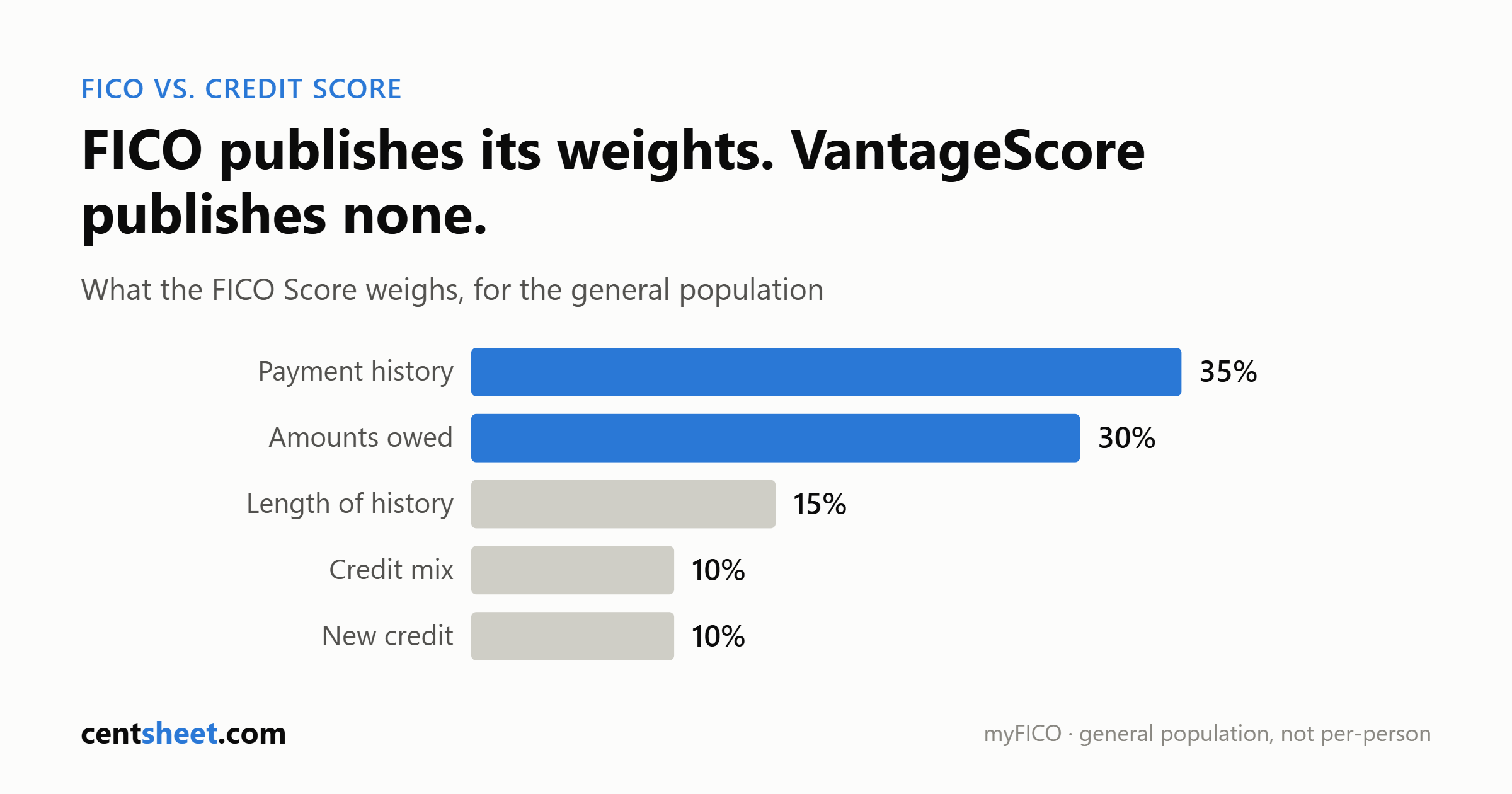
FICO publishes its factor weights for the general population:
| Factor | Weight |
|---|---|
| Payment history | 35% |
| Amounts owed | 30% |
| Length of credit history | 15% |
| Credit mix | 10% |
| New credit | 10% |
Two caveats FICO itself attaches, both of which get stripped off when this table is reproduced elsewhere. The weights are for the general population and “may be different for different credit profiles.” And the exact impact of any single factor cannot be measured without looking at the entire report.
VantageScore does not publish percentages at all. It describes factor importance in qualitative bands — payment history “extremely influential,” total credit usage “highly influential,” and so on. You will find precise-looking VantageScore percentage tables on aggregator sites; they are not VantageScore’s published figures. The two models are not symmetrical in what they disclose, and presenting them side by side as though they are is a small dishonesty that has spread widely.
Who can be scored at all
This is a real, practical difference rather than a technical one.
FICO requires a credit report with at least one account opened six months or more, at least one account reporting to that bureau within the past six months, and no deceased indicator. One account can satisfy all of it — but the six-month seasoning is a hard gate.
VantageScore has a much lower bar: a file containing a credit account, a bankruptcy filing, or a collection account can be scored, with no six-month seasoning or recency requirement. VantageScore markets 4.0 as able to score someone with as little as a month of history, and as able to use rent, utility and telecom data where it appears in the file.
If you are new to credit and have a VantageScore but no FICO Score, that is not a glitch. It is the models working as designed. Our guide to getting a first credit card covers the practical route through that window.
VantageScore claims its 4.0 model can score roughly 33 million more US adults than conventional models. Treat that as a contested vendor claim — FICO and the American Enterprise Institute’s Housing Center have both disputed the methodology behind it.
Trended data: the real modernization
The most meaningful difference between old and new versions is not the weights. It is whether the model looks at a snapshot or a trend.
The most common FICO versions assess your utilization from the single moment the score is pulled. VantageScore 4.0 and FICO Score 10 T evaluate trended data — how balances have behaved over the preceding 24 months or more.
That changes the strategy. Under a snapshot model, timing a payment before your statement closes presents a better number. Under a trended model, the pattern over two years is visible, and a single well-timed month matters less. Both kinds of model are in use right now, which is why the timing trick still works — just not everywhere.
FICO Score 9, from 2014, made a different refinement: it bypasses collection accounts reported as paid in full and treats medical collections less severely than non-medical ones. FICO said at the time that consumers whose only major negatives were medical collections saw a median increase of 25 points. That figure is from FICO’s 2014 announcement and describes a model change, not today’s market — do not read it as a promise.
What is changing in mortgages right now
In April 2026, FHFA announced that Fannie Mae and Freddie Mac would accept VantageScore 4.0 alongside Classic FICO, and that FHA will permit VantageScore 4.0 and FICO 10T.
The details matter more than the headline:
- It is an interim phase. Approved lenders may choose between Classic FICO and VantageScore 4.0, and the Enterprises will not accept scores from multiple models on a single loan.
- Classic FICO has not been retired. It remains permitted and remains what most borrowers are scored on.
- FICO 10T is not in production use for GSE loans. Historical 10T data was expected in Summer 2026, with model adoption later.
- FHA has announced intent, not implementation — we found no Mortgagee Letter confirming an effective date.
Adoption is real but partial. If you are buying a house, ask your lender which model they are using rather than assuming. The rest of the picture is in what credit score you need to buy a house.
The practical takeaways
1. Stop tracking the number. Track the direction. Comparing a free VantageScore to a lender’s FICO tells you nothing useful; comparing your own score to itself over time does. 2. Before a big application, get the right score. For a mortgage, that means a tri-merge with the mortgage FICO versions — not your app. 3. Never assume a fixed offset. There is no reliable “your VantageScore runs 20 points above your FICO.” No primary source supports any such rule. 4. Improve the inputs, not the readout. Payment history and utilization drive every model. Fixing those moves all your scores; nothing else moves them all.
FICO says its scores are used in 90% of top lending decisions — worth knowing, and worth noting it is FICO’s own claim about its own market share.
And the standing rule for this entire subject: no honest source can tell you what a specific action is worth in points. FICO says outright that the impact of a single factor cannot be measured without the full report. Both models are proprietary. Anyone quoting you a number is selling something.
CentSheet publishes educational content, not personalized financial advice.
Get the CentSheet Money Brief
Email me CentSheet weekly: practical money decisions, new calculators, and useful worksheets. Unsubscribe anytime.