The kitchen is the most expensive room in most renovations and the one with the widest possible price range. Ask what a kitchen remodel costs and the honest answer is “somewhere between $10,000 and $80,000,” which helps nobody.
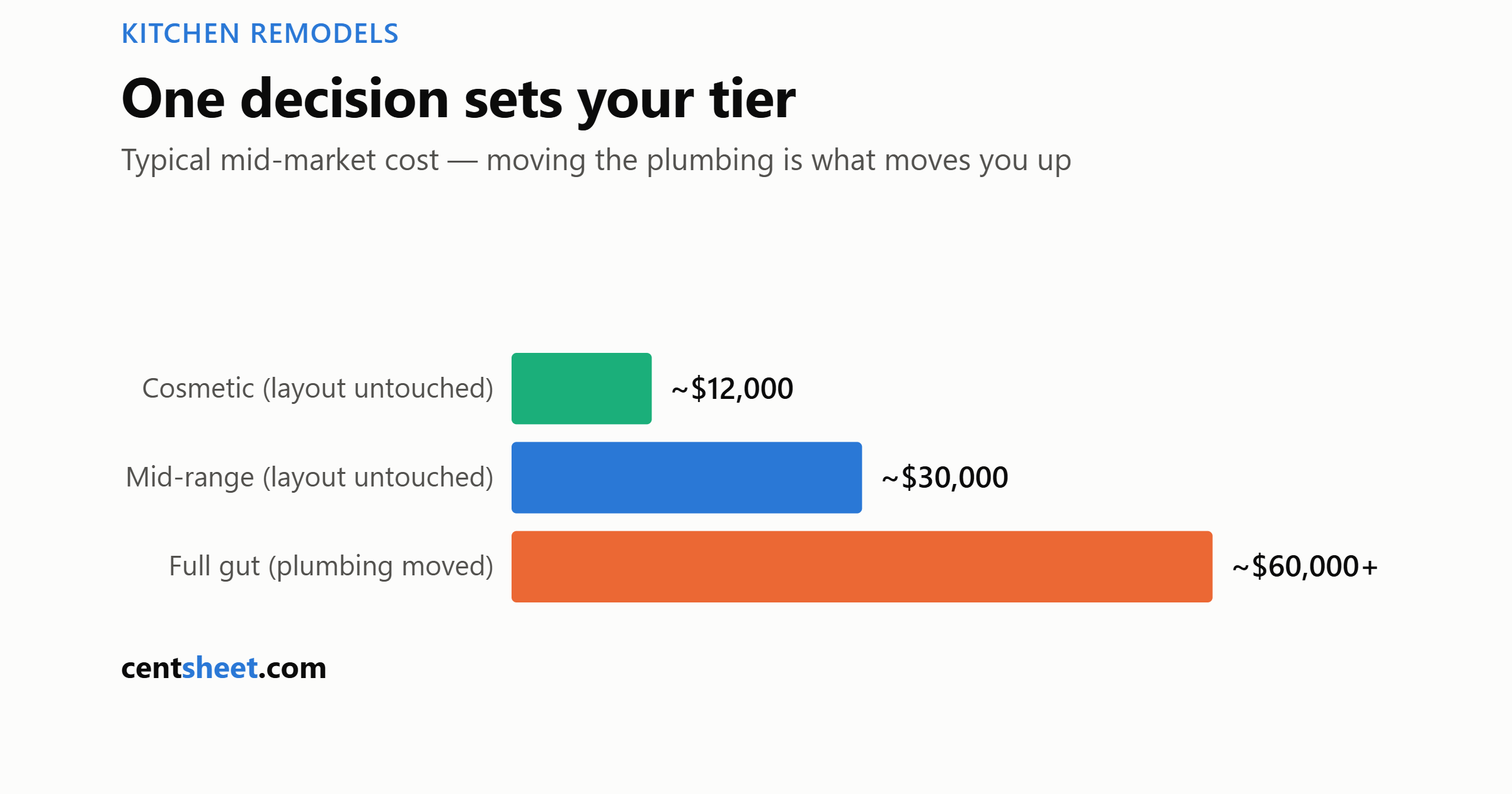
It becomes useful once you see that kitchens cluster into three tiers, and that one decision moves you between them.
The three tiers
Illustrative figures, mid-market, for a standard-size kitchen:
| Tier | Typical cost | What it is |
|---|---|---|
| Cosmetic | ~$12,000 | Paint, cabinet refacing or new doors, new counters, new hardware, appliances. Layout untouched. |
| Mid-range | ~$30,000 | New cabinets, counters, appliances, flooring, lighting. Layout mostly untouched. |
| Full gut | ~$60,000+ | Everything above plus moved plumbing, moved gas, rewiring, possibly walls. |
The decision that sets your tier
Do you move the sink, the stove, or a wall?
If no, you are in the first two tiers and the project is essentially replacement. If yes, you are in the third, because moving water and gas means opening floors and walls, permits, inspections, and multiple trades scheduled in sequence.
That single question explains most of the price gap. A kitchen that keeps its layout and gets everything else replaced is dramatically cheaper than the same kitchen with the sink relocated three feet — and once the floor is open, the renovation surprises start.
Worth asking honestly: is the current layout actually broken, or just dated? Dated is a cosmetic-tier problem. Broken — no counter space beside the stove, a fridge that blocks a doorway — may genuinely justify the jump.
Where the money goes
Within any tier, the spend concentrates in cabinets (usually the single largest line, often a third or more of the budget), then counters, then appliances. Labor typically runs a substantial share of the total on anything beyond cosmetic.
The practical consequence: cabinets are where the biggest savings live. Refacing rather than replacing, or keeping the existing boxes and replacing only doors and drawer fronts, can move a project down most of a tier without looking like a compromise.
Appliances are the other big lever, and the easiest to overspend on. A professional-grade range in a kitchen that reheats leftovers is a preference, not a requirement — a legitimate one, but it should be a decision rather than a default.
Budgeting it
Whatever tier you pick, add the contingency: a 20% line on top, non-negotiable, because kitchens involve plumbing and plumbing involves surprises. A $30,000 mid-range kitchen is a $36,000 project.
Then bank it before starting. At $1,250/month, a $30,000 kitchen takes 24 months to fund as a sinking fund — and a kitchen paid for in cash costs $30,000, while the same kitchen on credit at 24% APR costs substantially more and takes years.
On “recouping the cost at resale”
You will read that kitchen remodels return most of their cost when you sell. Treat those figures skeptically: they are averages across markets, they compare against homes with unrenovated kitchens, and they generally show remodels recouping part of their cost, not all of it. Renovation is spending, not investing. Do it because you want a better kitchen — a genuinely good reason — rather than because it pays for itself, because it usually doesn’t.
CentSheet publishes educational content, not personalized financial advice. Cost tiers are illustrative and vary substantially by region, kitchen size and material choices.
Get the CentSheet Money Brief
Email me CentSheet weekly: practical money decisions, new calculators, and useful worksheets. Unsubscribe anytime.