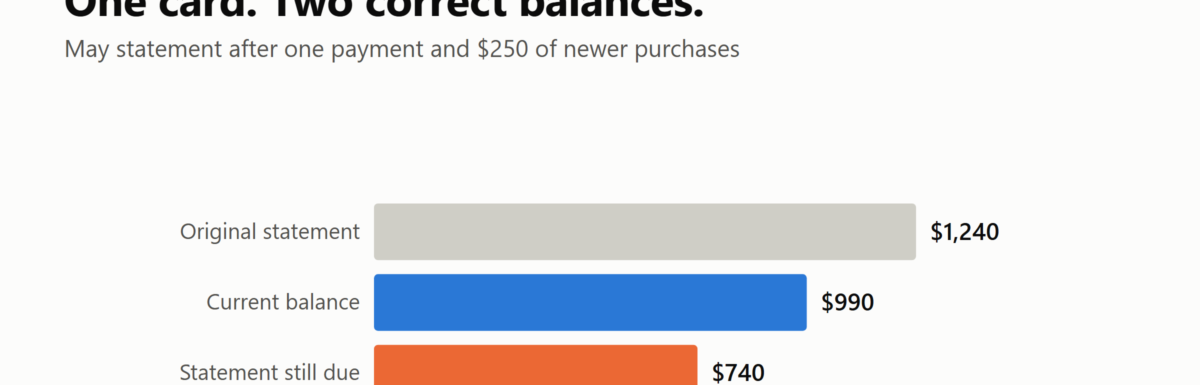
Your statement balance is a photograph. Your current balance is a live feed.
The statement balance records what you owed when the last billing cycle closed. The current balance keeps moving as later purchases, payments, credits, fees, and interest post. That is why both numbers can be correct even when they are hundreds of dollars apart.
If your card gives you a grace period on purchases and you are not already carrying interest-bearing debt, paying the statement balance in full by its due date will generally avoid purchase interest. Paying the current balance can also do that, but it may pay purchases that are not due until the next statement. Paying only the minimum keeps the account from being treated as unpaid; it usually does not protect the grace period.
| Balance shown | What it measures | What it is for |
|---|---|---|
| Statement balance | Amount owed when the last cycle closed | The usual pay-in-full target for that statement |
| Current balance | Posted activity through now | A live account total, not necessarily all due now |
| Minimum payment | Smallest required payment by the due date | Avoiding a missed required payment, not avoiding interest |
| Available credit | Credit line minus posted balance, with issuer adjustments | Whether another transaction may fit, not what you owe |
Your own statement and card agreement control. The labels in an app are useful shortcuts, not substitutes for those documents.
One billing cycle, frozen and then restarted
Take a card with a $5,000 credit line and no carried balance. Its billing cycle closes on May 31, and the payment is due June 25.
At the May 31 close, posted purchases total $1,240. The statement balance and current balance are both $1,240. The statement shows a hypothetical $40 minimum payment.
Then June activity begins:
| Date | Posted activity | Statement balance | Current balance | Statement amount still unpaid |
|---|---|---|---|---|
| May 31 | Cycle closes | $1,240 | $1,240 | $1,240 |
| June 3 | New purchase: $180 | $1,240 | $1,420 | $1,240 |
| June 6 | Payment: $500 | $1,240 | $920 | $740 |
| June 8 | New purchase: $70 | $1,240 | $990 | $740 |
This is a CentSheet calculation: $1,240 + $180 – $500 + $70 = a $990 current balance. The original statement balance remains the May 31 snapshot. After the $500 payment, $740 of that snapshot remains unpaid. Some apps display the original statement balance; others prominently display a separate “remaining statement balance.” Check the label.
If the cardholder is eligible for a purchase grace period, paying the remaining $740 by June 25 is the relevant target in this example. Paying $990 would also clear every posted dollar, but the extra $250 consists of June purchases that normally belong to the next statement. There is no interest prize for paying those purchases weeks early.
The example excludes pending authorizations, refunds, disputes, cash advances, balance transfers, fees, interest, and transactions posted out of order. Those exclusions matter in a real account.
Why the statement balance is the cycle's official number
Federal disclosure rules use the term new balance for the balance outstanding on the billing-cycle closing date. Regulation Z's periodic-statement rule requires the closing date and new balance to appear on the statement, together with payment and cost disclosures.
The CFPB's model credit-card contract definitions describe the bill as showing what is owed at the end of the billing period and the minimum that must be paid by the stated due date. That is the statement balance: a closed accounting period, not a real-time total.
The current balance is operational. It usually starts with the statement balance, adds later posted transactions and subtracts posted payments and credits. An issuer may update different transaction types at different times. A restaurant authorization can change when the tip settles. A refund may take days to post. Interest may appear only at cycle close.
So “current” does not mean “final,” and “statement” does not mean “stale.” They answer different questions.
Payment timing for a purchase grace period is also different from payment timing for a reported balance. A payment before the cycle closes may reduce the statement balance an issuer later reports, but issuers and scoring models differ. Our credit-utilization guide covers that separate question. Do not carry interest merely to create a balance for a credit score.
What to pay to keep a purchase grace period
A grace period is the time between the end of a billing cycle and the payment due date during which eligible purchases can be repaid without periodic interest. Card issuers are not required to offer one, and grace periods commonly apply to purchases rather than cash advances.
The CFPB's grace-period guidance says that, when a card offers a grace period and the cardholder is not carrying a balance, paying the balance in full by the due date can avoid interest on new purchases. As of August 14, 2026, Regulation Z also generally requires issuers to adopt procedures so a credit-card statement is mailed or delivered at least 21 days before the due date. That timing rule does not create a grace period where the agreement offers none.
The practical hierarchy is:
- Pay the statement balance in full by the due date if preserving the purchase grace period is the goal and the agreement says you are eligible.
- Pay at least the minimum by the due date if full payment is impossible. This avoids missing the required payment, but interest may accrue.
- Pay more than the minimum as early as practical when interest is already accruing. Many issuers calculate interest daily, so earlier principal reduction can help.
This is why a reliable first-credit-card setup usually pairs modest spending with statement-balance autopay. It is also why APR and APY are not interchangeable; our APR-versus-APY explanation shows what the annual rate does and does not tell you.
Autopay is only as good as its setting
“Autopay on” is incomplete information. Common choices include:
- Minimum payment: protects against accidentally paying nothing, but can leave most of the balance accruing interest.
- Statement balance: usually the cleanest option for a card used only for purchases by someone retaining a grace period.
- Fixed amount: useful only if the amount is deliberately maintained above the required payment and fits the payoff plan.
- Current or full account balance: offered by some issuers, but definitions and timing vary.
Three details deserve a manual check.
First, find out whether a payment made before autopay reduces the scheduled withdrawal. In the timeline above, the $500 manual payment might reduce a $1,240 statement-balance autopay to $740—or the issuer might still pull the original amount. Issuer systems differ.
Second, confirm the bank account has enough settled cash. A returned autopay is not a successful payment.
Third, inspect the next statement after changing autopay. Do not assume a new setting applies to a payment already scheduled.
A refund or merchant credit posted after the statement closes may reduce what remains to be paid, even though the original statement PDF still shows its frozen total. Check the issuer's “remaining statement balance” and how the credit was allocated before sending the original amount blindly. There is no benefit in deliberately creating a negative account balance merely to match an old snapshot.
If cash flow is tight, set a calendar alert several days before the debit. Paying a card should not cause the checking account problem described in our guide to escaping paycheck-to-paycheck timing.
Pending transactions are a fifth number, not debt twice
A pending transaction is generally an authorization that has not fully posted. It may reduce available credit without appearing in the current balance, or it may appear in a separate pending total. Hotels, gas stations, and car-rental companies can authorize an amount that differs from the final charge.
Return to the $990 current-balance example. If a $90 purchase is pending, an app might show:
- Current balance: $990
- Pending: $90
- Available credit: about $3,920
That available-credit estimate is a CentSheet calculation: $5,000 – $990 – $90 = $3,920. It assumes the issuer reserves the full authorization and makes no other adjustments. The $90 should not also be added to the current balance if it is already included there; app presentation varies.
Pending does not mean imaginary. Budget for the likely final charge. But do not send a payment merely to force the current balance to include an authorization that has not settled.
Available credit also is not the same as a spending budget. A $4,000 opening under a credit limit says what the issuer may permit, not what the household can repay.
If you are already carrying interest-bearing debt
Once a grace period is lost, “pay the statement balance” may not instantly return the account to interest-free status. The CFPB notes that interest can continue until payment is received and that card agreements differ. Its interest-calculation explainer says many issuers use a daily balance, so paying sooner can reduce interest when no grace period applies.
You may also see residual or trailing interest on the next statement: interest that accrued between the prior statement and the day the payoff arrived. Request a current payoff amount from the issuer if the goal is a true zero.
Stop using the card for new purchases while the old balance is being cleared unless the agreement and budget make the consequences explicit. Then compare a fixed payoff amount in the debt payoff calculator and choose an ordering method using the avalanche-versus-snowball math. The important move is increasing principal reduction, not chasing an app label.
You can find a general agreement in the CFPB's credit-card agreement database, but account-specific pricing and promotional terms may differ. Ask the issuer for the agreement governing your account.
What to actually do
- Open the latest PDF statement, not only the app dashboard.
- Confirm the statement balance, minimum payment, due date, purchase APR, and grace-period wording.
- Subtract any payments or credits already applied to that statement; do not subtract later purchases.
- If eligible and affordable, pay the remaining statement balance by the due date.
- Set autopay deliberately, then verify how manual payments affect the scheduled debit.
- Keep pending authorizations separate from posted balances and reserve cash for the final amounts.
- If interest is already accruing, stop new charges, request a payoff figure, and make a fixed debt-reduction plan.
CentSheet publishes educational content, not personalized financial advice. Card agreements, grace periods, transaction posting, and autopay behavior vary by issuer and account. This is not a credit offer; verify the current statement and agreement with your card issuer. Examples are mathematical illustrations based on the stated assumptions.
Get the CentSheet Money Brief
Email me CentSheet weekly: practical money decisions, new calculators, and useful worksheets. Unsubscribe anytime.