Subscriptions are the only product category engineered to be forgotten. The price point sits below the pain threshold, billing is automatic, and the cancel button lives behind three menus. This is not an accident; “breakage” — customers who pay and don’t use — is a line item in these business models.
Which makes the audit less like budgeting and more like pest control: routine, slightly tedious, and immediately rewarding. Households that do it for the first time routinely surface $50–150/month of forgotten or half-wanted recurring charges — real money, worth $200/month-at-7% money over time.
The 30-minute hunt
Subscriptions hide in five places; check all five, because no single list has them all:
1. 12 months of card and bank statements — the master list. Twelve months, not one: annual renewals (domains, software, memberships) are the biggest and best-hidden category. Search for last year’s charge amounts you don’t recognize. 2. App store subscriptions — the phone’s subscription page (both platforms have one). App subscriptions billed through the store never appear with recognizable names on card statements. 3. PayPal / payment-app recurring payments — a separate ecosystem with its own auto-renewals page. 4. Email search for “your subscription,” “renewal,” “receipt,” “trial ending.” 5. The shared-household blind spot — the streaming service each partner thought the other one wanted.
Write down every one with its real monthly cost (annual ÷ 12). The list is usually longer than predicted; that reaction is the finding.
The keep/kill/pause test
For each line, one question with teeth: “If this weren’t already set up, would I sign up for it today, at this price?” Not “do I use it sometimes” — subscriptions survive on sometimes.
- Keep: yes without hesitation. Fine. Money exists to be spent on things you value.
- Kill: no, or a pause before answering. Cancel today, not “after I use it one more time” — that’s the breakage model talking.
- Pause or rotate: the honest middle for streaming. You don’t need four services simultaneously; you need one at a time, and resubscribing later is always allowed and often discounted. Rotating two “sometimes” services saves half their cost with zero lifestyle change.
- Downgrade: the forgotten option — family plans nobody shares, premium tiers whose features you can’t name, annual plans for monthly-usage products (or the reverse: anything you keep for years is cheaper annually).
Expect friction on the way out: cancellation flows offer retention discounts (take them for keeps, ignore them for kills), “are you sure” loops, and occasionally phone-only cancellation. Budget five annoying minutes per kill and push through in one sitting.
Keeping it clean afterward
- Route the found money on purpose — raise the automated savings transfer by the audit amount that same day, or it re-dissolves into spending.
- Calendar every free trial’s end date the moment you start one.
- Calendar the annual renewals you kept, a week before they hit.
- Re-audit every six months — a standing 30-minute appointment. New subscriptions accumulate at a remarkably stable drip; the audit is maintenance, not a one-time purge.
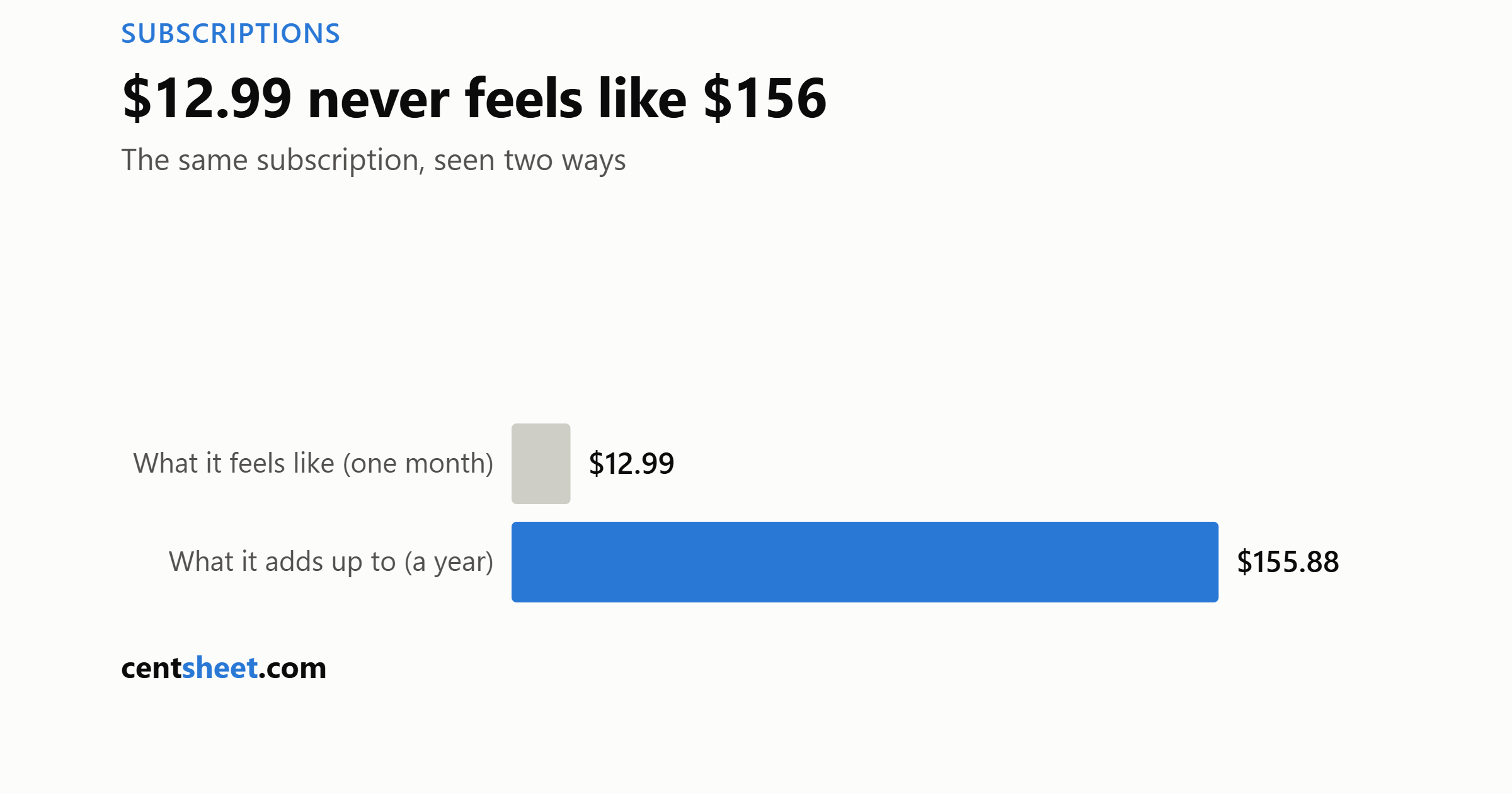
The meta-lesson is the pricing psychology: $12.99/month never feels like $156/year, and that gap between feeling and arithmetic is the entire business model. The audit is just arithmetic, applied.
CentSheet publishes educational content, not personalized financial advice.
Get the CentSheet Money Brief
Email me CentSheet weekly: practical money decisions, new calculators, and useful worksheets. Unsubscribe anytime.