Most 30-day money challenges are a fast: no eating out, no shopping, no fun. They work for 30 days and then reverse completely, because deprivation isn’t a system — it’s a held breath.
This one has a different goal. You’re not trying to spend less for a month. You’re trying to end the month with a permanently lower run rate and a written list of where the money was going.
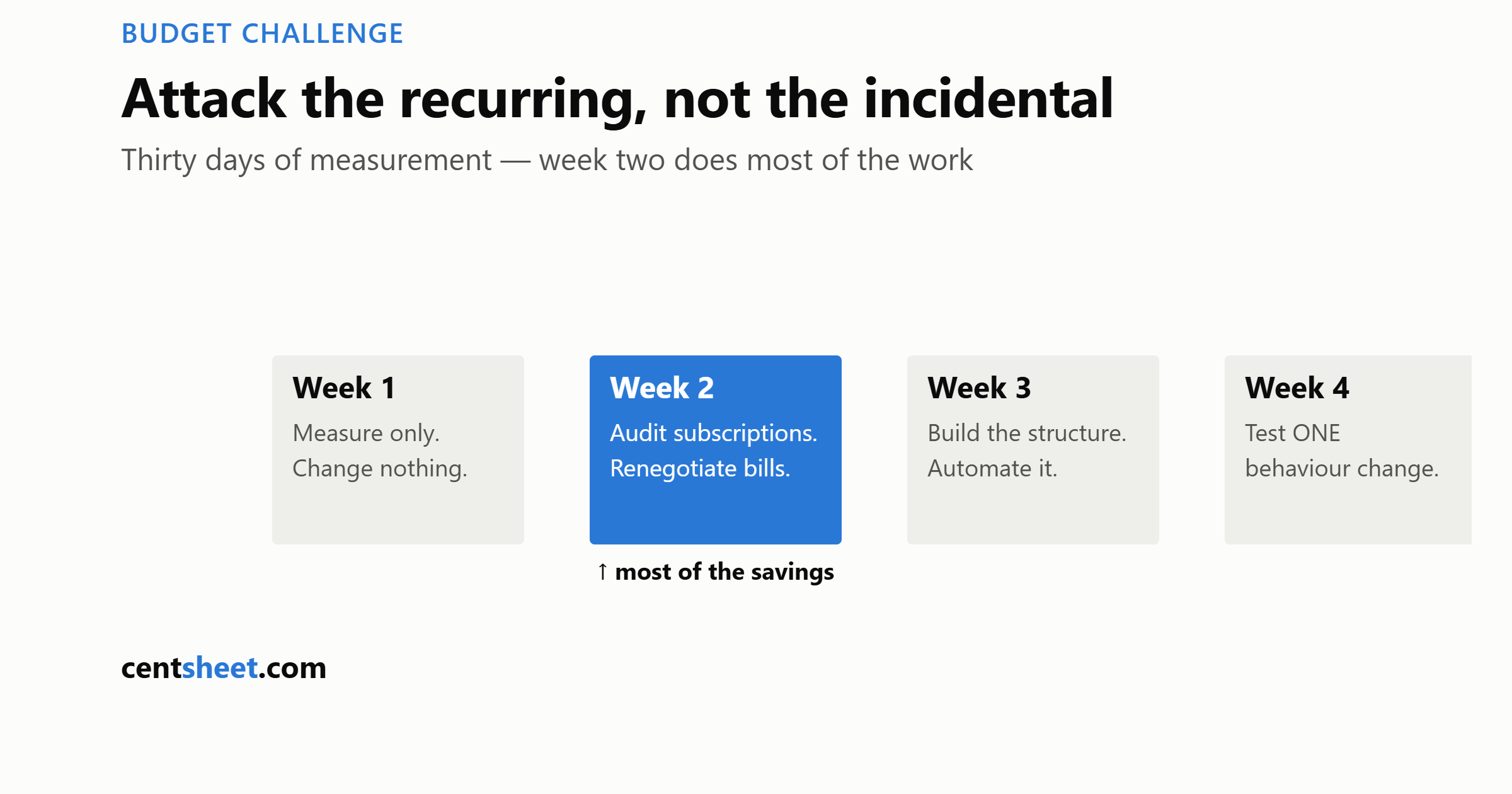
Week 1 — Measure only. Change nothing.
The instruction for week one is genuinely to change nothing. Buy what you would have bought. The only new behaviour is recording it.
Categorise every transaction — needs, wants, savings — and be honest rather than flattering. The reason for not changing anything yet is that a modified week produces a measurement of your intentions, and intentions are not what your budget is made of.
At the end of the week you’ll have a number you probably couldn’t have guessed within $200. That surprise is the point.
Week 2 — Attack the recurring, not the incidental
Now do the two things that produce most of the year’s savings, both of which are one-time actions with permanent effect:
Run a subscription audit. Twelve months of statements, the app-store subscription page, PayPal recurring payments. Households routinely find $50–150/month they’d forgotten they were spending.
Run a bill-audit day. Internet, phone, insurance. Three calls, roughly twenty minutes each, with a competitor’s price in front of you.
This week matters more than the other three combined, and it costs you no lifestyle at all. You are cutting the recurring line, which pays out every month forever, rather than the incidental one, which pays out once.
Week 3 — Build the structure
With real numbers in hand, install the machinery:
- Run your actual figures through the budget calculator to see which category is genuinely over — and whether you have a leak problem or a cost-structure problem, because the fixes are completely different.
- Set up sinking funds for the irregular expenses week one exposed. This is the step that stops future months being ambushed.
- Automate a transfer on payday, so saving stops depending on willpower.
- If you have high-interest debt, run the payoff calculator and pick a method.
Week 4 — Test one behavioural change
Now, and only now, pick one habit to change — the single largest want-category from week one. Not five. One.
One change tested for a week tells you whether it’s sustainable. Five changes tested at once tell you nothing, fail together, and convince you that budgeting doesn’t work for you.
What “success” looks like
Not a month of misery followed by a rebound. Success is:
- You know your real monthly number, which you didn’t on day one
- The recurring line is permanently lower, with no ongoing effort
- Irregular expenses have funded homes instead of ambush potential
- Saving happens automatically
- You’ve tested exactly one behaviour change and know whether it holds
That’s a system that keeps working in month two, which is the only test that matters. If you want the longer arc afterwards, the paycheck-to-paycheck exit sequence is the same logic extended over months rather than weeks — and zero-based budgeting is the power-tool upgrade if week one revealed leaks you couldn’t locate.
One honest note
If week one shows that your needs alone exceed your income, the challenge has done its job by telling you that — and no amount of week-four behaviour change will close it. That’s a structural situation, and the levers are housing, transport, and income. Finding that out in 30 days with numbers attached is still a far better outcome than another year of not knowing.
CentSheet publishes educational content, not personalized financial advice.
Get the CentSheet Money Brief
Email me CentSheet weekly: practical money decisions, new calculators, and useful worksheets. Unsubscribe anytime.