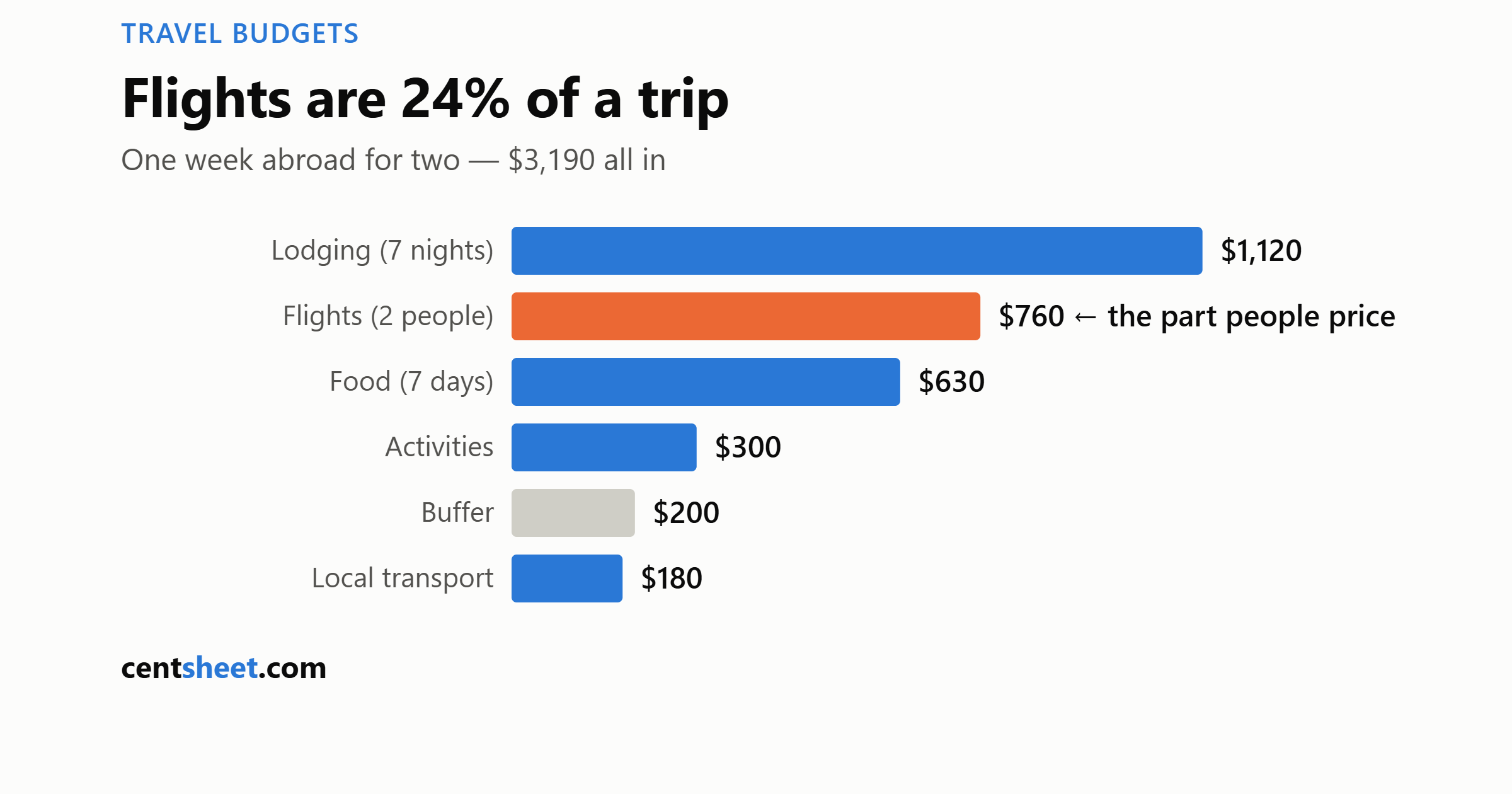
Most people budget a trip by pricing the flights, because flights are the part with an obvious number attached. Flights are usually under a quarter of the real cost.
Here is the whole formula.
The six lines
A one-week international trip for two, illustrative mid-range:
| Line | Cost |
|---|---|
| Flights (2 × $380) | $760 |
| Lodging (7 nights × $160) | $1,120 |
| Food ($45/person/day) | $630 |
| Local transport | $180 |
| Activities and entry fees | $300 |
| Buffer | $200 |
| Total | $3,190 |
$1,595 per person — and flights are 24% of it. Lodging and food together are 55%.
That ratio is the useful part. Chasing a $60 cheaper flight while adding a night to the trip is a losing trade, and people make it constantly because the flight price is the one they were watching.
Building your own version
The formula is: flights + (nights × nightly rate) + (days × daily food) + local transport + activities + buffer.
Two lines deserve care:
Daily food is the most underestimated number in travel budgeting. $45/person/day means real restaurants for some meals and not others. Eating out three times a day in an expensive city can double it. Estimate honestly against how you actually travel, not how you intend to.
The buffer is a real line, not padding. Trips generate unplanned spending — a taxi when you are exhausted, a ticket that costs more than advertised, a pharmacy visit. Budgeting zero for it means every one of those comes out of a category that was already spoken for.
The costs that get left off entirely
- Travel insurance, which is genuinely worth buying for international trips with prepaid non-refundable bookings
- Baggage fees, which on budget airlines can approach the fare
- Airport parking or transport at your own end — easily $100+ for a week
- Roaming or a local SIM
- Pet or house sitting
- Currency conversion spreads and foreign transaction fees, which quietly add a few percent to everything you spend abroad — a card without foreign transaction fees pays for itself on one trip
Fund it as a sinking fund, not a credit-card decision
A trip has a date. That makes it textbook sinking-fund material: $3,190 six months out is $532/month.
The alternative — booking now and paying later — converts a $3,190 holiday into a debt at 24% APR that outlives the tan. There is a specific trap here worth naming: buy-now-pay-later offers at checkout make an unaffordable trip feel affordable by splitting it into four payments. The trip did not get cheaper; the decision just got easier to make badly.
If the sinking fund says you can’t have the trip on your timeline, the honest options are a cheaper trip, a later trip, or a shorter one — all better than the fourth option, which is the same trip plus interest.
The one genuinely large lever
Trip length drives everything except flights. Cutting seven nights to five removes two nights of lodging, two days of food, and some activities — roughly $500 on this budget, without changing the destination or the experience much. Meanwhile a shoulder-season date change can move both flights and lodging simultaneously.
Destination, length, and timing are the three big dials. Everything else is rounding.
CentSheet publishes educational content, not personalized financial advice. Figures are illustrative for a mid-range international trip; costs vary enormously by destination and travel style.
Get the CentSheet Money Brief
Email me CentSheet weekly: practical money decisions, new calculators, and useful worksheets. Unsubscribe anytime.