The default way to buy a car is to finance it, because that is how cars are sold. The arithmetic of the alternative is rarely laid out, so here it is.
The two options, priced
An $18,000 used car:
| Approach | Monthly | Time | Total paid |
|---|---|---|---|
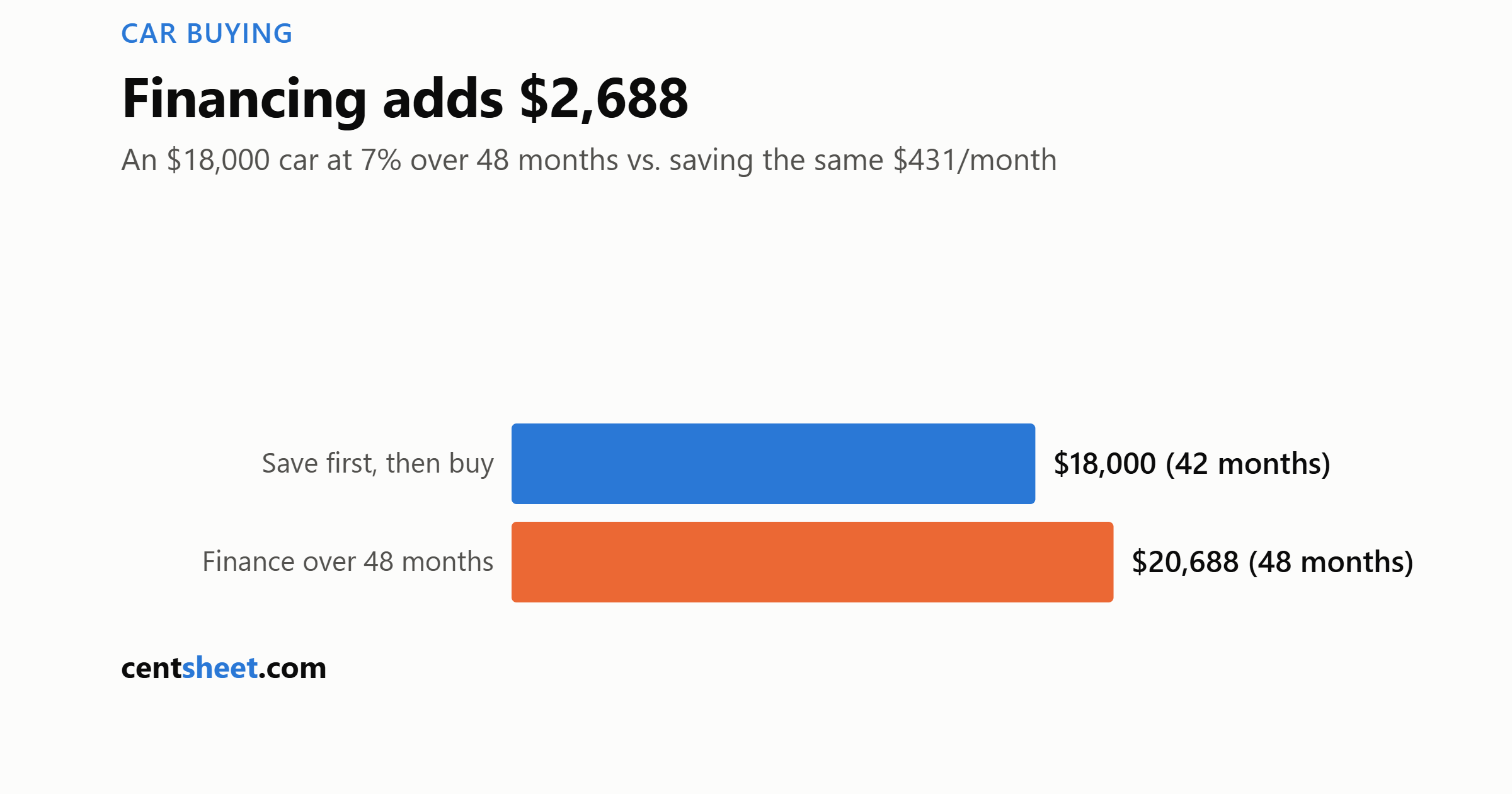
| Finance at 7% over 48 months | $431 | Drive immediately | $20,688 |
| Save $431/month, then buy | $431 | 42 months of waiting | $18,000 |
The interest is $2,688 — about 15% on top of the car. And the saving route is faster in months (42 vs 48) because none of your money goes to a lender.
The catch is obvious and real: financing gets you a car today; saving gets you one in three and a half years. For most people who need a car to work, “no car for 42 months” is not an option, which is why the honest comparison isn’t these two columns.
The third option, which is the actual answer
Buy a cheaper car now with cash, then save the phantom payment for the next one.
A $6,000 car bought outright, followed by $431/month saved for 36 months, produces $15,516 plus whatever the old car is worth at trade-in — enough to buy the $18,000 car in cash three years later, having paid zero interest and driven the whole time.
This is the mechanic that quietly separates people who always have a car payment from people who never do. The first car purchase is the hard one; after that, the dead payment funds the next car and the cycle inverts.
If you are financing anyway
Sometimes you are, and that is a legitimate decision. Three things then matter more than the monthly payment:
Get pre-approved before you shop. A bank or credit union rate is a number you can compare against; dealer financing offered after you have chosen the car is a negotiation you have already lost. Your credit score drives this rate directly.
Cap the term at 48 months. As covered in the affordability article, stretching to 72 months lowers the payment and raises the cost, while keeping you underwater — owing more than the car is worth — for most of the loan.
Negotiate the price, not the payment. “What monthly payment works for you?” is the question that lets a longer term hide a higher price. Settle the total first.
Where the savings should sit
A car fund has a date and needs certainty of value, which means a high-yield savings account, not the market. At around 4% APY, an $18,000 fund building over three years earns a few hundred dollars along the way — not life-changing, but strictly better than the same money sitting in checking at nothing.
And the costs beyond the car
Whatever route you take, the purchase price is not the cost of ownership. Insurance, fuel, maintenance and registration are the recurring bill, and the 20/4/10 rule caps all of it at 10% of gross income for good reason — a car you can buy but not run is not affordable.
CentSheet publishes educational content, not personalized financial advice. Rates and prices are illustrative; your loan terms and local market will differ.
Get the CentSheet Money Brief
Email me CentSheet weekly: practical money decisions, new calculators, and useful worksheets. Unsubscribe anytime.