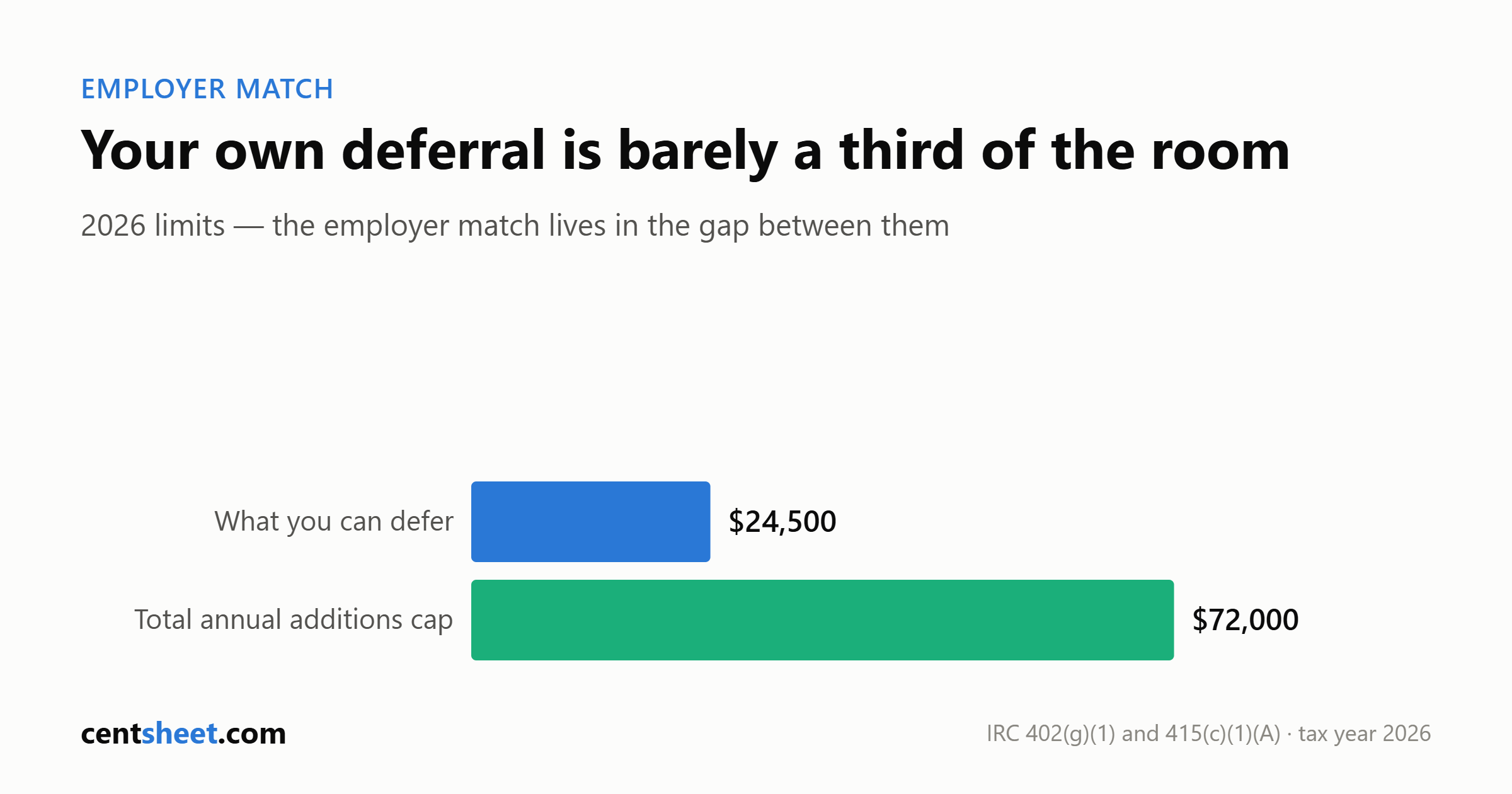
You can defer the full 2026 limit of $24,500 into your 401(k) and still finish the year with less employer match than a coworker who contributed less than you did. That is not an edge case. It is the ordinary result of two plan design choices — matching per pay period, and not running a year-end true-up — that appear in no marketing material and get about one sentence in a summary plan description.
The employer match is usually described as the only guaranteed return in personal finance. That description is close enough to be useful and wrong in three specific ways, and the three ways are the whole subject of this article.
What a match actually adds
If your plan’s formula puts a dollar in for every dollar you defer, then at the instant of contribution the dollars going into the account are double what came out of your paycheck. That is a 100% increase in the amount contributed. It is not a 100% return on your account, and it is not an annual rate of anything.
The distinction matters because of what happens next. Match dollars land in the same investments as the rest of your balance and behave the same way — they can fall. We are not publishing an expected return for a 401(k), because we have no source for one and neither does anyone else quoting one at you. What the match gives you is a one-time increase in principal. Principal is the input to compound growth, which is why the match matters, but conflating the two is how “guaranteed 100% return” gets said out loud.
The other two qualifications are vesting, and the base and schedule the match is computed on.
The four 2026 numbers that constrain a match
| Limit | 2026 | 2025 | What it constrains |
|---|---|---|---|
| Elective deferral, IRC 402(g)(1) | $24,500 | $23,500 | What you can defer from your own pay |
| Total annual additions, IRC 415(c)(1)(A) | $72,000 | $70,000 | Employee deferrals plus employer match plus after-tax/profit-sharing, combined |
| Annual compensation, IRC 401(a)(17) | $360,000 | $350,000 | The pay a match or profit-sharing contribution can be computed on |
| Highly compensated employee, IRC 414(q)(1)(B) | $160,000 | $160,000 | Who counts as an HCE for nondiscrimination testing |
The deferral and annual additions limits come from IRS Notice 2025-67, published in Internal Revenue Bulletin 2025-49. The compensation and HCE limits come from the IRS COLA table, last reviewed June 9, 2026. The HCE threshold is the only one of the four that did not move for 2026; HCE status can trigger limits on your deferrals and your match through nondiscrimination testing, a plan-level mechanic you cannot control.
The subtraction we are not printing
There is a line in nearly every article on this topic: the match does not count against your $24,500, so you and your employer can get all the way to $72,000. You can see the arithmetic that produces the leftover number.
We are not printing it. The 402(g) deferral limit and the 415(c) annual additions limit are separate provisions of the code, and the IRS describes the annual additions limit as a combined cap covering deferrals, employer contributions and after-tax money. But we did not verify from a primary IRS source how catch-up contributions interact with the $72,000 — whether they sit inside or outside it — and doing that subtraction in public without it is how a wrong number gets into circulation. The exact interaction lives in Publication 525, Publication 560 and the section 415 regulations.
Separately: the $72,000 is a legal ceiling, not a feature. Whether your plan permits after-tax contributions at all, or in-plan conversions of them, is a plan document question.
The compensation cap is $360,000 of pay for 2026
For 2026, an employer match can be computed on at most $360,000 of your compensation, up from $350,000 in 2025. Whatever percentage your formula uses, pay above that line generates no match. This is invisible to most people and decisive for a few.
It also interacts with timing, because a plan that matches per pay period applies the formula to each period’s pay as it goes — and both the compensation cap and the deferral cap can be reached partway through the year.
True-up, or no true-up
A per-pay-period formula matches some portion of what you deferred in that period. Defer nothing in a period and it matches nothing. Front-load and you hit the annual deferral cap early — after which you contribute zero per period, and a per-period formula owes you zero.
A true-up is the fix. Plans with one recalculate after year end using full-year pay and full-year deferrals, and deposit the difference. Plans without one do not.
Here is the shape of it. This is CentSheet arithmetic on stated assumptions, not a figure from any source: pay at the 2026 compensation cap of $360,000, paid evenly across 12 monthly pay periods, and a deferral rate of 20% of each check, which is our assumption for the illustration.
| Pay period | Pay | Your deferral | Cumulative deferral | Match-eligible deferral in that period |
|---|---|---|---|---|
| Months 1–4 | $30,000 | $6,000 each | $24,000 | Full |
| Month 5 | $30,000 | $500 | $24,500 | Partial — you hit the 2026 cap |
| Months 6–12 | $30,000 | $0 | $24,500 | None |
Seven of the twelve pay periods produce no match-eligible deferral at all. That result does not depend on the formula’s percentage — it holds for any formula that matches on what you deferred this period.
We are deliberately not converting that into a dollar amount of lost match, because doing so requires a match formula, and we have no verified source for what a common formula looks like. Anyone who prints “the average worker loses $X” is either using their own plan or making it up.
What to do with this is concrete. Search your summary plan description for “true-up” or “true up”. If the word is there, front-loading costs you nothing. If it is not, ask your benefits contact in writing and get the answer before you set next year’s deferral rate.
Vesting, and what forfeiture means
Vesting is when the employer’s contributions become yours to keep. It applies only to employer money. What you deferred out of your own paycheck is yours from the start.
Until match dollars vest, they are conditional. Leave before the schedule completes and the unvested portion is forfeited back to the plan. It appears on your statement in the meantime, which is why people are surprised by it.
We are not publishing the maximum vesting schedules an employer is allowed to use. Those maximums are set by IRC 411 and we did not verify the year counts against a primary source in this pass, so the number would come from memory rather than a document. That is not good enough for something you might make a job decision on. Your own schedule is in your summary plan description and it is the only one that matters.
An unvested match is a real cost of changing jobs and belongs in the same spreadsheet as the salary difference. Whether it outweighs a raise is arithmetic only you can do.
Catch-ups, and the 2026 Roth wage test
| Catch-up, tax year 2026 | Amount | Note |
|---|---|---|
| Age 50 and over | $8,000 | Up from $7,500 in 2025 |
| Attaining age 60, 61, 62 or 63 during 2026 | $11,250 | Unchanged from 2025; replaces the $8,000, does not stack with it |
| Roth catch-up wage threshold | $150,000 | Measured against 2025 wages from the plan sponsor |
Source: Notice 2025-67 (IRB 2025-49). The $150,000 test is the most frequently mangled detail in 2026 coverage, so precisely: it is prior-year wages from the employer sponsoring the plan. Not your 2026 wages, not household income, not AGI. Notice 2025-67 expressly excludes SEP plans and SIMPLE plans from the requirement, so SIMPLE IRA savers are not affected by it.
On when the requirement starts, two IRS documents read differently and it is worth knowing both. IRS newsroom release IR-2025-91, dated September 15, 2025, says the provisions in the final regulations relating to the Roth catch-up requirement “generally apply to contributions in taxable years beginning after Dec. 31, 2026.” The same release says the administrative transition period from Notice 2023-62 “generally ends on Dec. 31, 2025,” and the IRS participant-facing catch-up page, last reviewed May 7, 2026, states that beginning in 2026 affected participants must make catch-up contributions on a Roth basis. Notice 2025-67 sets the $150,000 threshold expressly for determining whether catch-ups “for 2026” must be Roth.
Both are accurate. The statutory requirement is in effect for 2026; the detailed final regulations generally apply from 2027, and the IRS says plans may implement the requirement for years before 2027 using a reasonable, good faith interpretation of the statute. So implementation details can differ between two employers in 2026, and the article you read saying “this starts in 2027” is describing the regulations, not the law.
When the match is not the first dollar
The standard rule is to capture the full match before doing anything else with your money. It is usually right and we are not going to pretend otherwise. But it is stated as if it were unconditional, and it is not.
Two situations change it. The first is an unvested match you do not expect to keep — if you are likely to leave before the schedule completes, the employer contribution is not a certainty and should not be treated as one. The second is high-rate debt: paying down a balance at a known interest rate is a certain, quantifiable result, while the match is a one-time addition to principal that is then exposed to markets and locked up until retirement age. Run both sides before you accept the slogan — the avalanche method math gives you one of them. Same with cash: if capturing the full match leaves you borrowing at credit card rates the next time the car needs work, build the emergency fund alongside it rather than after it.
If your employer offers no match at all, the 401(k) versus IRA comparison becomes a real question rather than a formality. The 2026 IRA contribution limit is $7,500 across all your traditional and Roth IRAs combined, per Notice 2025-67 — combined, not per account.
What to actually do
1. Pull your summary plan description — the actual document, not the portal summary — and find the match formula, the vesting schedule, and whether the word “true-up” appears. 2. If there is no true-up, set your deferral rate so you defer at least the match-eligible percentage of pay in every period, including the last one. Do not front-load. 3. Check what your deferral rate does when a bonus is paid. Bonus periods are where front-loading happens by accident. 4. Treat any unvested balance as a line item in a job change, not as money you own. 5. If your pay is near or above $360,000 for 2026, ask your benefits contact how the plan applies the compensation cap through the year. 6. If you turn 50, or 60 through 63, during 2026, confirm which catch-up applies and whether your plan requires it to be Roth based on your 2025 wages from that employer. 7. Do not use $72,000 minus your deferrals as a planning number until someone shows you the primary source on how catch-ups and the annual additions limit interact.
CentSheet publishes educational content, not personalized financial advice, and nothing here is tax or legal advice.
Get the CentSheet Money Brief
Email me CentSheet weekly: practical money decisions, new calculators, and useful worksheets. Unsubscribe anytime.