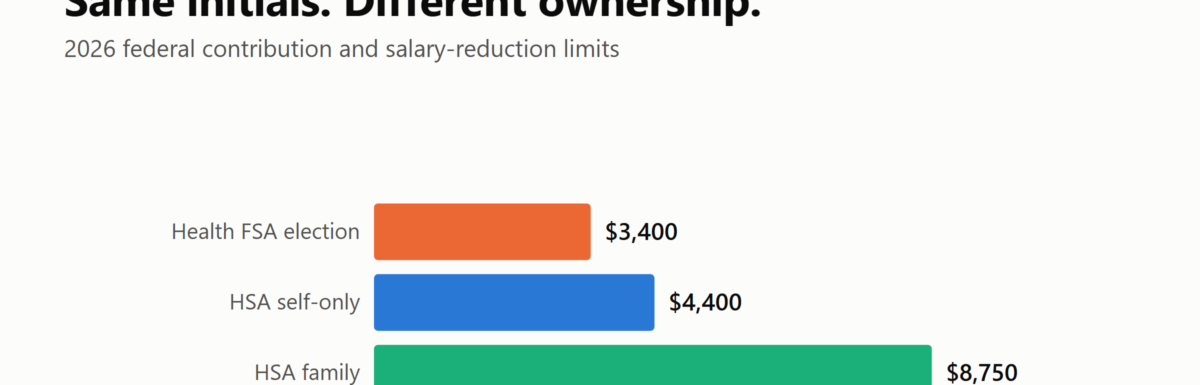
An HSA belongs to an eligible individual, and unused money stays in the account from year to year and through job changes. A health FSA is an employer benefit: you elect an annual amount, the full election is generally available for eligible claims during coverage, and unused money can be forfeited unless the employer's plan offers a carryover or grace period.
Those ownership and timing differences matter more than the similar initials.
| Feature | HSA | Health FSA |
|---|---|---|
| Who can use it | Eligible individual with qualifying coverage | Eligible employee whose employer offers the plan |
| Who owns it | Individual | Employer-sponsored arrangement |
| 2026 employee/total limit | $4,400 self-only; $8,750 family, including employer contributions | $3,400 employee salary reduction; employer plan may add money |
| When money is available | As it reaches the account | Annual election generally available during coverage before all payroll deductions occur |
| Unused balance | Carries forward without a federal annual forfeiture rule | Generally use-it-or-lose-it, subject to the plan's carryover or grace period |
| Job change | Account and balance stay with you | Coverage and claims rights follow the plan; COBRA may sometimes be available |
This article compares account mechanics. It does not decide whether the underlying health plan is economical; use the plan's premiums, deductible, cost sharing, and employer funding for that deductible-versus-premium comparison.
The 2026 limits—and what is actually known for 2027
The annual numbers use different calendars. HSA contribution limits apply by calendar year. Health FSA limits apply to plan years beginning in the stated year.
| Limit | 2026 | 2027 officially announced by August 14, 2026 |
|---|---|---|
| HSA contribution, self-only | $4,400 | $4,500 |
| HSA contribution, family | $8,750 | $9,000 |
| HDHP minimum deductible, self-only/family | $1,700 / $3,400 | $1,750 / $3,500 |
| HDHP maximum in-network out-of-pocket, self-only/family | $8,500 / $17,000 | $8,700 / $17,400 |
| Health FSA salary reduction | $3,400 | Not yet announced |
| Maximum health FSA carryover if the plan permits one | $680 | Not yet announced |
The 2026 HSA figures come from IRS Revenue Procedure 2025-19. The 2027 HSA figures were officially announced in Revenue Procedure 2026-24. The 2026 FSA figures come from the IRS's 2026 inflation-adjustment release.
As of August 14, 2026, the IRS had announced 2027 HSA limits but not the 2027 health FSA salary-reduction or carryover maximum. Do not copy an HSA number into an FSA election or treat a benefits vendor's estimate as an announced limit.
An HSA-eligible individual age 55 or older by year-end can generally make an additional $1,000 catch-up contribution. That fixed catch-up amount is separate from the table. When both spouses qualify for catch-ups, each spouse needs their own HSA for their own catch-up.
HSA eligibility is tested by month
Having a high deductible is not enough. Under IRS Publication 969, an HSA contributor generally must:
- have qualifying high-deductible health plan coverage;
- have no disqualifying other health coverage;
- not be enrolled in Medicare; and
- not be claimable as another person's tax dependent.
Eligibility and contribution room can be prorated by eligible months. A “last-month rule” may permit a full-year contribution in some cases, but it brings a testing period and possible income and additional tax if eligibility is not maintained. That is not a shortcut to use without checking Form 8889 instructions.
A general-purpose health FSA covering the HSA owner—or often the owner's spouse—usually provides first-dollar medical coverage and can disqualify HSA contributions. So can certain HRAs and other non-HDHP coverage. Exceptions include permitted insurance, preventive care, and properly designed limited-purpose or post-deductible arrangements.
One current wrinkle is dated: beginning January 1, 2026, federal law treats Bronze and Catastrophic plans available through an Exchange as HSA-compatible for this purpose even if they do not meet the general HDHP definition. The IRS explains that change in Notice 2026-05 guidance. Confirm that the exact coverage is Exchange coverage and that no other disqualifying coverage applies.
Employer money reduces your HSA room
The HSA limit is not an employee-only limit. Employer deposits and employee deposits share it.
Suppose a family-covered employee is eligible throughout 2026, is under 55, and the employer contributes $1,500. The remaining ordinary contribution room is:
$8,750 − $1,500 = $7,250
That is a CentSheet calculation. It assumes full-year family eligibility, no catch-up, no contributions from another employer or spouse allocated to the family limit, and no last-month-rule issue. It excludes account corrections and is rounded to whole dollars.
Check year-to-date deposits, not just your election. Employer seed money, wellness incentives deposited into the HSA, and pretax payroll contributions generally count toward the same limit. The HSA custodian does not know all contributions made to every HSA you own; Form 8889 and its instructions are where the taxpayer reconciles eligibility, contributions, and distributions.
FSA funding works differently. The $3,400 figure for a 2026 plan year caps voluntary employee salary reductions, while the plan document controls employer contributions and the reimbursement amount. Do not subtract employer FSA money from an HSA-style statutory total without reading the benefit terms.
Payroll tax is not the same as an income-tax deduction
Both accounts can exclude qualified funding from federal income and employment taxes when funded through an employer's cafeteria plan. But the route matters.
For an HSA, pretax salary reductions through a cafeteria plan are treated as employer contributions and generally avoid federal income tax, Social Security tax, and Medicare tax. A qualifying contribution made directly from a bank account can generally be claimed as an above-the-line federal income-tax deduction, but it does not retroactively refund payroll taxes already paid on wages.
For a health FSA, elected salary reductions generally avoid federal income and employment taxes. The 2026 IRS Publication 15-B describes the employer tax treatment and current limits.
State tax treatment can differ. HSA contributions or earnings do not receive identical treatment in every state, and payroll systems can apply state rules differently. “Triple tax-free” is therefore an incomplete slogan: federal tax-free growth and qualified withdrawals depend on following the rules, and state consequences need a separate check. If a payroll change affects take-home pay, reconcile it with your broader tax-withholding plan.
The HSA is funded cash; the FSA is annual coverage
An HSA can reimburse only up to the money currently in the account. If a $2,000 eligible bill arrives when the HSA contains $700, the account cannot pay $2,000 that day. You may pay outside the HSA and reimburse yourself later after funds arrive, provided the expense was incurred after the HSA was established, was qualified, was not reimbursed elsewhere, and was not also claimed as an itemized deduction. Keep the receipt and proof of payment.
A health FSA generally makes the full annual election available for covered medical claims during the coverage period, even before that much has been withheld from pay. Publication 969 states that eligible expenses can be paid even if funds have not yet been credited. This “uniform coverage” feature is useful for a planned early-year procedure.
Example: an employee elects $2,400 for the 2026 plan year, or $200 per month over 12 months. An eligible $1,800 bill in February can generally be reimbursed up to $1,800 if coverage and substantiation requirements are met, despite only a fraction having been deducted from pay. This is an illustration, not a promise that a particular claim is eligible; the employer's plan and claims administrator decide under the governing terms.
Qualified expenses overlap, but the rules are not identical
Both accounts commonly reimburse deductibles, copayments, prescriptions, many dental and vision costs, eligible over-the-counter medicines, and menstrual-care products. Neither lets you double-dip: an expense reimbursed by insurance or one account cannot be reimbursed again by the other or claimed again as an itemized medical deduction.
The account documents still matter. An FSA pays expenses specified in its plan. HSA tax treatment depends on federal qualified-medical-expense rules and the facts at the time of the expense and distribution. Insurance premiums are generally not qualified HSA or health FSA expenses, with limited HSA exceptions such as certain COBRA, unemployment, qualified long-term-care, and Medicare premiums. Do not assume “health-related” means reimbursable.
Save itemized receipts, the date service occurred, who received it, proof of payment, and the explanation of benefits. A card swipe is not proof that the distribution was tax-qualified.
Carryover, grace period, and job loss
HSA money has no federal use-it-or-lose-it deadline. It remains in the account, can be moved to another HSA by permitted transfer or rollover rules, and stays yours after the job ends. You can use the balance for qualified expenses even when you are no longer eligible to contribute. Those are separate questions.
A health FSA is generally use-it-or-lose-it. For a plan year beginning in 2026, an employer may choose a carryover up to the IRS maximum of $680, may choose a smaller carryover, or may offer none. Alternatively, a plan may offer a grace period of up to 2½ months to incur expenses using the prior balance. A health FSA cannot offer both carryover and grace-period relief for the same plan year. None of this is automatic.
Do not confuse a run-out period with a grace period. A run-out period is extra time to submit paperwork for expenses already incurred during coverage; it does not necessarily extend the date on which a new expense can be incurred.
At job loss, health FSA participation usually ends under the plan's terms, subject to claim-submission deadlines and possible COBRA continuation in some cases. Ask benefits staff for the last eligible service date, claim deadline, remaining balance, and COBRA cost before scheduling or abandoning an expense. The balance is not a portable cash account.
That portability difference resembles the distinction between a personally owned IRA and an employer plan, but the rules are not interchangeable; see 401(k) versus IRA for the retirement-account version.
When each account tends to fit
HSA example: You have confirmed HSA-eligible coverage, can absorb the deductible without raiding retirement savings, receive an employer contribution, and value keeping unused money. The HSA is usually the more flexible long-term account. Keep immediate medical cash and an emergency-fund buffer separate from investments inside the HSA.
FSA example: Your employer offers no HSA-compatible plan, and you expect $2,000 of predictable orthodontia, prescriptions, or therapy during the coverage period. An FSA election near that defensible amount can turn known spending into pretax spending. Build in a margin for canceled services and plan exclusions.
Both example: You are HSA-eligible and the employer offers a limited-purpose FSA restricted to permitted dental, vision, and post-deductible expenses. That combination can preserve HSA eligibility, but only if the FSA is actually designed as limited-purpose. A generic FSA label is not enough.
Neither-at-the-maximum example: You are unsure about eligibility, expect a midyear Medicare enrollment, or cannot comfortably lose an FSA balance. The statutory maximum is a ceiling, not a recommendation.
What to actually do
- Name the exact benefit. Confirm HSA, general-purpose health FSA, limited-purpose FSA, or HRA in the plan documents.
- Verify HSA eligibility month by month. Include spouse coverage, Medicare, other FSAs/HRAs, and dependent status.
- Subtract all employer HSA deposits. Use the remaining legal room before setting payroll or direct contributions.
- Estimate FSA spending conservatively. Count expenses likely to occur during coverage, not aspirational care.
- Read the forfeiture paragraph. Find the carryover, grace period, run-out period, termination date, and COBRA language.
- Use the right funding route. Compare payroll tax treatment with direct HSA deposits.
- Save substantiation. Keep receipts and prevent duplicate reimbursement.
- Recheck every enrollment year. Limits, coverage, employer contributions, and plan terms change.
This article provides general U.S. federal tax and benefits education, not individualized tax, legal, investment, or health-plan advice. Eligibility and reimbursement depend on current law, coverage by month, state tax rules, and the employer's governing plan. Confirm the choice with the plan administrator and a qualified tax professional.
Get the CentSheet Money Brief
Email me CentSheet weekly: practical money decisions, new calculators, and useful worksheets. Unsubscribe anytime.