A required minimum distribution, or RMD, is generally calculated account by account:
RMD for the year = account balance on the prior December 31 ÷ applicable IRS life-expectancy factor
For most living account owners, the factor comes from the Uniform Lifetime Table. The first-year trap is not the formula; it is the deadline. Waiting until April 1 of the following year for the first RMD can put both the first and second taxable distributions in that following calendar year.
The owner remains responsible even if an IRA custodian or plan administrator supplies a number. The IRS RMD FAQs state that the account owner must take the correct amount by the correct deadline.
| Input | Where to get it |
|---|---|
| Prior December 31 account balance | Year-end IRA statement or plan record |
| Age that year | Your date of birth and applicable-age rule |
| IRS factor | Current Publication 590-B table |
| First-year status | Prior RMD history and retirement status for an employer plan |
| Distribution already taken | Custodian and plan transaction records across the full year |
This page covers a living owner's calculation. A beneficiary uses a different decision tree; see inherited IRA rules when the original owner has died.
Find the year RMDs begin
As of August 14, 2026, owners currently beginning age-based RMDs generally use age 73. The statutory cohorts are:
- born before July 1, 1949: the old age-70½ rule applied;
- born July 1, 1949 through December 31, 1950: age 72 applied;
- born January 1, 1951 through December 31, 1958: age 73;
- born January 1, 1960 or later: age 75.
The 1959 birth year deserves a footnote, not false certainty. SECURE 2.0's statutory wording created overlapping age provisions. Treasury's 2024 proposed regulation would use age 73 for people born in 1959, while the final regulation reserved that paragraph. Nobody born in 1959 reaches 73 before 2032, so verify the finalized rule well before that person's first distribution year rather than hard-coding a 2026 draft into a 2032 decision.
For a traditional IRA, SEP IRA, or SIMPLE IRA, continuing to work does not postpone the owner's age-based RMD. Employer plans may use a later-of-age-or-retirement starting rule, but the still-working exception depends on the plan and does not protect a person who owns more than 5% of the employer. “I still have a job” is therefore not a universal exception.
Ask each administrator for its required beginning date, particularly when you retired, returned to work, own part of the company, or hold an old employer plan. The distinction between an individual account and a workplace plan is also central to 401(k) versus IRA.
Identify which accounts require an owner RMD
Living owners generally take RMDs from traditional IRAs and tax-deferred balances in qualified workplace plans once the applicable starting rule is met. SEP and SIMPLE IRAs follow IRA owner-RMD rules.
Roth treatment changed for workplace accounts. Starting in 2024, designated Roth accounts in 401(k) and 403(b) plans are not subject to lifetime RMDs for the original owner. Roth IRA owners likewise have no lifetime RMD. Beneficiaries can still face required-distribution rules after death, so “Roth never has an RMD” is wrong.
That difference can matter in a Roth-versus-traditional decision, but it does not make a conversion automatically sensible. A conversion can create current taxable income and needs a separate analysis.
An RMD itself is not an eligible rollover distribution. Taking it and placing the money in another retirement account does not erase the distribution requirement. You may spend it, hold it in cash, or invest it in a taxable account after distribution; there is no rule requiring consumption.
Choose the right IRS table
The current IRS Publication 590-B contains three life-expectancy tables:
- Uniform Lifetime Table, Table III: used by most living owners.
- Joint and Last Survivor Table, Table II: used when the sole beneficiary for the entire year is the owner's spouse and that spouse is more than 10 years younger.
- Single Life Expectancy Table, Table I: used in specified beneficiary calculations, not the ordinary living-owner calculation.
Do not choose a table merely because you are married or have named children. Most owners, including many married owners, use Table III. Table II requires both a sole-spouse-beneficiary condition and the more-than-10-years-younger condition.
Use the table published for the distribution year. A financial website's cached factor or an old worksheet can silently produce the wrong amount.
Work the formula account by account
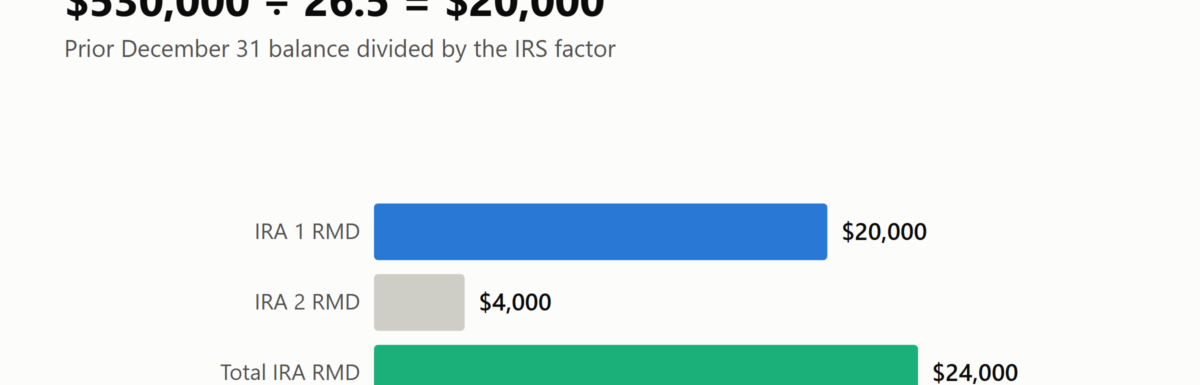
Assume an unmarried IRA owner turns 73 in 2026 and had $530,000 in the traditional IRA at the close of December 31, 2025. The Uniform Lifetime factor at age 73 is 26.5.
$530,000 ÷ 26.5 = $20,000 RMD for 2026
That is a CentSheet calculation. It assumes the full $530,000 is the relevant adjusted year-end balance, Table III applies, no distribution already counted toward the 2026 RMD, and no special annuity or corrective adjustment applies. The result is exact before rounding.
Now assume the same owner has a second traditional IRA with a December 31, 2025 balance of $106,000. Its separately calculated RMD is:
$106,000 ÷ 26.5 = $4,000
The owner has $24,000 of total IRA RMDs for 2026. IRA aggregation rules generally allow that total to come from one IRA or from both. But both calculations must be completed before choosing where to withdraw.
The prior-year balance can require adjustment in less-common situations, including an outstanding rollover or transfer not reflected at year-end. Annuities and qualifying longevity annuity contracts can also change the work. Use the custodian's records and current publication rather than forcing every account through the simple example.
Aggregation stops at account-type boundaries
The IRS calculation and withdrawal rules are not identical:
- Traditional, SEP, and SIMPLE IRAs: calculate each IRA's RMD separately; the combined IRA amount may generally be withdrawn from one or more of those IRAs.
- 403(b) contracts: calculate separately, then the combined 403(b) amount may generally be taken from one or more 403(b) accounts.
- 401(k), 457(b), and other qualified plans: calculate and satisfy the RMD separately for each plan. An IRA withdrawal cannot satisfy a 401(k) RMD.
Do not combine your spouse's RMD with yours. Each owner has a separate obligation. Do not combine a beneficiary obligation with a living-owner obligation either.
These boundaries are one reason a tidy account list matters more than an impressive investment list. Consolidation may simplify administration, but compare plan fees, protections, and investment choices first. The cheapest-looking option is not necessarily the best, although a low-cost index-fund menu is a useful input.
The first-year April 1 option can create two RMDs
The ordinary deadline is December 31 of the distribution year. Only the first RMD can generally be delayed until April 1 of the next calendar year.
Suppose the owner turns 73 in 2026:
- the 2026 RMD is based on the December 31, 2025 balance;
- it may be taken during 2026 or delayed until April 1, 2027;
- the 2027 RMD is based on the December 31, 2026 balance;
- it must still be taken by December 31, 2027.
Waiting therefore puts two RMDs into 2027. Both generally add to that year's taxable income to the extent the distributions are taxable. That could affect marginal tax rates, Medicare income-related premiums, taxation of Social Security, deductions, and credits. Taking the first RMD in 2026 can separate the income across two years, but whether that is better depends on the full returns.
The April 1 option is not an extension for every later year. It also does not change the balance date used in the formula.
Withholding does not change the RMD amount
An RMD can supply federal or state income-tax withholding if the custodian or plan permits the election. Withholding is a tax prepayment; it is not an extra distribution on top of the gross amount.
If the gross RMD is $20,000 and $4,000 is withheld for federal tax, the account distributes $20,000: $16,000 reaches the owner and $4,000 goes to the Treasury. The full $20,000 counts toward the RMD. This is a CentSheet illustration and assumes no fee or other withholding.
Do not choose a withholding percentage solely from the RMD. Pension income, wages, Social Security, investment income, deductions, credits, and quarterly payments all affect the result. Review the year as a whole rather than treating last year's refund or balance due as a rate.
RMD timing and withholding can also interact with the cash value of an employer 401(k) match only indirectly; matching is a contribution rule, while an RMD is a distribution rule. Keep the two phases separate.
If an RMD was missed or too small
Act; do not wait for a tax form to solve it automatically.
- Recalculate the required amount from the correct balance and factor.
- Subtract distributions that validly count for that account type and year.
- Ask the custodian or plan to distribute the shortfall promptly.
- Preserve statements showing the correction date and amount.
- Determine the correct year's Form 5329 filing and whether a reasonable-cause waiver request is supportable.
As of August 14, 2026, the IRS RMD topic page states that the excise tax can be 25% of the missed amount, reduced to 10% when corrected within the statutory window. The Form 5329 instructions explain reporting, the correction window, and a possible waiver for reasonable cause. A waiver is not automatic, and taking the late distribution does not itself complete the filing analysis.
Use the form for the year in which the RMD was due. Multiple missed years, an inherited account, a deceased owner, or a disputed plan calculation merits professional review.
What to actually do
- Inventory every retirement account and label it IRA, 403(b), 401(k), 457(b), Roth, or inherited.
- Confirm the start year using birth date, plan terms, retirement date, and 5% ownership status.
- Record each prior December 31 balance from the official statement.
- Select the current IRS table and factor; use Table III unless the Table II conditions truly apply.
- Calculate every account separately before applying allowed aggregation.
- Choose the first-year date deliberately after comparing one RMD this year with two next year.
- Set distribution and withholding instructions early enough to correct administrative problems before December 31.
- Reconcile in December rather than assuming an automatic payment covered every account.
This article is general U.S. federal tax education, not individualized tax, legal, or investment advice. RMD results depend on birth date, account type, beneficiary status, plan terms, balances, and current law. Confirm the calculation with the administrator and a qualified tax professional; inherited accounts require a separate analysis.
Get the CentSheet Money Brief
Email me CentSheet weekly: practical money decisions, new calculators, and useful worksheets. Unsubscribe anytime.