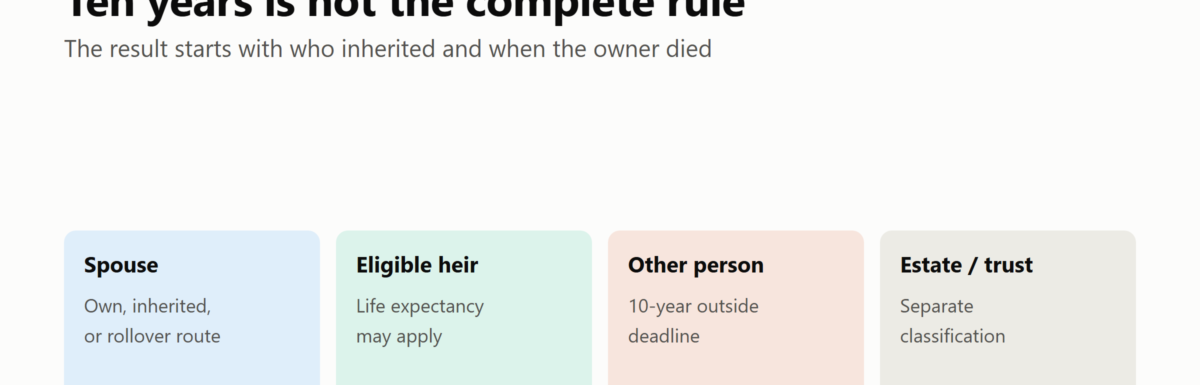
“Empty the inherited IRA within 10 years” is not a complete rule. The result depends on when the owner died, whether death occurred before the owner's required beginning date, what kind of beneficiary inherited, and whether the account is traditional or Roth.
Start with four facts before taking money or moving the account:
| Question | Why it changes the answer |
|---|---|
| Did the owner die in 2019 or earlier, or in 2020 or later? | The SECURE Act changed the beneficiary framework for post-2019 deaths |
| Was death before the required beginning date? | It determines whether annual distributions can apply inside a 10-year window |
| Is the heir a spouse, eligible designated beneficiary, other person, or non-individual? | Each class can have a different clock |
| Is the inherited account traditional or Roth? | Roth owners are treated as dying before a required beginning date, but beneficiaries still have distribution deadlines |
The IRS beneficiary guidance uses those same core variables. Do not use the living owner's RMD calculation without first completing this beneficiary branch.
First separate the original owner from the beneficiary
A required beginning date is a legal date, not simply the birthday on which an owner reaches an RMD age. For a traditional IRA owner it is generally April 1 of the year after the applicable starting-age year. An owner can therefore die after reaching the applicable age but still before the required beginning date.
If a traditional IRA owner dies on or after that date and has not completed the owner's RMD for the year of death, the beneficiary or beneficiaries must generally finish that year-of-death RMD. It is still the owner's RMD calculation. The beneficiary rules for later years begin after the year of death.
Example: an owner had a $12,000 RMD for 2026, took $5,000, and then died after the required beginning date. The remaining year-of-death amount is:
$12,000 − $5,000 = $7,000
That is a CentSheet calculation. It assumes both distributions count toward the same 2026 owner RMD, no other IRA distribution satisfies it through permitted aggregation, and the stated RMD is correct. Multiple beneficiaries should have the custodian or tax adviser coordinate who takes the remaining amount.
If the owner died before the required beginning date, there is no owner RMD for the year of death. Do not manufacture one from age alone.
Deaths through 2019 use older rules
For an IRA owner who died in 2019 or earlier, pre-SECURE beneficiary rules continue to matter. A designated beneficiary may have a life-expectancy schedule established under those rules, while a non-designated beneficiary may be under a five-year rule or the owner's remaining-life-expectancy method.
Do not convert an old inherited IRA to a new 10-year schedule just because an article published after 2020 discusses one. Find:
- the original owner's date of death;
- the beneficiary determination and account title;
- the first beneficiary RMD calculation;
- every distribution taken since;
- the life-expectancy table transition applied for 2022 and later.
The current IRS Publication 590-B includes transition instructions, but an inherited IRA with a 2019-or-earlier death should be reviewed against the rules and records for its original setup. A beneficiary's later death can start another clock.
The rest of this article focuses on IRA-owner deaths in 2020 or later, for which the post-SECURE framework generally applies.
Identify the beneficiary class
For a post-2019 death, an eligible designated beneficiary, or EDB, is generally one of five types:
- the owner's surviving spouse;
- the owner's child who had not reached majority when the owner died;
- a disabled individual under the tax definition;
- a chronically ill individual under the tax definition; or
- another individual who is not more than 10 years younger than the owner.
An ordinary adult child does not become eligible merely by being the owner's child. A grandchild who is a minor is not in the special “owner's minor child” class. Disability and chronic-illness status use technical definitions and documentation timing, not casual labels.
The 2024 final Treasury regulations, applicable to RMD determinations for 2025 and later, define majority for this rule as the child's 21st birthday. Once the owner's minor child reaches 21, the remaining balance moves onto a 10-year clock ending December 31 of the year containing the tenth anniversary of that birthday.
A person named directly on the beneficiary form is generally a designated beneficiary. An estate or charity is not. A trust is not automatically one or the other: qualifying “see-through” trust rules can cause its underlying beneficiaries to count, but drafting, documentation, and multiple-beneficiary rules are technical. Get estate counsel to classify a trust instead of applying the individual table by analogy.
The 10-year rule has two versions
An individual designated beneficiary who is not an EDB generally must empty the inherited IRA by December 31 of the year containing the tenth anniversary of death.
If the owner died in 2026, the outside date is:
December 31, 2036
That is calendar counting, not ten years from the day a custodian opens the inherited account.
What happens inside the window depends on the owner's required beginning date:
Owner died before the required beginning date
For an ordinary designated beneficiary subject to the 10-year rule, no distribution is required in years one through nine under the federal minimum-distribution rule. The entire balance must be gone by the end of year ten. The beneficiary may still choose earlier withdrawals.
“No annual RMD” does not mean “wait until the last week.” A final lump sum could stack ten years of growth into one income-tax year, create investment-sale timing pressure, and invite administrative failure. Model several withdrawal schedules without pretending future returns or tax brackets are known.
Owner died on or after the required beginning date
The same ordinary beneficiary generally has both obligations under the final regulations: take annual life-expectancy-based RMDs beginning the year after death and empty the account by the end of year ten. Annual payments do not replace the final deadline, and the final deadline does not erase annual payments.
Transition relief excused the excise tax for certain missed beneficiary RMDs in 2021 through 2024 while regulations were pending. It did not erase the account's ten-year deadline, and it is not a general waiver for 2025 or later. The final-rule explanation and Publication 590-B should be checked for the specific death and beneficiary.
Spouses have choices other heirs do not
A surviving spouse who is the beneficiary can often choose among:
- keep the account as an inherited IRA and use spouse-beneficiary rules;
- elect to treat the IRA as the spouse's own when eligible;
- roll eligible amounts into the spouse's own IRA or eligible plan.
The best route can change with the two spouses' ages. Remaining a beneficiary may let a younger spouse delay under special rules when the deceased spouse died before the required beginning date. It also preserves the death exception to the 10% additional tax on beneficiary distributions, which can matter before age 59½. Treating the account as the spouse's own moves it into the spouse's living-owner RMD and early-distribution rules.
Neither route makes an unpaid year-of-death RMD rollable. Required distributions must be separated before an own-IRA rollover. Confirm the order with the custodian.
The surviving-spouse regulations changed for 2024 and later, including an election to be treated as the owner for RMD purposes in specified circumstances. An older custodian form or generic flowchart may not reflect that. Compare the current paperwork with the account distinctions in Roth versus traditional, then review the tax years before acting.
Eligible designated beneficiaries can use life expectancy
An EDB can generally receive distributions over the applicable life-expectancy method, subject to the owner's death timing and account terms. A sole surviving spouse has additional recalculation and delay rules. A nonspouse EDB generally uses the Single Life Expectancy Table and reduces the initial denominator as required in later years.
The status is determined at the owner's death. Someone who later becomes disabled does not necessarily retroactively become an EDB. Required documentation for disabled or chronically ill status has deadlines in the final regulations, especially for plan beneficiaries and trusts.
Life expectancy is not necessarily a permanent stretch for the next heir. When an EDB dies, the successor beneficiary generally must empty the remaining inherited balance by the end of the tenth year after the EDB's death. When the owner's minor child turns 21, the child's ten-year clock begins. Those successor clocks are why both death certificates and the original owner identity must remain attached to the account history.
Roth and traditional inherited IRAs share a clock, not a tax result
A Roth IRA has no lifetime RMD for its original owner. After death, beneficiary rules apply, and the owner is treated as having died before the required beginning date. Therefore an ordinary designated beneficiary under the 10-year rule generally has no annual federal RMD in years one through nine but must empty the inherited Roth IRA by year ten.
That does not make the deadline optional. Nor does “Roth” guarantee that every inherited distribution is tax-free: earnings can be taxable if the Roth's five-tax-year qualified-distribution period was not satisfied. Publication 590-B explains that inherited Roth distributions follow ordering and qualification rules, while the additional 10% early-distribution tax generally does not apply to a distribution due to the owner's death.
Traditional inherited IRA distributions are generally ordinary income to the extent taxable. If the owner had nondeductible basis, Form 8606 work may be needed, and the inherited basis stays separate from the beneficiary's own IRA basis. State treatment can differ.
This distribution-stage tax analysis is separate from whether the underlying holdings are diversified or low cost. If investments need review, use the account deadline as a constraint—not as a reason to abandon a sensible low-cost fund approach.
Titling and transfers can preserve—or break—the account
A nonspouse beneficiary cannot treat an inherited IRA as their own, contribute to it, or complete a normal 60-day rollover into or out of it. The permitted movement is generally a direct trustee-to-trustee transfer to another properly titled inherited IRA.
The exact title follows the custodian's format, often identifying both the deceased owner and the beneficiary, such as “Alex Rivera, deceased, IRA for the benefit of Jamie Rivera, beneficiary.” Do not deposit a check into a personal IRA and ask the custodian to fix the name later.
Keep inherited accounts separate from your own IRAs. Do not use a withdrawal from your own IRA to satisfy an inherited IRA RMD. Inherited IRAs from different decedents also carry separate histories and cannot simply be pooled. Even accounts inherited from the same decedent should be combined or aggregated only after the custodian confirms compatible beneficiary and RMD treatment.
A direct rollover from an inherited workplace plan to an inherited IRA can be available to a nonspouse designated beneficiary, but it must preserve beneficiary status and cannot include an RMD. That execution issue is different from choosing between a personal IRA and employer plan in 401(k) versus IRA.
If a beneficiary distribution was missed
First establish whether an amount was actually due. Check the death year, required beginning date, beneficiary class, account type, final-rule applicability, and any transition relief. Then:
- calculate the shortfall using current Publication 590-B;
- take the corrective distribution promptly if one was required;
- preserve the custodian statements and calculation;
- review the correct year's Form 5329;
- determine whether the reduced excise-tax rate or reasonable-cause waiver process applies.
The IRS's Form 5329 instructions describe the 25% excise tax, potential 10% corrected rate, and waiver request. A late withdrawal alone does not decide the filing result. Death-year shortfalls, multiple beneficiaries, trust beneficiaries, and missed years call for a tax professional who works with inherited accounts.
What to actually do
- Freeze before moving money. Do not cash, retitle, or roll the account until the beneficiary route is confirmed.
- Record the four controlling facts: death date, required beginning date, beneficiary class, and traditional/Roth status.
- Check the year-of-death RMD. Determine what was due and what the owner already took.
- Get the custodian's written schedule. Ask whether annual RMDs apply inside the five- or ten-year outside deadline.
- Use a correctly titled inherited account. Nonspouses should request a direct trustee-to-trustee transfer.
- Calendar every deadline. Include annual RMD dates, age-21 transition, and the final December 31 date.
- Plan taxable withdrawals across years. Compare scenarios without relying on return forecasts.
- Escalate complex beneficiaries. Trusts, estates, multiple heirs, disabilities, and older deaths deserve estate and tax review.
This article is general U.S. federal tax and retirement-account education, not individualized tax, legal, estate-planning, or investment advice. Beneficiary results depend on documents, death dates, relationship, disability status, account type, state law, and current regulations. Confirm the schedule and title with the custodian and qualified tax and estate professionals.
Get the CentSheet Money Brief
Email me CentSheet weekly: practical money decisions, new calculators, and useful worksheets. Unsubscribe anytime.