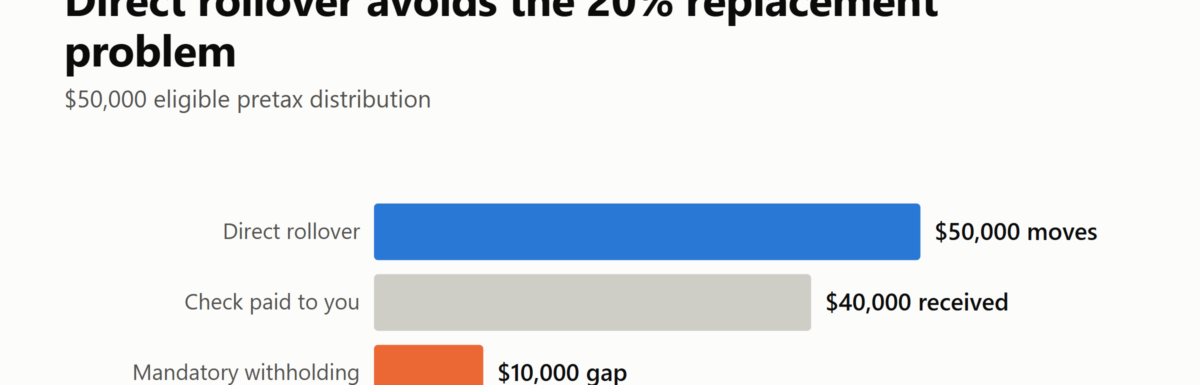
The clean way to move an old 401(k) into a new employer's 401(k) is a direct rollover after the new plan confirms that it accepts the exact money you hold. The old plan sends the eligible balance to the receiving trustee—or issues a check payable to the receiving plan for your benefit—so the mandatory 20% withholding and 60-day replacement problem generally do not apply.
The receiving plan does not have to accept rollovers. Confirm acceptance before telling the old plan to release anything. The IRS rollover guidance states both points plainly.
| Route | Current withholding on an eligible taxable amount | Main execution risk |
|---|---|---|
| Direct rollover to accepting new 401(k) | Generally 0% | Wrong payee, unsupported money type, incomplete acceptance paperwork |
| Eligible distribution paid to you | Generally 20% | Must replace withholding and complete rollover within 60 days |
| Direct rollover to IRA | Generally 0% | Different fees, protections, access, and future planning consequences |
| Cash distribution kept | Generally 20% prepaid, not necessarily final tax | Current income tax and possible additional 10% early-distribution tax |
This is a job-change execution guide. For the broader account-order question, start with 401(k) versus IRA.
Compare all four destinations first
Leaving a job does not automatically require moving the account. The common choices are:
- Leave it in the old plan, if permitted. This can preserve institutional investments, plan-specific access rules, and familiar administration. It also creates another account to monitor, and former-employee fees or services may differ.
- Roll it directly to the new employer plan, if accepted. This consolidates workplace savings and can simplify future RMD administration. The new menu, fees, loan terms, and withdrawal rules become important.
- Roll it directly to an IRA. An IRA may offer a broader investment menu and different service model. It can also change legal protections, early-access exceptions, advice costs, and future backdoor-Roth tax calculations.
- Take cash. This gives immediate access by ending tax deferral on the amount not rolled over. It is usually the most expensive tax route, but “never” is too strong when the facts might include an exception, emergency, or very small balance.
The Department of Labor's ERISA FAQ confirms that a new-plan transfer is available only if the new plan accepts it. Neither the old provider nor an IRA salesperson should make the destination decision from fees alone.
Direct rollover and 60-day rollover are different events
In a direct rollover, the distribution is payable to the receiving plan or IRA, not to you personally. A check can be mailed to you for forwarding and still be a direct rollover when the payee is correctly written as the receiving trustee for your benefit. Follow the recipient's payee wording exactly.
In a 60-day rollover, the old plan pays an eligible rollover distribution to you. For the taxable eligible portion, the plan generally must withhold 20% even if you intend to deposit the money elsewhere. You then have 60 days from receipt to roll over the gross eligible amount.
Assume a former employee requests a $50,000 eligible pretax distribution payable personally:
Mandatory withholding: $50,000 × 20% = $10,000
Check received: $50,000 − $10,000 = $40,000
To roll over the full $50,000, the worker must deposit the $40,000 received plus $10,000 from another source within 60 days. The $10,000 withheld is claimed as federal tax paid on the return; it is not sent into the retirement account automatically.
If only $40,000 is rolled over, the other $10,000 is generally current taxable income and may face the additional 10% early-distribution tax unless an exception applies.
This is a CentSheet calculation. It assumes the entire $50,000 is a taxable eligible rollover distribution from an employer plan, exactly 20% federal withholding, no state withholding, a timely $40,000 rollover, and no early-distribution exception. It excludes fees and rounding. A direct rollover of the same eligible pretax amount would ordinarily send $50,000 toward the receiving account with no mandatory federal withholding.
The 20% is withholding, not a statement of final tax. Your return determines final federal income tax from all facts.
The receiving plan controls what it will accept
“We accept rollovers” is only the first answer. Ask whether the new 401(k) accepts:
- pretax qualified-plan money;
- designated Roth 401(k) money;
- after-tax employee contributions that are not designated Roth;
- money from a 403(b), governmental 457(b), or IRA, if any is mixed into the request;
- rollover contributions before you are otherwise eligible to make elective deferrals.
Get the receiving instructions and acceptance form first. They should state the plan's legal name, trustee or recordkeeper payee, mailing or wire details, your identifying account information, and whether separate checks are required.
Then give those instructions to the old plan. Do not guess an abbreviated plan name. A check payable to you instead of the receiving trustee can change the transaction from direct to paid-to-participant and trigger withholding.
The new plan may request a recent statement, distribution confirmation, or letter showing that the source is qualified. Keep both plans' summary plan descriptions and rollover forms. The old plan must offer a direct-rollover route for an eligible rollover distribution, but the new plan can reject incoming money.
Keep pretax, Roth, and after-tax money in the right lanes
Tax character follows the money.
- Pretax 401(k) to pretax new 401(k): generally preserves tax deferral when done as an eligible direct rollover.
- Designated Roth 401(k) to designated Roth in the new plan: can preserve Roth plan character if the recipient accepts it; use a direct rollover.
- Designated Roth 401(k) to Roth IRA: generally an allowed Roth destination, with separate five-year-rule consequences to check.
- Pretax 401(k) to Roth IRA or designated Roth account: generally a taxable conversion of the untaxed amount, not a tax-free lane change.
- Roth IRA to 401(k): not an allowed incoming rollover route.
A new plan with a Roth feature does not automatically accept incoming designated Roth money. It must maintain separate accounting and its document must permit the rollover.
After-tax non-Roth contributions add another layer because their earnings are pretax. IRS guidance allows a distribution to direct pretax amounts to a traditional IRA or eligible plan and after-tax contributions to a Roth IRA in a coordinated transaction. The IRS after-tax rollover page shows that split. Do not attempt it from a dashboard button without both recipients' written instructions.
If you are considering deliberately converting pretax money, review Roth versus traditional and model the current income separately. Withholding conversion tax from the retirement balance can create an unrolled taxable distribution.
The one-rollover-per-year rule usually is not this rule
The once-per-12-month limitation is commonly misapplied. It generally governs 60-day rollovers from one IRA to another IRA. It does not limit:
- a rollover from an employer plan to another employer plan;
- a rollover from an employer plan to an IRA;
- a rollover from an IRA to an employer plan;
- a direct trustee-to-trustee IRA transfer;
- a conversion to a Roth IRA.
The IRS explains the boundary on its IRA one-rollover-per-year page. A plan-to-plan direct rollover therefore does not consume the IRA 60-day slot.
That does not make repeated plan movements harmless. Each transaction can create forms, investment time out of market, incompatible holdings, and mistakes. Use the cleanest single route that fits the chosen destination.
An outstanding plan loan needs its own decision
A 401(k) loan normally is not an asset that simply transfers to the new employer plan. On separation, the old plan may allow continued payments, demand repayment, or offset the outstanding balance against the account under its terms.
A plan loan offset is treated as a distribution even though no cash for the offset reaches you. To roll over the offset amount, you generally must contribute cash from elsewhere to an eligible retirement account. If the offset qualifies because of severance from employment or plan termination, a special deadline can extend to the federal return due date, including extensions, for the year of the offset. The current IRS plan-loan-offset guidance gives the conditions; not every default is a qualified plan loan offset.
Ask before separation:
- Can payments continue after employment ends?
- On what date would an offset occur?
- Will it be coded as a qualified plan loan offset on Form 1099-R?
- How much cash would be needed to roll over the offset?
- Does the new plan allow a new loan, and would taking one solve anything after fees and payroll risk?
Do not assume the ordinary 60-day deadline or the extended deadline. A failed rollover can make the offset taxable and possibly subject to an additional tax.
Compare fees, investments, protection, and access
Consolidation is useful only if the destination is acceptable. Compare the actual participant disclosures:
- recordkeeping and administrative fees charged to former and current employees;
- expense ratios and any sales, managed-account, advice, or transaction charges;
- breadth and quality of diversified investments;
- stable-value or institutional options unavailable elsewhere;
- loan and withdrawal provisions;
- beneficiary and service quality.
The Labor Department's guide to retirement-plan fees explains plan, investment, and individual-service charges. Compare total annual dollars at your balance, not just fund expense ratios. A good low-cost index fund can be useful, but one cheap fund does not reveal account-level charges.
Legal and access differences can outweigh small fee gaps. Employer plans and IRAs can have different federal and state creditor protections. A 401(k) can offer loans; an IRA cannot. The age-55 separation exception for some workplace-plan distributions differs from IRA early-distribution exceptions. Rolling appreciated employer stock may also eliminate a potential net-unrealized-appreciation strategy. These are reasons to pause for legal or tax review, not reasons to prefer one wrapper universally.
Finally, keep near-term living costs outside the rollover. A transfer delay is not an emergency fund, and cashing out retirement money to bridge routine expenses can turn an administrative task into a tax bill.
What to actually do
- Inventory the old account. Separate pretax, designated Roth, after-tax, employer stock, and loan balances.
- Compare all four destinations. Use fee disclosures, investment menus, protection, access, and service—not consolidation alone.
- Confirm the new plan accepts each money type. Obtain its payee and delivery instructions in writing.
- Resolve the loan before requesting a distribution. Identify repayment, offset, and deadline consequences.
- Request a direct rollover. Use separate checks or wires when pretax and Roth lanes require them.
- Inspect the payee immediately. A receiving-plan check may come to your address, but it should not be payable personally.
- Track receipt and investment. Confirm the money landed in the correct source accounts and is actually invested.
- Keep the tax trail. Retain statements, acceptance forms, Form 1099-R, and the new plan's confirmation; report the rollover as required even when nontaxable.
This article is general U.S. federal tax and retirement-plan education, not individualized tax, legal, or investment advice. Rollover eligibility and consequences depend on plan documents, money source, age, loans, employer stock, state law, and current rules. Confirm the transaction with both administrators and a qualified tax professional before authorizing it.
Get the CentSheet Money Brief
Email me CentSheet weekly: practical money decisions, new calculators, and useful worksheets. Unsubscribe anytime.