GAP is useful only while two numbers are in the wrong order: the auto-loan payoff is higher than the vehicle's insured value. If the car is stolen or declared a total loss during that window, ordinary auto insurance may pay less than the debt. GAP is intended to address some or all of the remaining shortfall, subject to the contract.
The decision starts with one subtraction:
Possible shortfall = current loan payoff − expected primary-insurance payment
If the result is zero or negative, there is no current “gap” to protect. If it is positive, compare that exposure with the GAP product's full cost, limits, exclusions, and the number of months the gap is likely to exist.
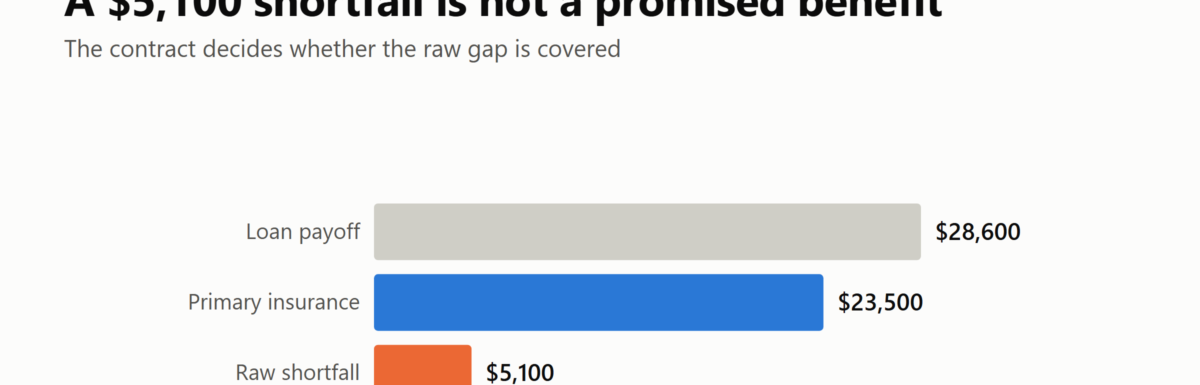
In the hypothetical total-loss example below, the raw shortfall is $5,100. Whether GAP pays $5,100, $4,100, less, or nothing cannot be answered from the product name. Deductible treatment, loan-to-value caps, prior negative equity, late payments, and financed add-ons live in the actual contract.
What GAP covers—and what it does not
The Consumer Financial Protection Bureau's GAP definition is narrow: it is an optional product intended to cover the difference between what is owed on an auto loan and what the insurer pays when the vehicle is stolen or totaled.
That means GAP is not:
- Collision or comprehensive insurance for repairing the car.
- Liability coverage for injury or property damage.
- A replacement-car fund.
- A warranty or mechanical-breakdown contract.
- A promise to pay every dollar of a loan balance.
- Protection against simply being unable to make the payment.
The product may be structured as insurance or as a contractual debt-cancellation waiver, depending on the agreement and state law. The title matters less than the operative sentence: what amount will the insurer, lender, or waiver administrator pay after the primary carrier settles the total loss?
Read the definitions of covered loss, actual cash value, loan balance, deductible, maximum benefit, excluded amounts, and required claim steps. A sales summary is not the contract.
Run the shortfall before pricing the product
Use current documents, not the original purchase figures:
- Ask the lender for a dated payoff quote, including accrued interest and any payoff fee.
- Estimate the vehicle's current insurable value using the primary carrier's method; a retail asking price is not necessarily the settlement value.
- Subtract the auto-policy deductible if it applies to the settlement.
- Compare the result with the payoff.
Hypothetical total loss
These are invented inputs, not averages or a prediction of any insurer's settlement:
| Item | Amount |
|---|---|
| Loan payoff on loss date | $28,600 |
| Vehicle actual cash value | $24,500 |
| Primary-policy deductible | −$1,000 |
| Expected primary-insurance payment | $23,500 |
| Raw loan shortfall | $5,100 |
The $5,100 is a CentSheet calculation: $28,600 − $23,500.
Now the contract matters. If a GAP waiver calculates its benefit using the $24,500 value but excludes the $1,000 deductible, it might address $4,100 and leave the deductible behind. Another contract may cover some deductible amount. A contract may also subtract overdue payments, late charges, unearned interest, service-contract refunds, prior negative equity, or amounts above a stated loan-to-value cap.
Do not use the raw shortfall as a promised benefit. Use it as the question the contract must answer.
When the gap becomes large
The gap grows when the debt starts high or falls slowly relative to the vehicle's value. Common drivers include:
- A small down payment or none at all.
- A long repayment term.
- Taxes, fees, service contracts, or GAP itself rolled into the loan.
- A prior car's negative equity carried into the new financing.
- A high interest rate that slows early principal reduction.
- A vehicle whose value falls faster than the loan balance.
None guarantees that GAP is worth buying. They increase the chance and size of a shortfall.
A down payment works twice: it reduces the starting loan and the interest charged on it. The car affordability guide and car affordability calculator should therefore include every financed add-on, not just the vehicle price.
The risk also changes every month. The loan amortizes on a schedule; the car's value does not. Re-run payoff minus value periodically. Once a defensible vehicle value stays above the payoff, future GAP benefit is hard to see unless the relationship could reverse.
Financing the premium makes it cost more
The CFPB warns that rolling GAP into the auto loan increases the amount financed and total interest. The FTC's vehicle-financing guide makes the broader rule explicit: auto add-ons are not free, and borrowers should ask for each price and its full financed cost in writing.
Suppose a hypothetical GAP product costs $900 and is added to a 72-month loan at 7.50% APR. Isolating that $900 as its own amortizing slice:
| Financed GAP illustration | Amount |
|---|---|
| Cash price | $900.00 |
| Added monthly payment | $15.56 |
| Total of 72 added payments | $1,120.40 |
| Interest attributable to the financed premium | $220.40 |
This is a CentSheet calculation using a fixed 7.50% APR, 72 equal monthly payments, no fees, and payments made on schedule. Rounding the added payment to cents causes a few cents of real-contract variation.
The correct price comparison is therefore not “$900 at the dealer versus another quoted premium.” It is:
- Cash price.
- Finance charge if rolled into the loan.
- Covered amount and exclusions.
- Cancellation method.
- Refund method after early payoff, refinancing, sale, or other termination.
A cheaper contract that excludes the likely loss is not cheaper in any useful sense.
GAP is generally optional
The CFPB's auto add-on requirement answer says GAP and similar products are generally optional. If a seller says it is required for a particular financing offer, ask the seller to show that requirement in the contract and verify it directly with the lender.
The financing disclosure changes when a product is genuinely required. CFPB guidance says that if GAP is required to obtain credit, its cost must be included in the finance charge and reflected in the disclosed APR. If it is optional, the buyer can decline it.
Read the retail installment contract before signing and compare its amount financed with the agreed out-the-door vehicle price. GAP, a service contract, credit insurance, and other add-ons should not appear without informed agreement. Understanding the difference between a product's sticker price, finance charge, and APR is covered in APR versus APY.
Exclusions decide the claim
Ask these questions against the actual policy or waiver:
| Contract question | Why it changes the benefit |
|---|---|
| Does it cover the primary-policy deductible? | A $1,000 deductible can remain due after the vehicle-value gap is addressed |
| Is there a maximum benefit or loan-to-value cap? | A large rolled-in balance may exceed coverage |
| Is prior negative equity excluded? | Debt from the previous car may survive the claim |
| Are late payments and late charges excluded? | The payoff can exceed the contract's defined covered balance |
| Are financed add-ons excluded or refunded first? | Unearned service-contract amounts may change the remaining debt |
| Which total-loss events qualify? | Theft, collision, flood, or other losses must satisfy both contracts |
| What documents and deadlines apply? | Missing the claim process can delay or defeat payment |
| Must loan payments continue during review? | Stopping without written direction can create delinquency |
The CFPB's October 2024 auto-finance supervisory findings documented servicers collecting payments while GAP claims were pending and later miscalculating reimbursements. That is not a rule to stop paying. It is a reason to obtain written instructions, keep payment records, and audit the final account ledger.
Cancellation and refunds are not automatic assumptions
The CFPB says a borrower may be entitled to a refund after selling, refinancing, or prepaying an auto loan and has the right to cancel optional add-ons. Its enforcement and supervision work has also found failures to return unearned GAP amounts after early loan termination.
“May” matters. Refund rights, who must initiate the request, the calculation, and the recipient can depend on the contract and state law. A refund may go to the lender and reduce the balance rather than arrive as cash.
If the payoff is now below the vehicle value:
- Read the cancellation and refund section.
- Ask the provider, lender, and selling dealer who processes the request.
- Request a written payoff before and after the credit.
- Keep the cancellation confirmation and calculation.
- Contact the relevant state insurance regulator if the product is insurance and the contract response is disputed.
Paying off the car early is one reason a cash purchase plan can reduce more than interest; saving for a car removes the negative-equity window itself.
What to actually do
- Get today's payoff. The statement balance may not include accrued interest through a loss date.
- Estimate the insurer's payment conservatively. Use likely actual cash value less the policy deductible, not a dealer retail price.
- Calculate the raw gap. Payoff minus expected primary-insurance payment is the exposure before contract exclusions.
- Read the full GAP contract. Mark deductible treatment, caps, prior negative equity, late amounts, add-ons, eligible losses, and claim deadlines.
- Compare full prices. If financing the premium, include its interest over the loan term.
- Verify whether it is optional. Ask for any claimed requirement in writing and confirm it with the lender.
- Avoid duplicated coverage. Check the auto policy, lender offer, lease agreement, and dealer product before buying another version.
- Recheck after principal falls. When payoff is below defensible vehicle value, review cancellation and refund terms.
- After a loss, keep paying unless the lender gives written direction otherwise. Track the primary settlement, GAP calculation, account payments, and final credit.
GAP does one narrow job: it transfers some contract-defined risk during the months when car debt can exceed insured value. Calculate that window, price the financed product, and read the exclusions. The name alone cannot tell you whether it is worth it.
CentSheet publishes educational content, not personalized financial advice. This article is not insurance, legal, or lending advice and is not a claim-coverage guarantee. GAP terms and refund rights vary by contract and state; verify them with the provider, lender, primary insurer, and relevant regulator.
Get the CentSheet Money Brief
Email me CentSheet weekly: practical money decisions, new calculators, and useful worksheets. Unsubscribe anytime.