A lease payment and a loan payment do not buy the same thing. The lease pays for a defined period of use and normally ends with the car going back. The loan pays interest and principal and leaves the buyer owning whatever value remains after the loan balance is gone.
That makes payment-versus-payment the wrong comparison. Put both written quotes on the same time horizon, count every dollar that leaves, and subtract anything you still own at the end.
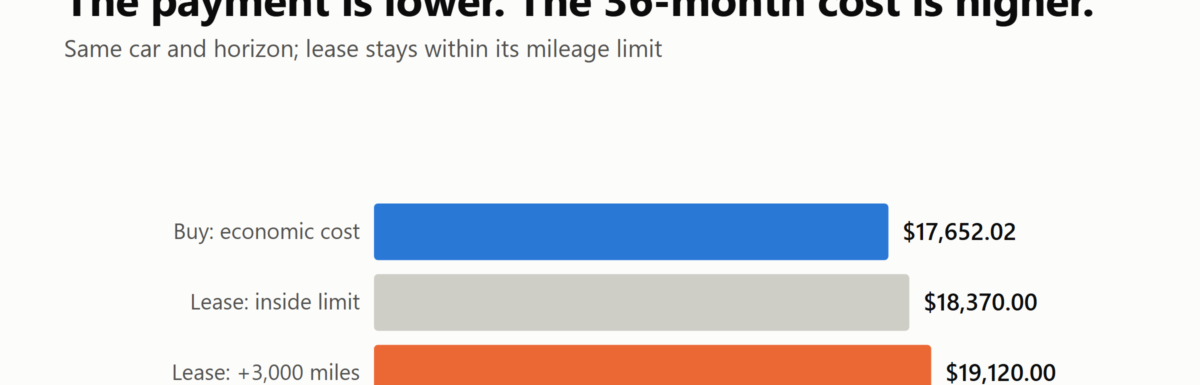
In the hypothetical 36-month comparison below, the lease payment is $181.55 lower. Yet the lease costs $718 more when both drivers stay within the lease mileage limit, because the buyer has $8,383.80 of vehicle equity at month 36. Change the resale value by $2,000, though, and the winner changes. The answer lives in the quote and the ending-value assumption—not in the word “lease” or “buy.”
Compare one horizon, not two payments
Use this structure:
Lease cost = cash due at signing + lease payments + expected end charges + maintenance − refundable amounts
Buy cost = down payment + loan payments + ownership costs − ending equity
Ending equity is the car's sale or trade value minus the loan payoff at the comparison date. It can be positive or negative.
The horizon must match. Comparing a 36-month lease with the full 60- or 72-month total of a purchase loan charges the buyer for years the lessee has not bought. Comparing only 36 payments and ignoring the buyer's remaining loan balance makes the opposite error. Freeze both at month 36, calculate the buyer's payoff and value, and then compare.
The FTC's current car-financing guide makes the same core point: know total cost, not only the monthly payment. It also recommends getting the vehicle's out-the-door price in writing before discussing financing.
Read the lease vocabulary before the offer
Under Regulation M's motor-vehicle lease disclosures, a covered consumer lease separates several numbers:
| Lease term | What it does |
|---|---|
| Agreed value / gross capitalized cost | Starting vehicle value plus any items rolled into the lease |
| Capitalized cost reduction | Cash, rebate, or trade credit that reduces that starting amount |
| Adjusted capitalized cost | Amount used to calculate the base payment |
| Residual value | Contract value assigned to the car at lease end |
| Depreciation and amortized amounts | Adjusted cap cost minus residual, plus qualifying rolled-in items |
| Rent charge | Charge added to depreciation for use of the lessor's money |
| Purchase option | Contract price or method for buying the vehicle, if offered |
The disclosure must also identify periodic payments and normal end-of-lease charges. Acquisition, disposition, registration, taxes, insurance, excess mileage, excess wear, and a prior loan balance can all affect cash cost, but not every item sits in the same box.
A large amount “due at signing” is not a cheap lease. It merely prepays part of the cost. Split it into first payment, acquisition fee, registration, refundable security deposit, and capitalized cost reduction. Only refundable money comes back in the cost equation.
The lease's costs do not end at the payment
The CFPB's lease-versus-buy guide identifies the main contract risks: mileage limits, excess wear charges, end-of-lease fees, and potentially expensive early termination.
For each lease quote, copy these lines into a worksheet:
- Total due at signing, separated into refundable and nonrefundable pieces.
- Number and amount of remaining payments.
- Acquisition and disposition fees.
- Annual mileage allowance and charge per excess mile.
- Definition and method for charging excess wear.
- Required maintenance and insurance standards.
- Purchase-option price and any option fee.
- Early-termination formula.
Do not assume the residual is what the car will actually be worth. It is a contract input used to calculate the lease and, if there is a purchase option, may help set the buyout. A favorable-looking residual can lower the monthly depreciation charge while leaving an unattractive purchase option. Those are separate decisions.
Mileage deserves its own scenario. If the contract allows 10,000 miles a year and the driver expects 13,000, that is not a surprise at month 36. It is 9,000 forecast excess miles multiplied by the contract rate today.
The purchase has costs—and an asset
A buyer's worksheet starts with the written out-the-door price, not the sticker price. Then add:
- Down payment and trade equity used.
- Amount financed, APR, and term.
- Every scheduled payment inside the comparison horizon.
- Maintenance and repairs that differ from the lease case.
- Loan payoff on the comparison date.
- Defensible sale or trade value on the same date.
A longer loan can make the purchase payment look closer to the lease payment while leaving more debt at month 36. That is not a cost saving. It is slower principal repayment. The car affordability calculator is useful for testing the payment, but this comparison must also carry the balance sheet forward.
Insurance, fuel, registration, parking, and taxes belong in both columns when they differ. A lease may require particular insurance limits; a purchased car with a loan also has lender requirements. Obtain actual insurance quotes instead of assuming they cancel out.
A hypothetical 36-month comparison
These are invented quote inputs designed to show the method, not market averages or offers. Both cases cover the same car and 36 months. Taxes are assumed already reflected in each written quote. Fuel, insurance, and registration are excluded because the example assumes they are identical. No trade-in, prior negative equity, or sale transaction cost is involved.
Purchase quote
- $34,000 out-the-door price.
- $3,000 cash down; $31,000 financed.
- 6.50% APR, 60 months.
- $1,200 maintenance over 36 months.
- Estimated month-36 sale value: $22,000.
CentSheet's standard amortization calculation produces a payment of $606.55, 36 payments totaling $21,835.82, and a month-36 loan balance of $13,616.20. The ending equity is $22,000 − $13,616.20 = $8,383.80.
Purchase cost through month 36 = $3,000 + $21,835.82 + $1,200 − $8,383.80 = $17,652.02
Lease quote
- $2,500 due at signing, including the first payment and disclosed nonrefundable fees; no refundable security deposit.
- 35 later payments of $425.
- $395 disposition fee.
- $600 maintenance over 36 months.
- 30,000-mile allowance; no excess wear assumed.
Lease cost inside allowance = $2,500 + (35 × $425) + $395 + $600 = $18,370
If the car comes back with 3,000 excess miles at a hypothetical contract charge of $0.25 per mile, add $750. The lease becomes $19,120.
| 36-month outcome | Purchase | Lease |
|---|---|---|
| Monthly payment after signing | $606.55 | $425.00 |
| Cash cost before ending value | $26,035.82 | $18,370.00 |
| Ending asset/equity | $8,383.80 | $0 |
| Economic cost | $17,652.02 | $18,370.00 |
| With 3,000 excess lease miles | — | $19,120.00 |
The $22,000 resale value is the fragile input. If the buyer receives only $20,000, ending equity falls to $6,383.80 and purchase cost rises to $19,652.02. At $24,000, purchase cost falls to $15,652.02. A $2,000 valuation error moves the result by exactly $2,000.
That sensitivity is more useful than declaring a permanent winner.
What happens after month 36 matters
Returning the lease resets the problem. The driver needs another car, another lease, or a purchase-option payment. Buying creates the option to keep driving the same car after the loan ends, when monthly principal and interest fall to zero but maintenance risk rises.
Buying the leased car can be rational if the contract buyout plus tax and fees is attractive relative to the car's condition and defensible market value. It does not retroactively turn all lease payments into equity. The lease paid for the first 36 months of use; the buyout is a new purchase decision.
Likewise, selling the purchased car at month 36 is only a modeling device. A buyer who plans to keep it should extend both strategies to the real ownership horizon. Comparing six years might require two consecutive leases against one purchase, including the second lease's signing cash and fees.
Early exit is asymmetric
A financed car can usually be sold at any time, but the sale proceeds must cover the lender's payoff or the owner must bring the shortfall. A lease cannot normally be returned early by simply stopping payments. Regulation M requires the early-termination method to be disclosed, and the required warning says the charge may be substantial and tends to be greater earlier in the lease.
Before signing, ask the lessor for a written explanation of the termination formula and run an exit at month 12 and month 24. If a job, household, commute, or expected mileage may change, flexibility has a dollar value.
Rolling an old loan shortfall into either structure makes both harder to read. The FTC calls owing more than the trade is worth negative equity and warns that rolling it forward can increase the amount financed, term, or payment. Treat the old shortfall as a separate line, not part of the new car's price.
What to actually do
- Get the out-the-door purchase price in writing before discussing a loan or lease.
- Request complete disclosures for both structures. A monthly ad is not a quote.
- Use the same car, mileage, cash at signing, and time horizon. Normalize different offers before comparing.
- Negotiate the vehicle value and remove unwanted add-ons. The FTC notes that dealers can profit from financing and add-ons; every accepted item needs a price in writing.
- Keep lease signing cash low unless the lower total cost is documented. Prepaying does not make the economics better by itself.
- Calculate ending equity from a loan payoff, not the original loan amount. Use several resale values, not one optimistic number.
- Price expected mileage and wear now. Contract charges multiplied by forecast use belong in the main scenario.
- Read the early-exit method and purchase option. They determine how much flexibility the contract actually gives you.
- Keep tax claims out of a personal-use comparison. Business-use deductions depend on ownership, use, substantiation, and current tax law; this article makes none.
- Check the car against the broader budget. The car affordability guide owns the maximum-cost decision, while saving for a car shows what avoiding either contract requires. Credit pricing is covered separately in credit score for a car loan.
Leasing buys a controlled slice of a car's life. Buying finances the whole asset and leaves both its future value and repair risk with you. Put both on one clock, price the exits, and the lower payment stops deciding the answer for you.
CentSheet publishes educational content, not personalized financial advice. This article is not a loan offer, tax advice, or a recommendation to lease or buy. Actual prices, taxes, insurance requirements, mileage terms, and contract charges vary; compare complete written disclosures before signing.
Get the CentSheet Money Brief
Email me CentSheet weekly: practical money decisions, new calculators, and useful worksheets. Unsubscribe anytime.