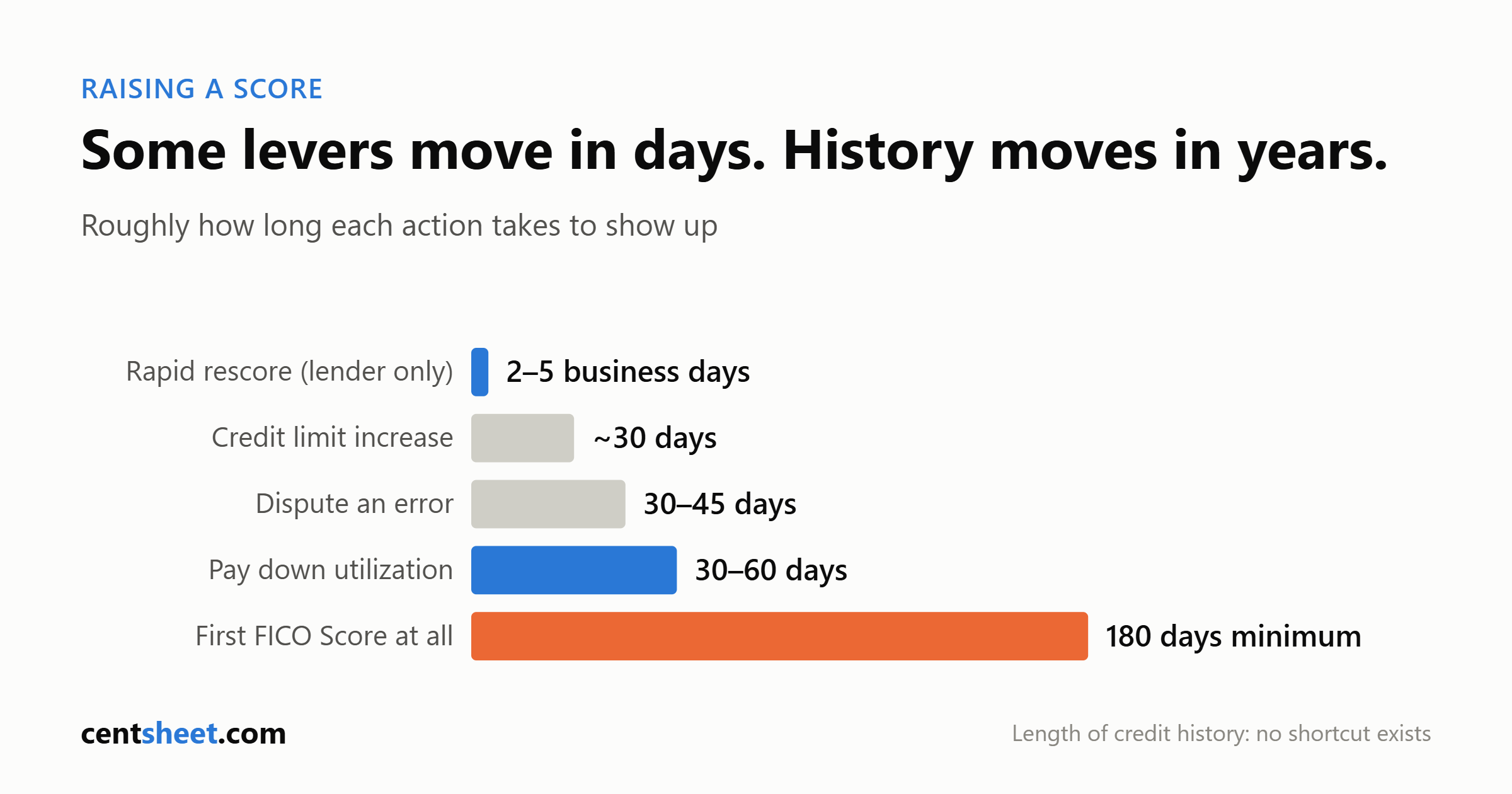
There is a real answer to this question, and it has two halves that most articles blur together: a few things genuinely move a credit score within a month or two, and several things cannot be accelerated by any means at all.
The gap between those two lists is where every credit repair scam operates.
The fast lane
Utilization — the only major factor with essentially no memory
In classic scoring models, high utilization stops hurting as soon as a lower balance is reported. There is no penalty period and no residue. That makes it the fastest meaningful lever available to most people.
The mechanics: card issuers report to the bureaus roughly monthly, at the close of the billing cycle. So a paydown appears on your report within about one reporting cycle, and a score change can follow quickly after that.
How quickly, exactly? Be suspicious of anyone who gives you one number — Experian’s own pages give three different answers across three articles (“as little as 30 days,” “30 to 45 days,” and “a few billing cycles — one to two months”), and TransUnion says lenders generally report every 30 days but it can take up to 45. Plan on 30 to 60 days, depending on where you are in your billing cycle.
The timing detail that actually matters: issuers report your statement balance, and your due date falls roughly 21 to 25 days after the statement closes. Paying before the due date does nothing for the reported number. Pay before the statement closing date. Full mechanics in credit utilization.
One caveat that is becoming more important. Newer trended-data models — VantageScore 4.0 and FICO Score 10 T — look at balance behavior over up to 24 months rather than a single snapshot. Under those, a last-minute paydown does not erase a two-year history of high balances. Both kinds of model are in use right now, which is why the trick still works, just not everywhere.
Forget the 30% rule — the two developers openly disagree
This one deserves its own section because it is repeated everywhere as settled fact.
VantageScore recommends keeping utilization at or below 30%, and in single digits for an excellent score.
FICO explicitly rejects the threshold idea. Its own material says the data does not support the implication that a score dips once utilization crosses 30% — there is no cliff, lower is simply better, and single-digit utilization is associated with the best scores.
So “stay under 30%” is not a universal rule; it is one developer’s guidance, and the other developer disputes the premise behind it. The practical synthesis: lower is better, continuously, with no magic line. If you have been aiming at 29% and relaxing, aim lower.
And do not aim at zero. FICO’s guidance is that a low utilization ratio has a more positive impact than using none of your available credit at all — a 0% report gives the model no revolving-usage signal to reward.
A credit limit increase
This lowers utilization arithmetically — same balance, bigger denominator — and can show up as fast as a paydown, typically by the end of the next billing cycle. The application may trigger a hard inquiry and a brief dip.
Worth doing only if the extra headroom does not become extra spending. Know yourself first.
Disputing an actual error
If something on your report is genuinely wrong, this is fast by law: bureaus generally must investigate within 30 days, extending to 45 if you supply additional information during that window. If the information is wrong or cannot be verified, it must be corrected or deleted and the other bureaus notified.
It is free, and it is a statutory right. The CFPB’s position is blunt: there is no reason to pay anyone to dispute inaccuracies for you. Full walkthrough in how to dispute a credit report error.
Rapid rescore — real, but not for you to buy
A rapid rescore expedites updated information onto your report, typically in roughly two to five business days. It is the single fastest legitimate mechanism that exists.
Three things people get wrong about it:
- You cannot order one. Only a lender — usually a mortgage lender — can initiate it. You cannot shop for one or buy one directly.
- You cannot be charged for it. The lender pays the bureau’s fee, though the cost may reach you indirectly through closing costs or rate.
- It does not raise your score. It accelerates the reporting of changes that have already happened and can be documented. Experian states plainly that it does not guarantee improvement — if your utilization is already low, paying down further may do nothing.
If you are mid-mortgage-application and have just paid down a card, ask your loan officer. Otherwise it is not a tool available to you.
Experian Boost — instant, and narrow
Experian Boost adds qualifying utility, telecom and similar payments to your Experian file. Experian says most people who get an increase see an average of 13 points.
Read that carefully. It is a vendor’s own marketing figure, for its own product, on its own bureau file — and Experian discloses that not all payments are eligible and some users see no increase or even a decrease. Critically, it does not touch your Equifax or TransUnion files, so a lender pulling either of those sees nothing. For a mortgage, where all three are pulled and the middle or lowest score often governs, that limits its usefulness considerably.
What cannot be rushed
Length of credit history
Fifteen percent of a FICO Score, driven entirely by elapsed time: age of your oldest account, age of your newest, and the average age of all of them. There is no action that accelerates it. You cannot buy time.
This is also why closing old cards is an own-goal — it removes their limit from your utilization denominator and works against you. FICO’s published action analysis does not even cover card closure as an improvement strategy.
The six-month floor for new credit
If you are starting from nothing, FICO cannot score you until your report shows at least one account opened six months or more, at least one account reported within the past six months, and no deceased indicator. That is a hard gate. VantageScore’s bar is lower, which is why some people have a VantageScore before a FICO Score — see FICO vs. credit score and our guide to a first credit card.
Late payments and negative items
An account is not reported late until it reaches 30 days past due — so a payment a few days late generally creates no credit-report entry, though the late fee still applies.
Once reported, the item stays. Bringing a delinquent account current helps, but the account continues to show that it was past due. The impact fades with age rather than disappearing.
Retention periods:
| Item | How long it can be reported |
|---|---|
| Most negative information | 7 years |
| Collections and charge-offs | 7 years + 180 days from the date of first delinquency |
| Bankruptcy | Up to 10 years |
| Lawsuits and judgments | 7 years, or until the statute of limitations expires — whichever is longer |
Two details worth knowing. Selling a debt to a collector does not restart the clock — it runs from the original delinquency, not from the sale. And these time limits do not apply at all when a report is pulled for a job paying $75,000 or more, or a credit or insurance application of $150,000 or more.
You may have read that Chapter 13 falls off at seven years. That is a reporting practice we could not confirm from any primary source; the CFPB says bankruptcy can stay up to ten years without distinguishing chapters.
Hard inquiries
These stay visible for up to two years, but FICO Scores only count inquiries from the last 12 months — so the score damage self-clears in a year even though the entry remains.
When rate shopping, multiple inquiries for the same loan type are deduplicated into one: a 45-day window on newer FICO versions, 14 days on older ones. Since you rarely know which version a lender uses, compress your shopping into two weeks and the question becomes moot.
Things that do not work
The 15/3 hack. Making payments 15 days and 3 days before your due date does not raise your score. Those payments generally land after the statement has closed and been reported, and credit reports do not show how many payments you made. The real version of this idea is simply paying before the statement closing date.
Paying a collection to make it vanish. The deletion carve-outs we could verify are medical only: the bureaus voluntarily stopped reporting paid medical collections from July 2022 and unpaid medical collections with an initial balance under $500 from April 2023, and lengthened the delay before unpaid medical collections appear from six months to a year. For an ordinary collection, we found no primary source saying payment removes it — and the seven-year clock runs from the original delinquency regardless.
(The CFPB’s separate rule that would have banned medical debt from credit reports entirely was vacated in July 2025 and is not in force. Any article describing it as current law is out of date.)
Goodwill letters — sometimes, but manage expectations. Asking a creditor to remove a late payment as a courtesy is legitimate, free, and occasionally works. It is not a right, creditors have no obligation to consider it, and many decline on policy grounds citing their accuracy obligations. It is described as most likely to succeed in one narrow case: a single late payment on an otherwise clean, now-current account with an explainable one-off cause. It will not resolve multiple delinquencies, charge-offs, collections or bankruptcy. Nobody publishes a success rate.
Paying someone to remove accurate negatives. The CFPB is explicit that accurate negative information generally cannot be removed, and treats a promise to delete it as a scam indicator.
Authorized user tradelines. Being added to someone’s account can help, typically appearing within a month or two — but only if that issuer reports authorized-user accounts, and not all do. No source publishes how much it helps.
What actually works, in order
1. Pay everything on time, always. Payment history is 35% of a FICO Score and it is the only factor where a single mistake creates years of drag. 2. Get utilization down and keep it down — before the statement closes, not the due date, and lower than 30% rather than merely under it. 3. Pull all three reports free at AnnualCreditReport.com and dispute anything genuinely wrong. 4. Do not close old cards. Age and available credit both work for you. 5. Compress rate shopping into 14 days. 6. Then wait. For anything left, time is the mechanism.
For scale: the national average FICO Score is 714, and a record 48.1% of consumers score 750 or higher. FICO’s own profile of high scorers — from a 2019 analysis, so directional rather than current — described about 7% utilization, an average account history of 11 years with an oldest account around 25 years, and 96% paying on time. Nothing exotic. Mostly just duration.
And the rule that governs this entire subject: no honest source can tell you what any single action is worth in points. FICO states outright that the impact of one factor cannot be isolated without the full report, and its own modeling of five different starting profiles produced materially different results from identical actions. Any site quoting you “+40 points” is guessing, and any company promising it is selling something.
CentSheet publishes educational content, not personalized financial advice.
Get the CentSheet Money Brief
Email me CentSheet weekly: practical money decisions, new calculators, and useful worksheets. Unsubscribe anytime.