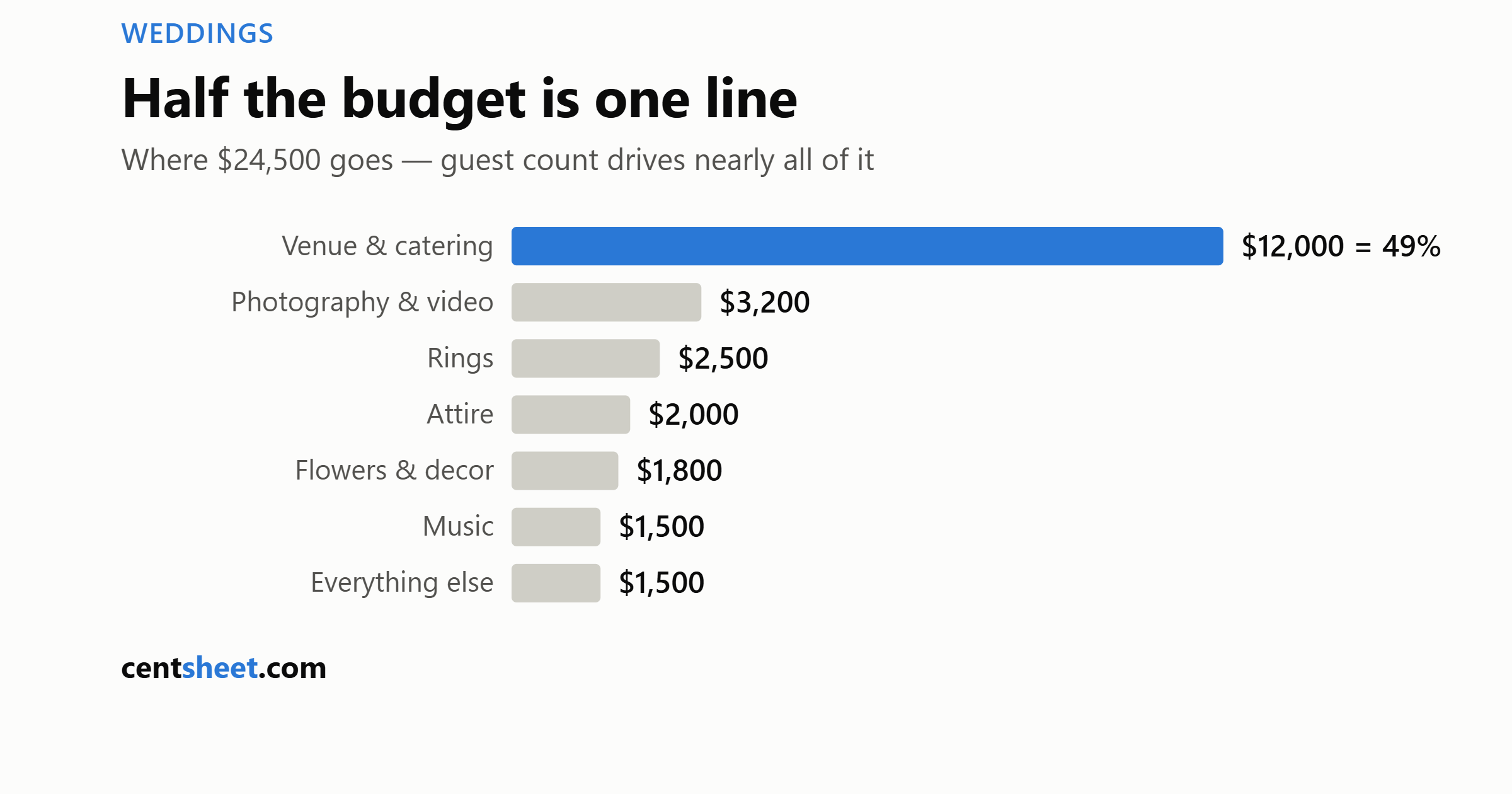
Wedding budgets fail in a specific way: people economise hard on the small, visible items and leave the one line that dominates the total untouched.
Where the money actually goes
An illustrative mid-range wedding:
| Line | Cost |
|---|---|
| Venue and catering | $12,000 |
| Photography and video | $3,200 |
| Rings | $2,500 |
| Attire (both) | $2,000 |
| Flowers and decor | $1,800 |
| Music / DJ / band | $1,500 |
| Stationery, favours, transport, misc | $1,500 |
| Total | $24,500 |
Venue and catering is 49% of the budget — roughly as much as everything else combined.
That single fact should reorganise how you plan. Spending a weekend sourcing cheaper favours might save $200. Cutting fifteen guests saves well over a thousand, because catering, bar, seating, stationery and cake all scale with headcount.
Guest count is the master variable
Nearly every large line is per-head. So the guest list is not a social decision that happens to have a cost; it is the budget decision, and it should be made first, deliberately, before venues are toured.
A useful test on each name: would you be genuinely disappointed if this person wasn’t there? A list built by asking “who might be offended if we left them off” grows without limit and prices the wedding accordingly.
The other structural levers, in rough order of power:
Date and day. Off-season and non-Saturday dates are routinely and substantially cheaper for the same venue and vendors. This is the largest saving available that changes nothing about the day itself.
Venue type. All-inclusive venues bundle convenience into the price; a hall you cater yourself trades money for logistics. Neither is wrong — but know which trade you are making.
Bar arrangement. Open bar, limited bar, or beer-and-wine-only is a four-figure decision at most guest counts.
The lines people forget
- Tips and vendor meals, which can add several hundred and are rarely quoted
- Alterations, often a meaningful fraction of the dress price
- Marriage licence and officiant
- Postage — real money at 100+ invitations with reply cards
- Overtime if the reception runs late, usually billed by the hour
- The deposit trap: many are non-refundable, so vendor decisions made early are effectively final
Add a contingency line of around 10% for these, the same discipline renovation budgets need.
Funding it
A wedding has a date, which makes it a sinking fund: $24,500 over 18 months is about $1,361/month. That figure is the honest affordability test, and if it doesn’t fit your budget, the answer is a longer engagement, a smaller wedding, or a different format — not a loan.
We’ll be blunt about wedding debt, because the industry won’t: borrowing for a one-day event means starting a marriage with a balance that outlives the flowers. At 24% APR, a $10,000 shortfall financed on cards is a multi-year drag on a household that is also trying to save for a home. The single most valuable financial decision available here is choosing a wedding you can pay for in cash.
None of which is an argument for a joyless wedding. It is an argument that the guest list, the date, and the venue determine almost the entire number — so decide those three carefully and stop agonising over the favours.
CentSheet publishes educational content, not personalized financial advice. Figures are illustrative; US wedding costs vary enormously by region, season and guest count.
Get the CentSheet Money Brief
Email me CentSheet weekly: practical money decisions, new calculators, and useful worksheets. Unsubscribe anytime.