Renovation budgets do not blow up because homeowners are careless. They blow up because of a structural feature of the work: you cannot see inside the walls until you open them.
Everything else follows from that.
The contingency line
Every professional renovation budget carries a contingency. Homeowner budgets usually do not, which is the entire difference in outcomes.
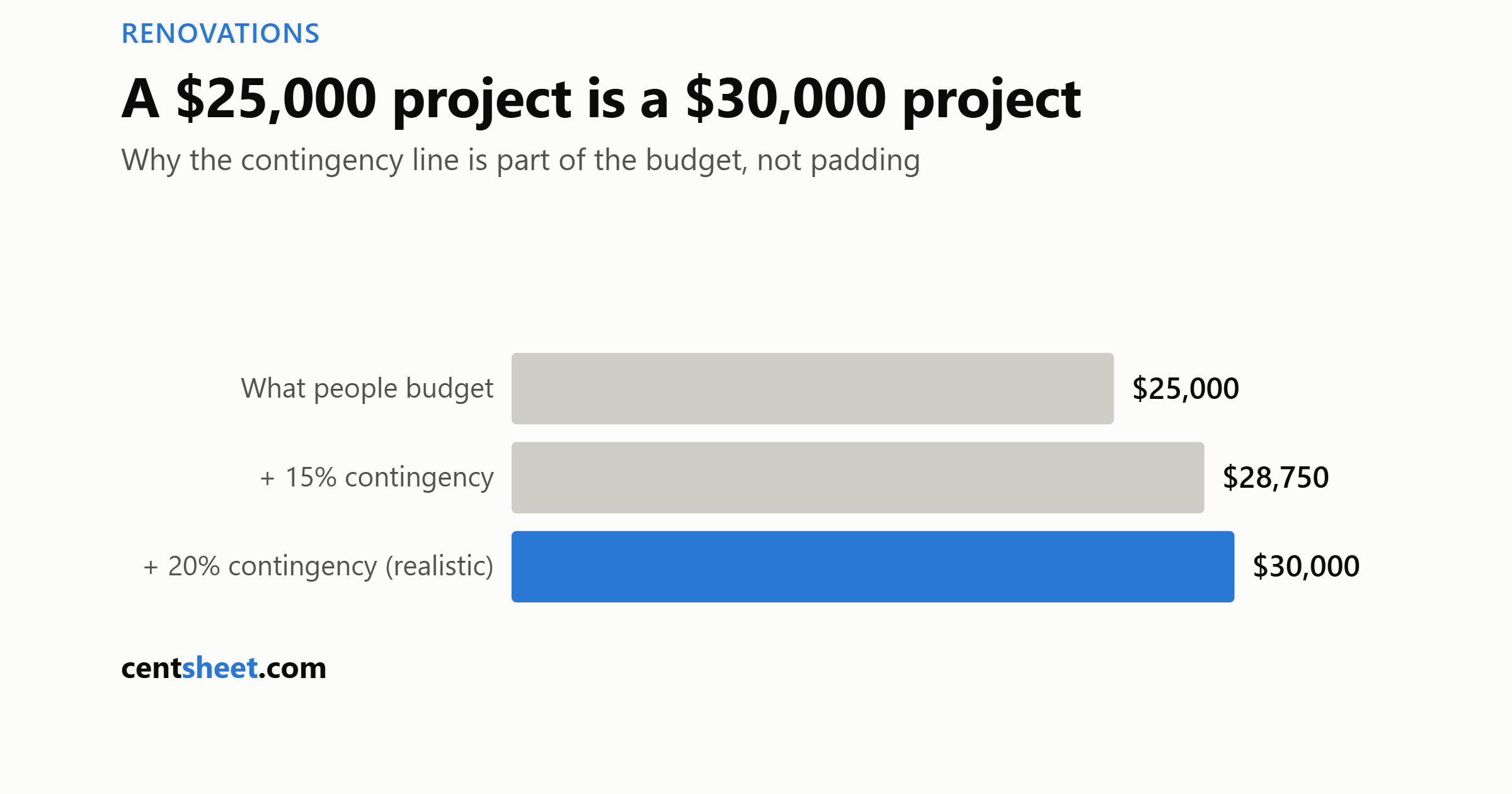
| Approach | Budget | Contingency | True budget |
|---|---|---|---|
| No contingency | $25,000 | $0 | $25,000 — will overrun |
| Conservative (15%) | $25,000 | $3,750 | $28,750 |
| Realistic (20%) | $25,000 | $5,000 | $30,000 |
For an older home or anything touching plumbing, wiring or structure, 20% is the floor, not the ceiling. Some renovators use 25% on pre-1970 houses and are not being timid.
The mental move that matters: the contingency is not “extra money I might spend.” It is part of the budget. A $25,000 renovation is a $30,000 project. Deciding you can afford $25,000 and treating the contingency as optional is how projects stop halfway with a bathroom you cannot use.
Why the surprises are systematic
They cluster in four predictable places:
Things behind walls. Wiring that is not to code, pipes that are corroded, water damage nobody knew about, structural work the previous owner did without permits. Once it is exposed, it usually has to be fixed — that is not a choice, and often not one an inspector could have caught.
Permits and code compliance. Bringing one part of a house up to code frequently obliges you to bring adjacent parts along. This is the classic “we only wanted a new bathroom” cascade.
Scope creep. The genuinely voluntary category, and the largest one. The floor looks wrong against the new counters. Since the wall is open anyway, why not. Each decision is individually reasonable and collectively expensive.
Delays. A backordered item stalls the trades, and rescheduling costs money — sometimes rent on two places at once, or eating out for three extra weeks. Time overruns turn into cost overruns through the side door.
How to budget it properly
Get three quotes, and interrogate the cheapest. A quote well below the others usually means a different scope, not a better deal. Ask what is excluded.
Insist on an itemized quote. “Kitchen renovation: $25,000” is unmanageable. Line items let you cut intelligently when the contingency gets eaten.
Bank the whole thing before starting — project plus contingency — as a sinking fund. Financing renovations on credit cards is how a $30,000 project becomes a $40,000 debt at 24% APR.
Decide your cut-list in advance. Before work starts, write down what gets dropped if you hit the contingency. Making that decision calmly beforehand is enormously easier than making it under pressure with a demolished kitchen.
Do not spend the contingency early. It is not an upgrade budget. If the project finishes without needing it, that money was never yours to spend — it goes back to savings.
The honest expectation
A renovation finished on the original number is uncommon enough that it is worth treating as luck rather than skill. Budget for 20% more, keep an itemized cut-list, and the project either finishes on plan or finishes on contingency. Both are successes. The failure mode is the one where the money runs out while the house is in pieces.
Related: what buying the house actually costs and kitchen remodel costs specifically.
CentSheet publishes educational content, not personalized financial advice. Figures are illustrative; renovation costs vary enormously by region, scope and property age.
Get the CentSheet Money Brief
Email me CentSheet weekly: practical money decisions, new calculators, and useful worksheets. Unsubscribe anytime.