Everyone budgets for the price of the house. Almost nobody budgets for the other four categories, which is why “we can afford the mortgage” and “we can afford the house” turn out to be different sentences.
Here is the complete list, on an illustrative $300,000 purchase.
1. Cash due before you own anything
| Line | Amount |
|---|---|
| Down payment (10%) | $30,000 |
| Closing costs (2–5%) | $6,000–$15,000 |
| Inspection | $450 |
| Appraisal | $550 |
| Survey | $450 |
The last three — $1,450 — are the ones worth flagging, because they are spent before you know whether the deal closes. A failed inspection means you paid $1,450 to learn the house was a bad idea. That is money well spent and money genuinely gone, and it can happen twice before you buy.
The down payment timeline math is its own article, including why 20% is a convention rather than a requirement.
2. The monthly cost that isn’t the mortgage
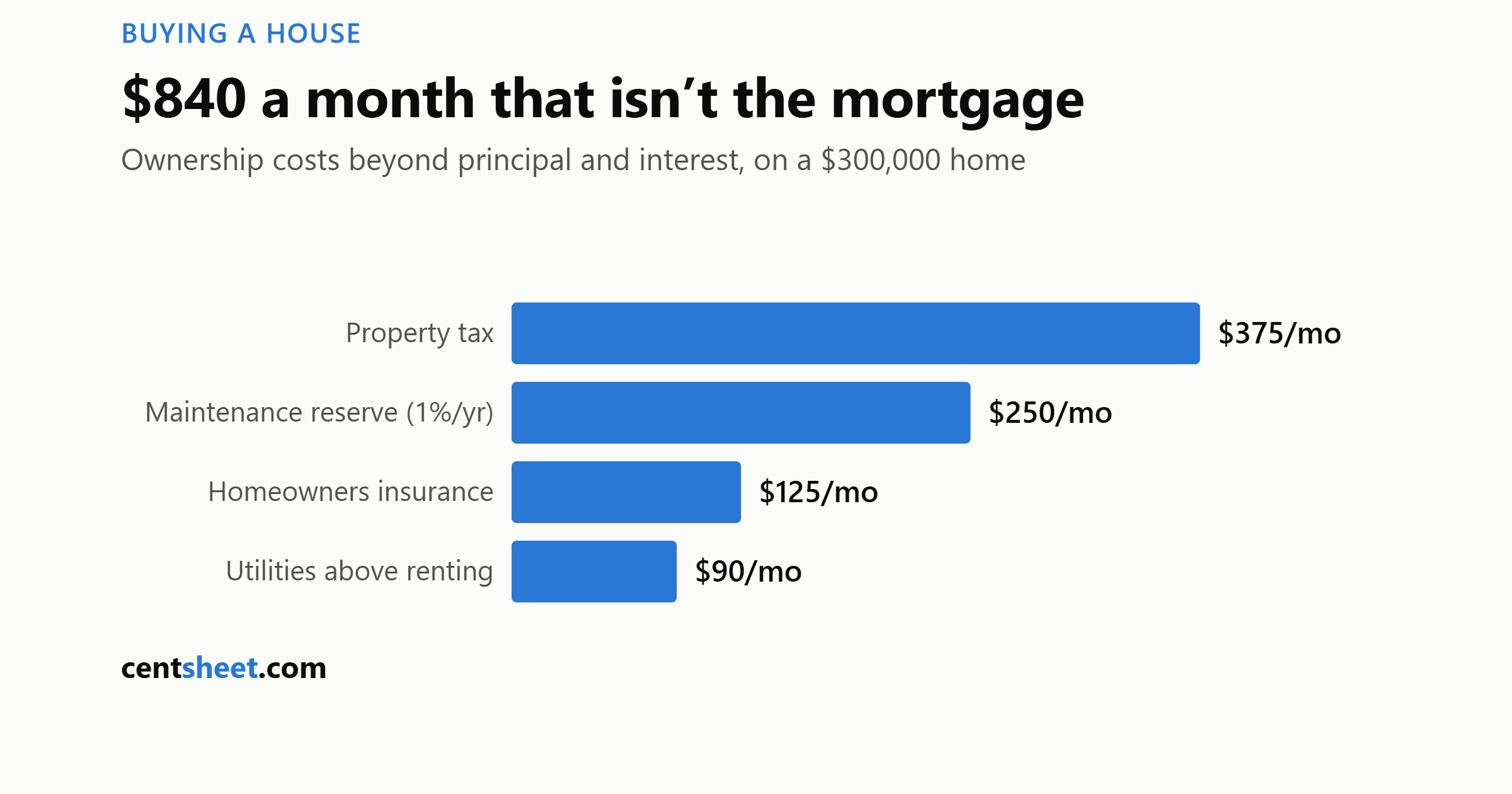
This is the category that breaks budgets, because the mortgage payment is the only part anyone quotes:
| Line | Monthly |
|---|---|
| Property tax | $375 |
| Homeowners insurance | $125 |
| Maintenance reserve | $250 |
| Utilities above what you paid renting | $90 |
| Total, on top of principal and interest | $840 |
Tax and insurance are usually escrowed into the payment, so they at least appear on the statement. Maintenance and the utility step-up appear nowhere until they happen.
On maintenance, the common planning rule is 1% of the home’s value per year — $3,000 on a $300,000 house, or $250/month. Some years you spend nothing. Then a water heater goes, and you spend four years’ worth in a weekend. That is precisely the profile a sinking fund exists for: it is not an emergency, it is a slow bill.
Add an HOA if there is one, which can be anywhere from trivial to another mortgage payment.
3. The move itself
Closing and moving happen in the same week, and moving costs $2,200 to $5,750 depending on distance. Budget it separately or it comes out of the reserves you promised the lender you would keep.
4. The first-year furnishing spiral
Bigger space wants more furniture; a yard wants tools; the previous owner’s taste wants changing. This is optional spending that feels mandatory in month one. It is the single easiest place to overspend after closing, and it is the reason “house poor” usually arrives within a year rather than at signing.
What this means for the budget
Under the 50/30/20 diagnostic, your housing “need” is principal + interest + tax + insurance + maintenance — not the mortgage quote. On this example that is roughly $840 more per month than the number a lender’s pre-approval implies you can handle.
Which is the real point: lenders approve you on a different formula than the one that keeps you comfortable. Pre-approval considers your debts and income; it does not know that you want to keep saving 20%, keep the emergency fund intact, and still take a holiday. Borrowing the maximum offered is how people end up technically solvent and functionally stuck.
Run the all-in number through the budget calculator before you run it past a lender.
CentSheet publishes educational content, not personalized financial advice. Figures are illustrative on a $300,000 purchase; taxes, insurance and closing costs vary enormously by state and property.
Get the CentSheet Money Brief
Email me CentSheet weekly: practical money decisions, new calculators, and useful worksheets. Unsubscribe anytime.