A mortgage escrow account is money your servicer collects with the mortgage payment and later uses for property taxes, homeowners insurance, and sometimes other property-related charges. If those bills or the projected account balance change, the escrow portion can change even when the loan has a fixed interest rate.
The useful way to read a new payment is to rebuild it:
New payment = principal and interest + new monthly escrow deposit + any shortage or deficiency repayment
The principal-and-interest line may be unchanged. The other two lines can still move. The Consumer Financial Protection Bureau's escrow explainer confirms that taxes and insurance can change from year to year and therefore change the total monthly payment.
| Payment piece | Why it can change on a fixed-rate loan |
|---|---|
| Principal and interest | Usually does not change on a standard fixed-rate loan |
| Property taxes | Assessment, exemption, rate, or supplemental bill changed |
| Homeowners or flood insurance | Premium, coverage, carrier, or risk pricing changed |
| Mortgage insurance or another escrowed item | Coverage or cancellation status changed |
| Shortage/deficiency repayment | Last analysis found the account below its target |
Purchase escrow and mortgage escrow are different
The word escrow does two jobs in real estate.
Purchase or closing escrow is the neutral process that holds documents and money while a home sale closes. It ends when the transaction is completed and funds are distributed. That belongs in the cash-to-close work described in saving for a house down payment and budgeting to buy a house.
Mortgage-servicing escrow, sometimes called an impound account, continues after closing. The servicer adds part of each mortgage payment to the account, then pays scheduled property bills from it. The account remains your money, but it is not a general savings account you can withdraw from at will.
The current Regulation X definition covers accounts controlled by a servicer to pay taxes, insurance premiums including flood insurance, and other agreed property charges. Your loan documents, state law, and loan program determine whether the account is required and what it includes.
What the servicer may collect
The common items are:
- county, city, school-district, or other property taxes;
- homeowners insurance;
- flood insurance when applicable;
- mortgage insurance or another charge identified in the loan documents.
Do not infer the contents from the word “escrow.” Read the itemized annual statement. Homeowners insurance and mortgage insurance are different products, and a policy's deductible is not its premium.
For a federally related mortgage covered by Regulation X, the normal monthly collection is one-twelfth of the annual disbursements the servicer reasonably expects to pay. The servicer may also maintain a cushion, but the federal ceiling is generally one-sixth of estimated annual disbursements—two months of escrow payments. State law or the mortgage documents can require a smaller cushion. The federal rule permits a cushion; it does not require every servicer to use the maximum.
This cushion is a target low balance, not necessarily a separate fee. Its purpose is to prevent the account from running out when a bill arrives before enough monthly deposits have accumulated or costs rise unexpectedly.
Read the annual analysis in two passes
Under Regulation X, a covered servicer generally analyzes the account at the end of each 12-month escrow computation year and sends an annual statement within 30 days after that year ends. The statement must show the past account activity and the next year's projection.
First check the history:
- Compare every tax payment with the local taxing authority's records.
- Compare every insurance payment with the declarations page and insurer billing history.
- Confirm deposits match the escrow portions of your mortgage statements.
- Look for a late, duplicate, omitted, or estimated disbursement.
Then check the projection:
- Is the new annual tax estimate reasonable?
- Is the insurance estimate based on the renewal premium, not last year's bill?
- Which other items are included?
- What cushion does the projection target?
- Is a shortage or deficiency being collected, and over how many months?
Do not stop at “your payment increased $100.” The statement should let you identify how much is the higher ongoing cost and how much is temporary catch-up.
Shortage, deficiency, and surplus are not synonyms
Regulation X gives the words precise meanings.
| Term | What it means at analysis | Typical result for a current borrower |
|---|---|---|
| Shortage | Current balance is below the projected target balance | May be left in place, collected quickly in limited cases, or spread over at least 12 months |
| Deficiency | Escrow account actually has a negative balance | Servicer may collect additional deposits under the rule's repayment options |
| Surplus | Current balance exceeds the target | If at least $50, generally refunded within 30 days when the loan is current; a smaller surplus may be refunded or credited forward |
The 12-month protection is especially important for shortages. If a shortage is at least one monthly escrow payment, a servicer that chooses to collect it must generally use equal payments over at least 12 months. If it is smaller than one monthly escrow payment, the servicer may leave it alone, request it within 30 days, or spread it over at least 12 months.
A deficiency follows different minimum-installment rules. If the loan is current, a deficiency may be left in place or collected in two or more equal monthly payments; a deficiency smaller than one monthly escrow payment may also be requested within 30 days. The details are in Regulation X section 1024.17(f).
These federal treatments can interact with loan terms and state protections. They also differ when the borrower is not current, so do not use a current-loan example to predict a delinquent-loan result.
A fixed-rate payment can rise by two changes at once
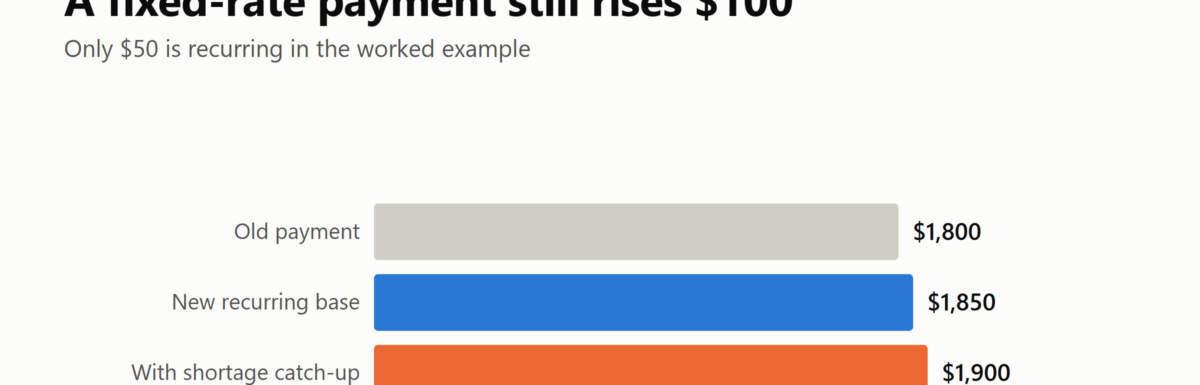
Assume a fixed-rate mortgage has $1,400 of principal and interest each month.
Last year's escrow projection was:
- property tax: $3,600 a year, or $300 a month;
- homeowners insurance: $1,200 a year, or $100 a month;
- total ongoing escrow: $400 a month;
- total mortgage payment: $1,800.
At the new analysis, projected tax is $3,960 and insurance is $1,440. The new ongoing escrow is:
($3,960 + $1,440) ÷ 12 = $450 a month
The analysis also finds a $600 shortage and spreads it over 12 months:
$600 ÷ 12 = $50 a month for one year
The new payment is therefore:
$1,400 + $450 + $50 = $1,900 a month
That is a $100 increase, but only $50 is the new recurring baseline. The other $50 is scheduled to end after the shortage is repaid—assuming the next analysis does not find another change.
This is a CentSheet calculation, not a servicer quote. It assumes the listed items are the only escrow items, the shortage is spread over exactly 12 months, all payments are current, and dollars are rounded to the nearest whole dollar. The servicer's trial balance can differ because real tax and insurance bills arrive in particular months and may include a permitted cushion.
Why the estimate can be wrong without the math being wrong
A correct division can start with a bad input. Common causes include:
- a tax exemption was removed, never applied, or not transmitted to the servicer;
- new construction was initially taxed as vacant land and later assessed as a completed home;
- a supplemental property-tax bill arrived outside the normal schedule;
- an insurer raised the premium, changed coverage, or issued a policy replacement;
- the servicer projected a bill before receiving the final amount;
- the prior year's payment date or amount was entered incorrectly.
Check the source, not only the mortgage statement. Ask the taxing authority whether the assessment, rate, exemptions, and installment schedule are correct. Ask the insurer for the declarations and billing pages. If insurance is the problem, compare coverage and deductibles deliberately rather than cutting protection simply to restore the old payment.
An escrow increase also exposes a budgeting problem: property costs are variable even when debt service is fixed. Keep a separate emergency fund sized for your household instead of treating the escrow cushion as cash available for repairs or income loss.
Should you send a lump sum?
A servicer may offer a choice between paying a shortage in one amount and spreading it through the monthly payment. Paying it now can remove the temporary repayment line, but it does not reverse the higher tax or insurance estimate. In the example, a $600 payment could remove the temporary $50, while the recurring payment would still be $1,850.
Do not send an unsolicited payment and assume the system will use it as intended. Ask the servicer, in writing if possible:
- the exact shortage or deficiency payoff amount;
- how to designate the payment to escrow rather than principal;
- whether it will trigger a revised payment notice;
- when the temporary repayment line will disappear.
Regulation X allows a borrower and servicer, after an analysis, to agree voluntarily to deposits above normal limits for the coming computation year. That does not mean every extra payment automatically causes an immediate re-analysis. Preserve the confirmation and the next statement.
How to dispute a servicing error
Call first if a simple explanation will solve it, but preserve a written trail when the numbers are wrong. The CFPB's mortgage-servicing error rule describes the formal notice-of-error process.
A useful written notice identifies the borrower and loan, states the specific error, and shows the supporting number. “My escrow is wrong” is weaker than “the statement shows a $4,200 county-tax disbursement, while the attached county record shows $3,600.” Send it to the servicer's designated address for notices of error, which may differ from the payment address.
Attach copies, not irreplaceable originals, of the annual escrow analysis, tax bill, exemption confirmation, insurance declarations, and relevant mortgage statements. Keep delivery proof. Continue making the required payment unless the servicer gives different written instructions; disputing the analysis does not by itself suspend the mortgage obligation.
If the servicer does not resolve the issue, use the escalation routes shown in its response and consider a CFPB complaint. A local housing counselor or attorney can help when foreclosure, force-placed insurance, bankruptcy, or state-law rights are involved.
What to actually do
- Split the new payment into three lines: principal and interest, ongoing escrow, and temporary catch-up.
- Verify the source bills: get the current tax record and insurance declarations rather than relying on the projection alone.
- Recompute the annual base: add expected escrow bills and divide by 12; then compare with the statement.
- Identify the account status: shortage, deficiency, or surplus, and the exact repayment or refund treatment.
- Ask before paying extra: obtain instructions for a lump-sum escrow payment and a revised-payment confirmation.
- Put a specific error in writing: use the designated notice address and attach the evidence.
- Budget for the recurring number: once catch-up ends, taxes and insurance can still rise again.
This article is general educational information, not legal, tax, insurance, or mortgage-servicing advice. Escrow requirements and remedies depend on the loan, account status, state law, and current federal rules. Confirm the result with your servicer, insurer, taxing authority, and an appropriate licensed professional.
Get the CentSheet Money Brief
Email me CentSheet weekly: practical money decisions, new calculators, and useful worksheets. Unsubscribe anytime.